
Low Poly Assets for Godot 4
Generate low poly models that Godot 4 imports natively as GLB. No plugins, no conversion, just drop the file in and Godot builds a ready to use scene.
Matching downloadable assets
Start with these seed models, then generate variants in the same low-poly direction.
Members unlock protected STL access
Use the free OBJ to test the shape. Subscribe for protected STL downloads now; GLB, FBX, USDZ and Unity are shown as production export targets, not direct library downloads yet.
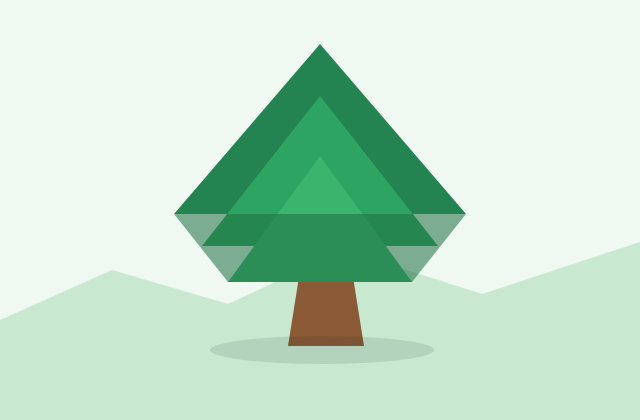
Nature Starter Pack
Low-Poly Pine Tree
A lightweight forest prop with a trunk, two faceted foliage layers and a clean base pivot for scattering.
View details- Triangles
- 24
- Texture
- Flat color
- License
- Commercial use
- Formats
- OBJ
Protected STL download
Production export targets
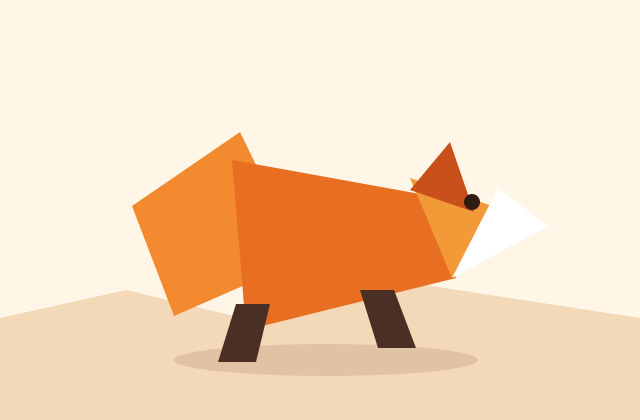
Cozy Animal Pack
Low-Poly Fox
A stylized animal prop for cozy games, woodland scenes and AR previews.
View details- Triangles
- 24
- Texture
- Flat color
- License
- Commercial use
- Formats
- OBJ
Protected STL download
Production export targets
Highlights
- Export GLB, the native Godot 4 model format, and import with no plugin or conversion.
- GLB bundles geometry, materials and textures in one self contained binary file.
- Expand the imported model so each mesh becomes a reusable MeshInstance3D node.
- Use scene inheritance so scripts and collision survive a reimport of the GLB.
- Apply Material Override to reskin a mesh without touching the imported material.
- Target 1,000 to 5,000 triangles for mobile and web heroes, 200 to 800 for props.
- Bake LightmapGI on static meshes for cheap, soft global illumination.
- Godot is MIT licensed and AI generated assets are user owned, so there are no royalties.
Godot 4 has the cleanest import story of any engine for low poly work because GLB is its native model format. A GLB is a self contained binary that bundles geometry, materials and textures in one file, and Godot reads it directly without a plugin or a conversion step. Drop a .glb into your project folder and Godot imports it as an inherited scene built from MeshInstance3D nodes, with materials already wired up. The companion text format GLTF works the same way and is handy when you want to inspect the JSON, but for shipping assets the binary GLB keeps everything in a single tidy file.
When the GLB appears in the FileSystem dock, double click it to open the Import panel and decide how Godot should treat the data. You can import the model as a single scene, or expand it so each mesh becomes its own MeshInstance3D you can reference and reuse. Set the root type, choose whether to generate collision shapes automatically, and pick whether textures compress with VRAM compression for shipping or stay lossless while you iterate. Godot reimports deterministically whenever the source file changes, so you can regenerate a model, overwrite the GLB and your scene updates in place without losing the node setup around it.
Polycount for Godot follows the same sensible budgets as other real time engines, and the flat shaded low poly aesthetic keeps you comfortably under them. For mobile and web exports aim for 1,000 to 5,000 triangles on a hero and 200 to 800 on props, while desktop targets can run 10,000 to 50,000 triangles on a focal mesh and up to 20,000 on a hero. Godot has no built in LOD generator as mature as some engines, so author LOD meshes yourself or use the visibility range fields on each MeshInstance3D to fade distant geometry. Keeping geometry lean matters most on the web export where every megabyte counts.
Scene inheritance is the Godot pattern that makes low poly kits reusable, and it pairs beautifully with material override. Open the imported model, save it as a new inherited scene, then add scripts, collision and audio without touching the source. When you reimport the GLB your edits survive because they live in the inherited scene above it. To reskin a mesh, set a Material Override on the MeshInstance3D rather than editing the imported material, which lets one piece of geometry serve seasonal or team color variants. Combine that with a single shared atlas, 512 to 1024 pixels for props and 1024 to 2048 for a hero, painted in flat colors, and your scenes stay light and consistent.
Lighting low poly scenes in Godot is fast because the geometry is simple. You can light dynamically with the built in renderer, but for static environments bake a LightmapGI for soft, performant global illumination that costs nothing at runtime. Set each mesh to Static lightmap mode, unwrap a second UV channel for the lightmap, and let Godot bake. The flat faces of low poly geometry take lightmaps cleanly and the result looks crafted rather than noisy. Because Godot is free and open source under the MIT license, there are no royalties or seat fees layered on top of your assets, which makes it a natural home for indie and hobby projects.
The free engine and free assets pairing is the real story here. Godot itself costs nothing and the AI generated models you make are fully owned by you, safe for commercial release on any storefront and free of attribution requirements. A practical loop is to generate the model, export GLB, drop it into the FileSystem dock, expand it into MeshInstance3D nodes, save an inherited scene, apply a material override with your atlas, set visibility ranges for distance fade, and bake a LightmapGI for static areas. From prompt to playable scene there is no licensing or pipeline tax, only the engine and the work.
Round out your Godot pipeline
Frequently asked questions
Why is GLB the best format for Godot 4?
GLB is the native Godot model format. It is a self contained binary bundling geometry, materials and textures, and Godot imports it directly into MeshInstance3D nodes with no plugin or conversion step. Drop the file in and you have a ready scene.
How do I keep my edits when I reimport a model?
Use scene inheritance. Save the imported model as a new inherited scene and add scripts, collision and audio there. When you overwrite the GLB and Godot reimports, your inherited scene edits survive because they live in a layer above the source.
How do I recolor a low poly mesh in Godot?
Set a Material Override on the MeshInstance3D instead of editing the imported material. One piece of geometry can then serve seasonal or team color variants, and pairing it with a shared atlas keeps the scene consistent and light.
Does Godot generate LOD automatically?
Godot does not have a mature automatic LOD generator, so author LOD meshes yourself or use the visibility range fields on each MeshInstance3D to fade distant geometry. Keeping low poly counts lean matters most for the web export.
Are there any fees for using Godot with these assets?
No. Godot is free and open source under the MIT license with no royalties or seat fees, and the AI generated assets you make are fully owned, commercial safe and require no attribution. It is an ideal stack for indie projects.
Related
Browse allNeed a custom low-poly model?
Generate one from a text prompt or reference image, then export GLB, FBX, OBJ or STL.
Open the generator