
Low Poly Assets for Unity
Generate low poly models that drop straight into Unity. FBX keeps your hierarchy, pivots and material slots intact for clean prefabs and tight draw calls.
Matching downloadable assets
Start with these seed models, then generate variants in the same low-poly direction.
Members unlock protected STL access
Use the free OBJ to test the shape. Subscribe for protected STL downloads now; GLB, FBX, USDZ and Unity are shown as production export targets, not direct library downloads yet.

Nature Starter Pack
Low-Poly Pine Tree
A lightweight forest prop with a trunk, two faceted foliage layers and a clean base pivot for scattering.
View details- Triangles
- 24
- Texture
- Flat color
- License
- Commercial use
- Formats
- OBJ
Protected STL download
Production export targets
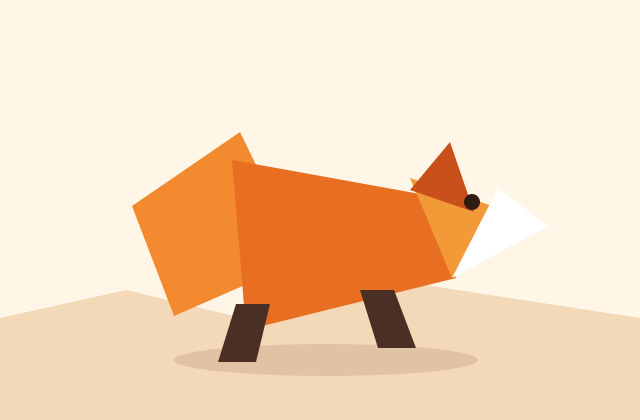
Cozy Animal Pack
Low-Poly Fox
A stylized animal prop for cozy games, woodland scenes and AR previews.
View details- Triangles
- 24
- Texture
- Flat color
- License
- Commercial use
- Formats
- OBJ
Protected STL download
Production export targets
Highlights
- Export FBX for Unity to preserve hierarchy, pivots, material slots and skeletons.
- Set Scale Factor so one unit equals one meter, and disable Read/Write unless scripts need mesh access.
- Extract materials on import and reassign them to URP Lit or Simple Lit shaders.
- Target 3,000 to 5,000 triangles for mobile heroes and 200 to 800 for props, with LOD groups.
- Use one shared 512 to 1024 pixel atlas per kit to keep draw calls low.
- Enable the SRP Batcher and GPU instancing so shared materials batch automatically.
- Bake colliders, LOD groups and scripts into prefabs, then use Prefab Variants for reskins.
- AI generated assets are user owned, commercial safe and need no attribution.
Unity treats FBX as a first class citizen, so it is the format you want when you export a low poly asset for a Unity project. FBX preserves the transform hierarchy, the object pivots, named material slots and any skeleton or animation, which means your model lands in the Project window already organized rather than as a single flattened mesh. GLB and OBJ can be imported too, but OBJ loses animation and discards pivots, and GLB embeds materials in a way Unity has to unpack on import. For static props, characters and modular kits alike, FBX gives you the most predictable result and the cleanest material assignment inside the editor.
When the FBX lands in your Assets folder, select it and walk through the Import Settings inspector before you do anything else. On the Model tab set Scale Factor so one Unity unit equals one meter, enable Mesh Compression for mobile builds, and turn off Read/Write unless a script needs runtime mesh access because leaving it on doubles memory. On the Materials tab choose to extract materials into your project so you can swap them for URP or HDRP shaders, then remap textures to a shared atlas. On the Rig tab pick Humanoid for a character that will use Mecanim retargeting, or Generic for a creature or prop with a custom skeleton. Apply, and Unity rebuilds the import deterministically every time.
Polycount discipline is what keeps a Unity scene running fast, and low poly art is a natural fit for the engine budgets. For mobile, aim for hero characters around 3,000 to 5,000 triangles and background props at 200 to 800 triangles, then author two or three LOD levels with the LOD Group component so distant objects swap to cheaper meshes. For desktop and console you have room for 10,000 to 50,000 triangles on a hero and up to 20,000 on a focal prop, but the flat shaded low poly look rarely needs that many. The real performance lever is draw calls, not raw triangles, so the goal is to render as much as possible in one batch.
Draw call batching is where low poly assets earn their keep in Unity. Static objects that share one material get combined automatically by static batching when you mark them Batching Static, while GPU instancing and the SRP Batcher in URP let many objects share a shader and render together. The trick is to give every asset in a kit a single shared texture atlas, 512 to 1024 pixels for props and 1024 to 2048 for a hero, painted with flat colors or baked gradients. One atlas plus one URP Lit or Simple Lit material means dozens of objects collapse into a handful of draw calls, which is the difference between sixty frames per second and a stutter on a mid range phone.
Prefabs are how you make all of this reusable. Drag the imported model into a scene, attach the LOD Group, colliders and any scripts, then drag it back into the Project window to create a prefab, and from then on every instance inherits your setup. Prefab Variants let you reskin the same low poly mesh with a different atlas for seasonal versions without duplicating geometry. Because the assets you generate here are AI created, they are yours to use: fully owned, fine for commercial games published to the Asset Store or any storefront, and they need no attribution. You can iterate on a prompt, regenerate a variant and ship it without licensing friction.
A practical workflow looks like this. Generate the model, export GLB or FBX, and if you started from GLB run it through Blender once to confirm scale and re-export FBX with a clean hierarchy. Drop the FBX into Assets, dial in the import settings, extract and assign a URP material with your atlas, build the LOD chain, and bake the result into a prefab. Test draw calls in the Frame Debugger, confirm the SRP Batcher is folding your objects together, and profile on a real device. Done this way, a generated low poly kit behaves exactly like assets a studio artist would hand you, only faster to produce and free to modify.
Round out your Unity pipeline
Frequently asked questions
Should I import FBX or GLB into Unity?
Use FBX. It preserves the transform hierarchy, pivots, named material slots and skeleton, which gives you clean prefabs and predictable material assignment. GLB works but Unity has to unpack embedded materials, and OBJ drops animation and pivots entirely.
What polycount should I use for a mobile Unity game?
Keep hero characters around 3,000 to 5,000 triangles and background props between 200 and 800. Add two or three LOD levels with a LOD Group so distant objects render cheaper meshes and keep the frame rate steady on mid range phones.
How do I keep draw calls low with many low poly objects?
Give every asset in a kit one shared texture atlas and one URP material, mark static objects Batching Static, and enable the SRP Batcher and GPU instancing. Shared materials let dozens of objects collapse into a few draw calls.
Will generated low poly assets work with Mecanim?
Yes. Export FBX with the skeleton intact and set the Rig import type to Humanoid for retargetable Mecanim animation, or Generic for a custom creature rig. Unity then drives the model with your animator controller like any other character.
Can I sell a game made with these assets?
Yes. AI generated assets are fully owned by you, safe for commercial use including titles published to the Unity Asset Store or any storefront, and they require no attribution. You can regenerate variants and ship them freely.
Related
Browse allNeed a custom low-poly model?
Generate one from a text prompt or reference image, then export GLB, FBX, OBJ or STL.
Open the generator