
Low Poly Character 3D Models
Generate stylized low poly characters with clean, rig-friendly topology, or download a base mesh you can take straight into Blender, Unity or Godot.
Matching downloadable assets
Start with these seed models, then generate variants in the same low-poly direction.
Members unlock protected STL access
Use the free OBJ to test the shape. Subscribe for protected STL downloads now; GLB, FBX, USDZ and Unity are shown as production export targets, not direct library downloads yet.
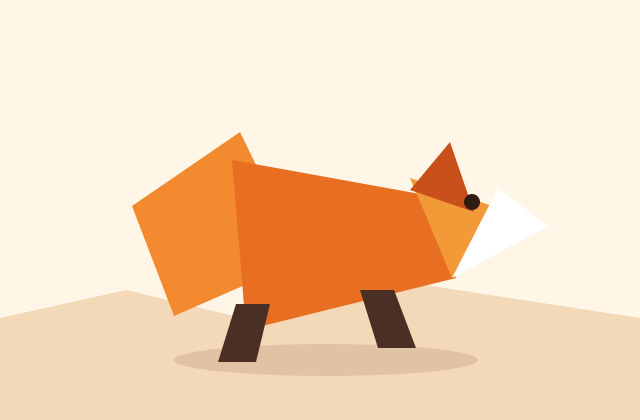
Cozy Animal Pack
Low-Poly Fox
A stylized animal prop for cozy games, woodland scenes and AR previews.
View details- Triangles
- 24
- Texture
- Flat color
- License
- Commercial use
- Formats
- OBJ
Protected STL download
Production export targets
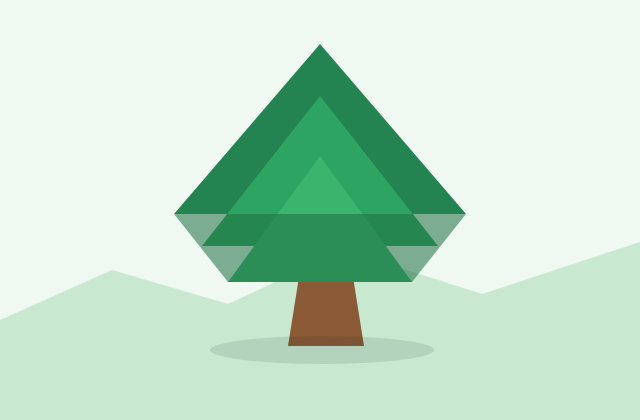
Nature Starter Pack
Low-Poly Pine Tree
A lightweight forest prop with a trunk, two faceted foliage layers and a clean base pivot for scattering.
View details- Triangles
- 24
- Texture
- Flat color
- License
- Commercial use
- Formats
- OBJ
Protected STL download
Production export targets

Vehicle Starter Pack
Low-Poly Arcade Car
A simple separated-wheel vehicle mesh for racing prototypes, traffic fillers and WebGL demos.
View details- Triangles
- 30
- Texture
- Material slots
- License
- Commercial use
- Formats
- OBJ
Protected STL download
Production export targets
Highlights
- Mobile characters: 1,500-5,000 triangles
- Desktop/console heroes: 8,000-20,000 triangles
- Quad-friendly topology around joints for clean deformation
- FBX carries skeleton + animation for Unity/Unreal
- GLB supports skeletal animation for web/Godot/AR
- Single 1K-2K atlas to minimize material slots
- T-pose, origin at feet, facing forward for rigging
- Generate matching character casts in one style
Characters are the hardest assets to get right at a low polygon count because the silhouette and proportions carry almost all of the personality. A solid target for a stylized mobile character is 1,500 to 5,000 triangles; desktop and console heroes often live between 8,000 and 20,000 triangles once you add hands, faces and accessories. The characters here are built with even, quad-friendly topology around the joints so they deform cleanly when rigged, which is the single biggest difference between a model that animates well and one that pinches at the elbows and knees.
For format choice, FBX is the standard for character work in Unity and Unreal because it carries skeletons, skin weights and animation clips. GLB is excellent when your target is the web, Godot or AR, and it also supports skeletal animation through its skin and node-animation channels. OBJ only carries the static mesh, so reserve it for sculpting references or print bases. If you are exporting a character base to refine inside Blender, GLB or FBX both round-trip cleanly while preserving the rig if one exists.
Rigging readiness is what separates a usable game character from a pretty statue. Keep the mesh in a clean T-pose or A-pose, with the origin at the feet and the model facing forward down the positive axis your engine expects. Avoid intersecting geometry around armpits and crotch, and give fingers either separate loops or a simple mitten shape depending on how much hand animation you need. A single 1024x1024 or 2048x2048 texture atlas keeps material slots low, which matters because every extra material is an extra draw call per character on screen.
Low poly characters serve far more than combat games. They power crowd systems where hundreds of agents share one mesh, VR social avatars that must run at 90 frames per second, NPC villagers in cozy games, and AR figures that stand on a real table through a phone. For crowds and mobile, lean hard on shared materials and texture atlases. For close-up cutscene characters, you can afford a higher-resolution face texture and a few extra loops around the eyes and mouth for expression.
Every character you generate is licensed for your own commercial use with no attribution, so you can ship it in a paid game or sell it inside a product without licensing worry. If you need a cast of matching characters, generate one and then request variations in clothing, color and proportion so your villagers, enemies or party members all share a coherent art style instead of looking like they came from five different asset packs.
Next steps for character assets
Frequently asked questions
Are these characters rigged?
They are built rig-ready with clean topology and a neutral pose. You can auto-rig in Blender, Mixamo or your engine, and our generator can also produce a base that is straightforward to skin.
What polycount is right for a VR avatar?
Aim for roughly 5,000-15,000 triangles for a VR avatar that needs to hold 90fps, and keep to a single texture atlas to limit draw calls in social VR scenes.
Which format keeps the skeleton?
FBX for Unity and Unreal, or GLB for web, Godot and AR. Both preserve the skeleton and skin weights. OBJ is mesh-only and drops any rig.
Can I generate a matching cast of NPCs?
Yes. Generate one character, then request variations in outfit, color and proportions so an entire NPC cast shares one consistent art style.
Can I sell a game using these characters?
Yes. Generated characters are yours for commercial use with no attribution required, including paid games and products.
Related
Browse allNeed a custom low-poly model?
Generate one from a text prompt or reference image, then export GLB, FBX, OBJ or STL.
Open the generator