
Low Poly Knight 3D Model
A knight is a character built almost entirely from hard-surface pieces layered over a soft body, and that layered-plate construction is exactly what makes a knight a fundamentally different modeling and rigging problem than a bare humanoid or a soft-clothed villager.
Matching downloadable assets
Start with these seed models, then generate variants in the same low-poly direction.
Members unlock protected STL access
Use the free OBJ to test the shape. Subscribe for protected STL downloads now; GLB, FBX, USDZ and Unity are shown as production export targets, not direct library downloads yet.

Nature Starter Pack
Low-Poly Pine Tree
A lightweight forest prop with a trunk, two faceted foliage layers and a clean base pivot for scattering.
View details- Triangles
- 24
- Texture
- Flat color
- License
- Commercial use
- Formats
- OBJ
Protected STL download
Production export targets
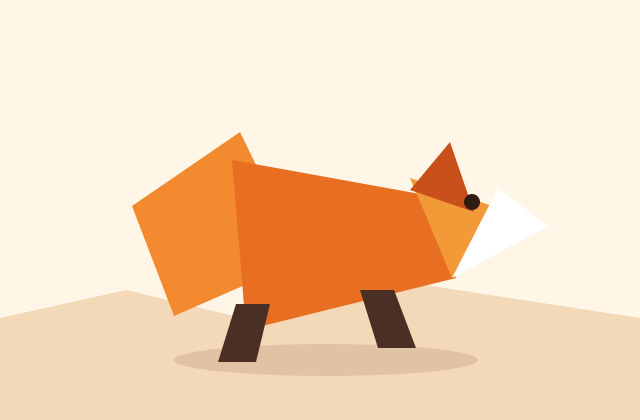
Cozy Animal Pack
Low-Poly Fox
A stylized animal prop for cozy games, woodland scenes and AR previews.
View details- Triangles
- 24
- Texture
- Flat color
- License
- Commercial use
- Formats
- OBJ
Protected STL download
Production export targets
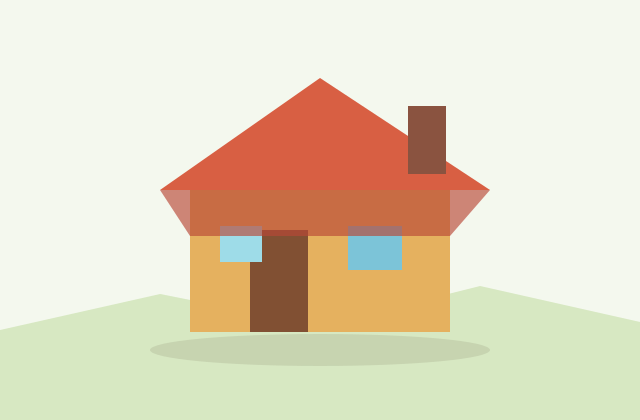
Village Starter Pack
Low-Poly Cottage House
A compact village building for cozy sims, isometric towns and stylized environment blocking.
View details- Triangles
- 18
- Texture
- Flat color
- License
- Commercial use
- Formats
- OBJ
Protected STL download
Production export targets
Highlights
- Mobile/indie knight: 2,500-6,000 triangles; desktop hero knight: 10,000-20,000
- Body underneath the armor stays extremely simple — none of it is ever visible
- Armor built as separate modular pieces (helm, pauldrons, cuirass, gauntlets, greaves)
- Armor parented to skeleton bones, not vertex-skinned, so it rotates as a rigid unit
- Cape needs its own 3-6 joint bone chain for cloth-sim or bone-spring physics
- Cape as a single-sided plane with thickness offset, not a fully closed double-sided mesh
- Single 1K-2K shared atlas, with a small region reserved for a swappable heraldic crest
- FBX for Unity/Unreal to keep parented armor + cape rig; GLB for Godot/web
A mobile or stylized-indie knight reads clearly at 2,500 to 6,000 triangles once helm, pauldrons, cuirass, gauntlets and greaves are added on top of a base humanoid body. A desktop or console hero knight, the kind featured in a close-camera cutscene or a boss-tier enemy encounter, commonly runs 10,000 to 20,000 triangles, with the extra budget going toward beveled armor edges, a heraldic emblem on the chest plate, and a cape or cloth element that needs its own geometry rather than being painted onto the body. Keep the plain body underneath the armor extremely simple and low-detail, since none of it is ever visible once the armor pieces are attached; spending polygons on unseen skin under a full plate suit is pure waste.
The armor itself should be built as separate modular pieces, helm, pauldrons, cuirass, gauntlets, greaves, rather than sculpted as one continuous shell fused to the body. This modularity is what lets a game swap a knight's helm for a different design, tint the cuirass to a different faction color, or strip pieces off entirely for a "battle-damaged" variant, all without remodeling the character. Parent each armor piece to the corresponding bone in the skeleton rather than skinning it directly to vertex weights, since rigid armor plates should rotate as a solid unit with the limb rather than deforming and stretching the way cloth or skin does.
A cape or cloak is the one part of a knight that behaves nothing like the rigid armor around it, and it needs to be treated as its own dedicated object with its own short bone chain (typically 3 to 6 joints running down its length) rather than a single rigid plane. That chain is what a physics or cloth-simulation system (Unity's Cloth component, Unreal's Chaos cloth, or a simple bone-spring script in Godot) actually drives, letting the cape sway and settle with movement instead of clipping stiffly through the legs during a run animation. Keep the cape as a single-sided plane with a small thickness offset rather than a fully closed solid, since a true double-sided mesh roughly doubles its triangle cost for a visual difference nobody notices in motion.
A single shared texture atlas at 1024 to 2048 pixels typically covers the whole knight: skin, cloth undergarments, and every armor piece painted with flat metallic tones or a subtle baked gradient rather than a full physically-based metal shader, since photoreal metal rarely reads well against the site's flat-shaded low poly aesthetic. Reserve a small separate region of that same atlas for a heraldic crest or emblem so faction variants only need a texture swap, not a geometry change.
Low poly knights populate fantasy RPGs as player characters, guard NPCs and boss encounters, tabletop VTT miniature stand-ins, and tower-defense unit rosters. Export FBX for Unity and Unreal to carry the skeleton, the parented armor hierarchy and the cape's bone chain into the engine; export GLB for Godot and the web where skeletal animation is equally well supported. Everything generated here is yours to use commercially with no attribution required, so a knight you generate can headline a shipped RPG or a paid character asset pack. Generate one base knight you like, then request armor-color and crest variants so an entire order of knights reads as a coherent, matched faction.
Equip and rig the knight
Frequently asked questions
How many triangles does a low poly knight need?
A mobile or indie-scale knight with full armor reads clearly at 2,500-6,000 triangles. A desktop hero knight in a close-camera scene commonly runs 10,000-20,000, with the extra budget spent on beveled armor edges and a cape.
Should the armor be modeled as one solid piece or separate parts?
Build it as separate modular pieces (helm, pauldrons, cuirass, gauntlets, greaves) parented to skeleton bones. This lets a game swap individual armor pieces, retint them per faction, or strip pieces for a damaged variant without remodeling the character.
How do I make a knight's cape move realistically?
Give the cape its own dedicated object with a short 3-6 joint bone chain, then drive that chain with a cloth-simulation system (Unity Cloth, Unreal Chaos cloth) or a simple bone-spring script so it sways naturally instead of clipping through the legs.
Should the cape be a double-sided mesh?
No, keep it single-sided with a small thickness offset. A fully closed double-sided cape roughly doubles its triangle cost for a visual difference that is essentially invisible once the cape is moving.
Can I use a generated knight in a commercial game?
Yes. Generated knight models are yours to use commercially with no attribution required, including in a shipped RPG or a paid character asset pack.
Related
Browse allNeed a custom low-poly model?
Generate one from a text prompt or reference image, then export GLB, FBX, OBJ or STL.
Open the generator