
Low Poly Tree 3D Models
Browse ready-to-use low poly trees or generate a custom tree pack that matches the exact style, season and polygon budget your project needs.
Matching downloadable assets
Start with these seed models, then generate variants in the same low-poly direction.
Members unlock protected STL access
Use the free OBJ to test the shape. Subscribe for protected STL downloads now; GLB, FBX, USDZ and Unity are shown as production export targets, not direct library downloads yet.
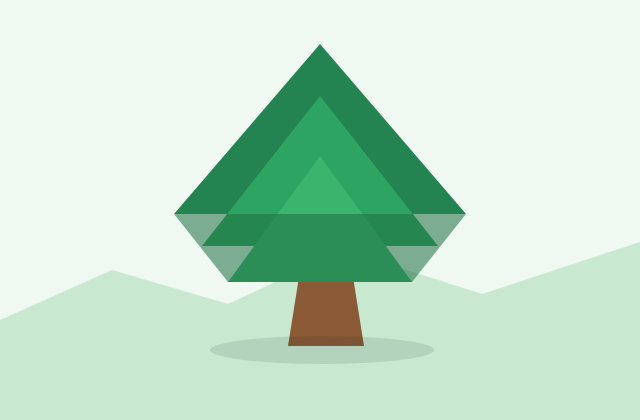
Nature Starter Pack
Low-Poly Pine Tree
A lightweight forest prop with a trunk, two faceted foliage layers and a clean base pivot for scattering.
View details- Triangles
- 24
- Texture
- Flat color
- License
- Commercial use
- Formats
- OBJ
Protected STL download
Production export targets
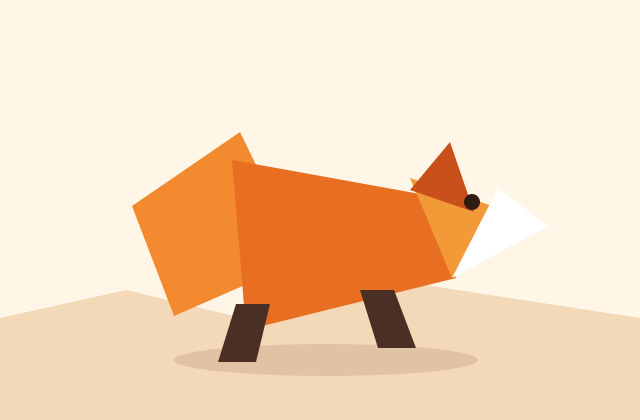
Cozy Animal Pack
Low-Poly Fox
A stylized animal prop for cozy games, woodland scenes and AR previews.
View details- Triangles
- 24
- Texture
- Flat color
- License
- Commercial use
- Formats
- OBJ
Protected STL download
Production export targets

Vehicle Starter Pack
Low-Poly Arcade Car
A simple separated-wheel vehicle mesh for racing prototypes, traffic fillers and WebGL demos.
View details- Triangles
- 30
- Texture
- Material slots
- License
- Commercial use
- Formats
- OBJ
Protected STL download
Production export targets
Highlights
- Mobile/WebGL budget: 150-600 triangles per tree
- Desktop hero trees: up to 3,000 triangles with LOD
- GLB for web/Godot/AR, FBX for Unity/Unreal, OBJ universal
- STL or 3MF for 3D-printed decorative trees
- Single shared 512-1024px atlas keeps draw calls low
- Origin at trunk base for clean instance placement
- Generate matching variant packs for whole forests
- Commercial use included, no attribution required
Low poly trees are one of the most-used props in stylized games because a single well-built tree can be instanced thousands of times across a forest without crushing the frame rate. For mobile and WebGL scenes, aim for roughly 150 to 600 triangles per tree, including the trunk and canopy. Desktop and console projects can comfortably push individual hero trees to 1,500 to 3,000 triangles when they sit close to the camera, but background foliage should stay lean and lean on level-of-detail (LOD) swaps. The trees here are built with flat-shaded faces and a tight UV layout so they read clearly from a distance and tile into dense forests cheaply.
Picking the right file format matters more than most beginners expect. GLB is the best default for the web, Godot, Three.js and AR because it bundles geometry, materials and textures into a single self-contained binary file. FBX is the smoothest path into Unity and Unreal because both engines preserve its node hierarchy, pivots and material slots on import. OBJ is the universal fallback that opens almost everywhere but carries no animation. If you are 3D printing a decorative tree, export STL or 3MF instead, since printers care about a watertight mesh rather than textures.
Texture strategy keeps a low poly forest both pretty and performant. Most stylized trees use a single shared atlas of 512x512 or 1024x1024 pixels with simple flat colors or a subtle gradient bake, which lets the GPU draw the entire forest in very few draw calls. Avoid per-tree unique textures unless a tree is a genuine focal point. When you generate a tree on this page you can request a flat-color material for the cheapest result, or a baked gradient for a slightly richer look that still stays inside a mobile budget.
Use cases for low poly trees go well beyond fantasy RPGs. They populate cozy farming sims, isometric strategy maps, racing-game roadsides, AR placement demos and architectural visualizations that want a friendly stylized mood. For real-time scenes, set the tree origin at the base of the trunk so it snaps cleanly to the ground when you scatter instances, and add a simple capsule or box collider only if players can walk into it. For 3D printing, thicken thin branches so they survive the printer and the handling afterward.
Licensing is simple here: anything you generate is yours to use, including in commercial games, apps and products, with no attribution required. That removes the biggest anxiety behind free model hunting, where unclear or non-commercial licenses can put a shipped game at legal risk. If you need a whole matching set of trees, generate one you like and then request a variant pack so the trunks, leaf shapes and color palette stay consistent across your forest.
Where trees fit next
Frequently asked questions
What polycount should a low poly tree be for a mobile game?
Keep individual trees around 150-600 triangles and rely on instancing plus LOD swaps. A dense forest of low-budget trees will outperform a handful of high-detail ones on phones.
Which format should I download for Unity?
Use FBX for Unity. It preserves pivots, hierarchy and material slots on import. If you target WebGL specifically, GLB is also a great choice.
Can I 3D print these low poly trees?
Yes. Export STL or 3MF and make sure thin branches are thickened so they survive printing. Textures are ignored by most printers, so a clean watertight mesh is what matters.
Can I make a whole forest in one consistent style?
Generate a tree you like, then request a variant pack. The generator keeps the trunk shape, leaf style and color palette consistent so the trees look like a matched set.
Are the generated trees free to use commercially?
Yes. Models you generate are yours, including for commercial games, apps and products, with no attribution required.
Related
Browse allNeed a custom low-poly model?
Generate one from a text prompt or reference image, then export GLB, FBX, OBJ or STL.
Open the generator