
Low Poly Rock 3D Models
Rocks are the most-repeated prop in any 3D environment, scattered by the hundreds across terrain, riverbeds and mountainsides, which makes them the single best test of whether an asset is genuinely cheap enough to instance at scale.
Matching downloadable assets
Start with these seed models, then generate variants in the same low-poly direction.
Members unlock protected STL access
Use the free OBJ to test the shape. Subscribe for protected STL downloads now; GLB, FBX, USDZ and Unity are shown as production export targets, not direct library downloads yet.

Fantasy Props Pack
Low-Poly Crystal Cluster
A faceted fantasy or sci-fi prop for caves, spell pickups, resource nodes and AR collectibles.
View details- Triangles
- 28
- Texture
- Vertex color ready
- License
- Commercial use
- Formats
- OBJ
Protected STL download
Production export targets
Nature Starter Pack
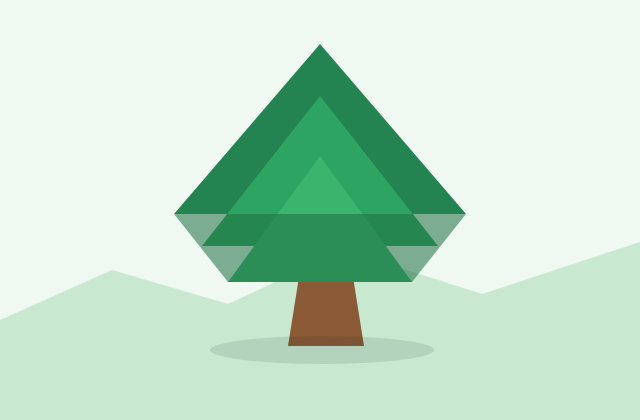
Low-Poly Pine Tree
A lightweight forest prop with a trunk, two faceted foliage layers and a clean base pivot for scattering.
View details- Triangles
- 24
- Texture
- Flat color
- License
- Commercial use
- Formats
- OBJ
Protected STL download
Production export targets
Cozy Animal Pack
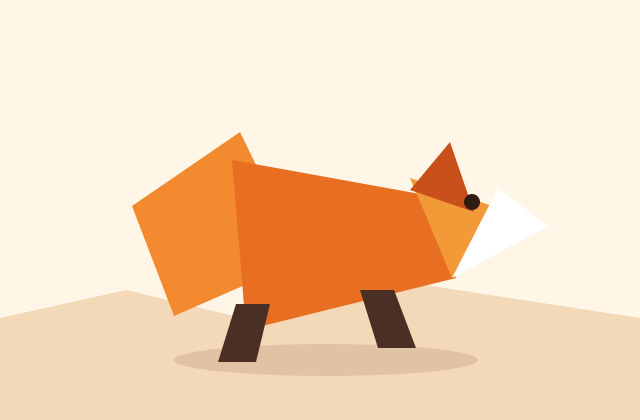
Low-Poly Fox
A stylized animal prop for cozy games, woodland scenes and AR previews.
View details- Triangles
- 24
- Texture
- Flat color
- License
- Commercial use
- Formats
- OBJ
Protected STL download
Production export targets
Highlights
- Small scatter rock: 50-200 tris; mid boulder: 200-600 tris; hero rock face: 2,000-6,000 tris
- 6-12 large deliberate flat planes read as geological, better than dense organic sculpting
- Build a kit of 3-5 base shapes and vary rotation/scale/tint rather than authoring one perfect rock
- Bake ambient occlusion into crevices on a single 512px shared atlas
- Use vertex color for per-instance tint variation (moss, snow, dust) instead of unique textures
- GPU instancing (Unity, Godot, Three.js InstancedMesh) renders hundreds of rocks in a handful of draw calls
- Use simple box/capsule/convex collision, never mesh collision, on scattered rock instances
- GLB for web/Godot/Three.js/AR, FBX for Unity/Unreal terrain, OBJ for static exchange
A rock has no rig, no animation and no face the player needs to recognize, which means its entire budget can go toward silhouette and nothing else. A small scatter rock should sit at 50 to 200 triangles, a mid-size boulder that anchors a scene at 200 to 600, and a genuine hero rock formation that the camera lingers on, a canyon wall or a cliff face, can run 2,000 to 6,000 triangles broken into a handful of large chunks. The habit that separates a good low poly rock from a bad one is restraint: 6 to 12 large, deliberately angled flat planes read as convincingly geological as a rock with 10 times the triangle count, because real rock faces genuinely are made of a small number of large fracture planes.
Because a scene needs so many rocks, variation matters more than any single rock being perfect. Generate 3 to 5 base shapes and treat them as a kit: a flat slab for ground cover, a rounded boulder, an angular jagged chunk, and one or two mid-size variants, then scatter and rotate them randomly with non-uniform scale to avoid the unmistakable "same rock copy-pasted a hundred times" look that breaks immersion faster than almost any other environment mistake. A tiny amount of per-instance tint variation, driven by a vertex color channel rather than unique textures, goes a long way toward making a field of the same 4 rock meshes look like hundreds of unique ones.
Texturing a rock is almost always cheaper than texturing anything else in a scene, and that is a genuine advantage to lean into. Bake ambient occlusion directly into a single shared atlas, 512px covers an entire rock kit comfortably, so the crevices between flat planes read as naturally darker without any real-time lighting cost. A simple triplanar or flat gray-brown material with the AO baked in is usually enough; save any per-vertex color variation for tinting moss, snow caps or dry-desert dust on top of that same shared base rather than building separate materials per rock.
Instancing is where rocks earn their keep in a real engine. Because every rock in a kit shares one mesh, one material and one atlas, a scene with a thousand rocks scattered across a mountainside can render in a small handful of draw calls using GPU instancing in Unity, Godot or Three.js's InstancedMesh, rather than one draw call per rock. This is the exact scenario instancing was built for, and rocks are usually the first prop worth setting it up for in any new environment, since they are almost always the single most numerous static object in an outdoor scene.
Rocks show up everywhere: mountain and canyon environments, riverbeds, dungeon floors, quarry and mining scenes, and as simple physical obstacles or collision blockers in a level layout. For collision, a rock almost never needs its actual mesh collider; a simple box, capsule or convex hull collider matches player expectations closely enough and is dramatically cheaper than mesh collision on hundreds of instances. Export GLB for web, Godot, Three.js and AR scattering tools, FBX for Unity and Unreal terrain systems, and OBJ for a simple static exchange. Everything you generate is yours to use commercially with no attribution required, so a full rock kit for an outdoor environment, mining level or quarry scene ships without any licensing question.
Scatter these across a scene
Frequently asked questions
How many triangles should a scatter rock have?
A small background scatter rock should sit at 50 to 200 triangles, a mid-size boulder at 200 to 600, and only a genuine hero rock formation the camera lingers on should climb toward 2,000 to 6,000 triangles.
How do I avoid an obviously repeated rock look?
Build a small kit of 3 to 5 base shapes, then randomize rotation, non-uniform scale and a vertex-color tint per instance. That variation is far more important to believability than any single rock having more detail.
Do rocks need collision meshes?
Almost never a full mesh collider. A simple box, capsule or convex hull collider matches player expectations closely and is dramatically cheaper across hundreds of scattered instances.
Why does instancing matter so much for rocks?
Rocks are usually the single most numerous static object in an outdoor scene. Because a whole kit shares one mesh, material and atlas, GPU instancing can render a thousand rocks in a handful of draw calls instead of one per rock.
Can I use generated rock packs in a commercial game?
Yes. Every rock you generate is yours to use commercially with no attribution required, so a full outdoor, mining or quarry rock kit ships without any licensing concern.
Related
Browse allNeed a custom low-poly model?
Generate one from a text prompt or reference image, then export GLB, FBX, OBJ or STL.
Open the generator