
Sci-Fi Low Poly Assets
Engineer sleek futuristic worlds with hard surface sci-fi low poly assets, complete with panel lines, glowing neon accents, and metallic roughness materials.
Matching downloadable assets
Start with these seed models, then generate variants in the same low-poly direction.
Members unlock protected STL access
Use the free OBJ to test the shape. Subscribe for protected STL downloads now; GLB, FBX, USDZ and Unity are shown as production export targets, not direct library downloads yet.

Nature Starter Pack
Low-Poly Pine Tree
A lightweight forest prop with a trunk, two faceted foliage layers and a clean base pivot for scattering.
View details- Triangles
- 24
- Texture
- Flat color
- License
- Commercial use
- Formats
- OBJ
Protected STL download
Production export targets
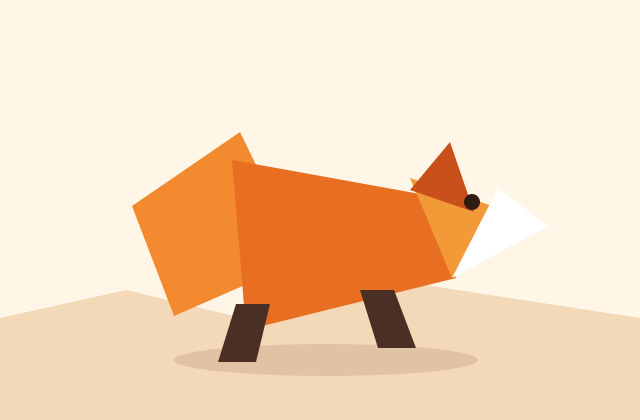
Cozy Animal Pack
Low-Poly Fox
A stylized animal prop for cozy games, woodland scenes and AR previews.
View details- Triangles
- 24
- Texture
- Flat color
- License
- Commercial use
- Formats
- OBJ
Protected STL download
Production export targets
Highlights
- Hard surface forms with sharp clean bevels that read as machined metal
- Panel lines and greebles that imply mechanical complexity at low triangle counts
- Metallic roughness physically based materials for realistic alloys and glass
- Emissive neon strips and engine glows that shine without real time lighting
- Cold restrained palette of steel grays, deep blues, and gunmetal
- Scalable polycounts from 200 triangle props to 50000 triangle capital ships with LODs
- Export to GLB, FBX, OBJ, STL, or USDZ for web, engine, AR, or printing
- User owned assets, free for commercial use with no attribution required
Sci-fi low poly is a hard surface discipline. Where organic styles soften edges, the sci-fi look celebrates precision: clean bevels, mechanical paneling, and a sense that every part was machined for a purpose. It is the style of spaceships, combat robots, orbital stations, drones, and futuristic weapons. Our generator focuses on producing assets that feel engineered rather than sculpted, with crisp geometry and a cold, industrial confidence that suits any near future or deep space setting.
Panel lines and greebles are the soul of the genre. Even on a low triangle budget you can imply enormous mechanical complexity by breaking large flat surfaces into panels and adding small functional looking details, the greebles, that suggest vents, hatches, thrusters, and antennae. Sharp clean bevels catch light along every edge and read as machined metal, while the panel grooves create rhythm and scale. The trick is to bake most of this detail into textures rather than modeling every screw, keeping the mesh efficient while the surface looks dense.
Materials are where sci-fi diverges sharply from flatter styles. Lean into a metallic roughness physically based workflow so surfaces respond to light like real alloys, painted hulls, and brushed steel. Vary roughness to separate glossy cockpit glass from matte armor plating, and use the metallic channel to make panels read as genuine metal. A single shared atlas of 1024 pixels handles a fleet of small props, while a hero ship or boss robot earns a 2048 pixel atlas with crisp panel and wear detail baked in.
Emissive neon is the signature accent that makes sci-fi assets pop. Run glowing cyan strips along a hull, light up engine nozzles with hot orange, add blinking status lights to a robot, or wash a station interior in cold blue panels. Emissive materials glow without real lighting, so they perform everywhere and instantly communicate that something is powered and alive. Keep the base palette cold and restrained, dominated by steel grays, deep blues, and gunmetal, so the neon reads as a deliberate, high contrast highlight rather than visual noise.
For polycounts, match the device and role. Mobile and WebGL props sit between 200 and 800 triangles, drones and small robots around 1000 to 5000 triangles, capital ships and full space stations from 10000 to 50000 triangles, and a hero vessel up to 20000 triangles when it carries the camera. Ship LODs for large vehicles and structures so distant hulls simplify cleanly. Export GLB for web, Three.js, Godot, and AR as a self contained binary, FBX for Unity and Unreal to preserve hierarchy, pivots, material slots, and animation rigs, OBJ for static props, STL or 3MF for 3D printing model kits, and USDZ for iOS AR Quick Look.
Sci-fi low poly assets drive space shooters, strategy games, survival and base building titles, cyberpunk worlds, technical visualizations, and futuristic animated shorts. Because the kits are modular, you can bolt together fleets, factories, and stations rapidly while holding a consistent hard surface look. Every asset you generate is yours to own and use commercially with no attribution required, so you can launch an entire armada or build a sprawling station for a paid project without any licensing worries.
Assemble a sci-fi fleet
Frequently asked questions
What defines the sci-fi low poly style?
Hard surface geometry with sharp bevels, panel lines and greebles for mechanical detail, metallic roughness materials, and emissive neon accents over a cold steel and blue palette.
How do panel lines work on a low poly model?
Most panel detail is baked into the texture rather than modeled, so the mesh stays efficient while the surface looks dense. A few real bevels catch light along edges to sell the machined metal feel.
Why use metallic roughness materials here?
A physically based metallic roughness workflow makes hulls, glass, and armor respond to light like real materials. Varying roughness separates glossy cockpits from matte plating and makes panels read as genuine metal.
What polycount fits a spaceship?
Small drones sit at 1000 to 5000 triangles, while capital ships and stations range from 10000 to 50000 triangles. Ship LODs so distant hulls simplify cleanly in large space scenes.
Can I use these in a commercial sci-fi game?
Yes. Every asset you generate is yours to own and use commercially with no attribution required, so you can build and sell a full sci-fi project freely.
Related
Browse allNeed a custom low-poly model?
Generate one from a text prompt or reference image, then export GLB, FBX, OBJ or STL.
Open the generator