
Low Poly Gun and Firearm Model Generator
Generate game-ready low poly guns with separated magazine, slide, and trigger parts so you can animate reloads and firing, plus a hollow muzzle ready for your VFX.
Matching downloadable assets
Start with these seed models, then generate variants in the same low-poly direction.
Members unlock protected STL access
Use the free OBJ to test the shape. Subscribe for protected STL downloads now; GLB, FBX, USDZ and Unity are shown as production export targets, not direct library downloads yet.

Fantasy Weapons Pack
Low-Poly Iron Sword
A clean fantasy weapon prop for RPG prototypes, item pickups and inventory icons.
View details- Triangles
- 24
- Texture
- Flat metal
- License
- Commercial use
- Formats
- OBJ
Protected STL download
Production export targets

Nature Starter Pack
Low-Poly Pine Tree
A lightweight forest prop with a trunk, two faceted foliage layers and a clean base pivot for scattering.
View details- Triangles
- 24
- Texture
- Flat color
- License
- Commercial use
- Formats
- OBJ
Protected STL download
Production export targets
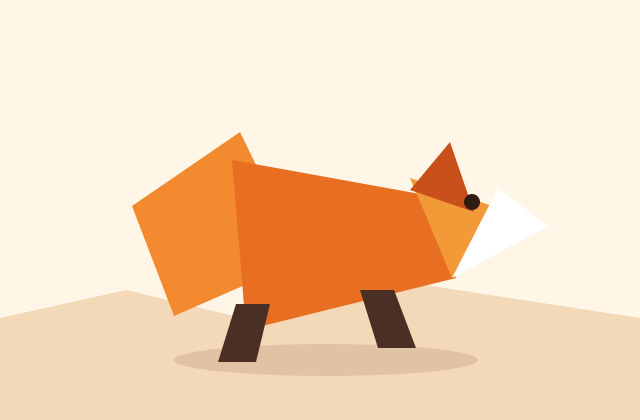
Cozy Animal Pack
Low-Poly Fox
A stylized animal prop for cozy games, woodland scenes and AR previews.
View details- Triangles
- 24
- Texture
- Flat color
- License
- Commercial use
- Formats
- OBJ
Protected STL download
Production export targets
Highlights
- Separated magazine, slide or bolt, and trigger group for real reload and fire animation
- Hollow muzzle opening left empty as a clean socket for muzzle-flash VFX
- FPS first-person detail at 4k-8k tris, third-person and enemy guns at 1k-3k
- LODs from one base so a single weapon serves first and third person
- Shared atlas at 1024-2048px for hero weapons, 512-1024px for distant guns
- Emissive ammo counter or reticle from the same atlas for a sci-fi touch
- FBX preserves separated parts and pivots for Unity and Unreal shooter pipelines
- GLB for web, Three.js, Godot, and AR; STL or 3MF for a printed prop
A firearm is a mechanism, and a believable game gun has to move like one. That is why our generator builds guns with the key moving parts kept separate: a detachable magazine, a sliding bolt or slide, and a trigger group that can travel. With those pieces split into their own meshes and given sensible pivots, you can animate a magazine drop, a slide rack, a bolt cycle, and a trigger pull without faking it through textures. The result is a weapon that feels mechanical and responsive in the player hands.
Polycount depends heavily on where the gun appears on screen. A first-person FPS weapon fills a large portion of the view and benefits from higher detail, typically 4,000 to 8,000 triangles, with crisp panel lines, defined sights, and clean edges that survive close inspection. A third-person or enemy weapon seen at a distance can drop to 1,000 to 3,000 triangles because the player never studies it up close. Building both as LODs from the same base lets you reuse one weapon across first and third person while keeping each context within budget.
The muzzle is a deliberate design choice. We model a hollow opening at the barrel end rather than capping it, leaving a clean empty point where you can spawn a muzzle flash, smoke, and shell-ejection VFX. That little detail is what makes firing feel alive, and an empty, well-placed muzzle socket means your particle systems line up perfectly every shot. The same thinking applies to the ejection port and magazine well, which are modeled to read correctly during reload animations.
Texturing follows the same low-draw-call discipline as other props. The receiver, barrel, grip, and magazine share a single atlas, around 1024 to 2048 pixels for a hero FPS weapon and 512 to 1024 for distant third-person guns, with flat color and baked gradients carrying the matte metal look. A subtle emissive ammo counter or sight reticle can light up from the emissive channel of that same atlas, adding a sci-fi touch at no extra draw-call cost. One material for the whole weapon keeps performance clean even with several guns on screen.
For export, FBX is the natural choice for shooter pipelines in Unity and Unreal because it preserves the separated parts, their pivots, material slots, and any animation, so your reload and fire animations drop straight in. GLB is ideal for web-based and Three.js shooters, Godot, and AR previews, bundling everything into one self-contained file. OBJ covers static exchange when you only need the geometry. If you want a tabletop replica or prop, STL or 3MF produce a printable mesh. Every weapon you generate is yours to use commercially with no attribution required.
A clean workflow: generate the gun, confirm the magazine, slide, and trigger are separated with correct pivots, and check that the muzzle is hollow for your VFX. Accept or recolor the shared atlas, wire the emissive ammo counter, and export FBX for engine work or GLB for web. Author the reload and fire animations against the separated parts, attach a muzzle-flash particle to the muzzle socket, and build a high-detail FPS LOD plus a lighter third-person LOD from the same base model.
Build out an armory
Frequently asked questions
Can I animate reloads and firing?
Yes. The magazine, slide or bolt, and trigger group are kept as separate meshes with sensible pivots, so you can animate a magazine drop, a slide rack, a bolt cycle, and a trigger pull directly.
What is the difference between FPS and third-person polycount?
A first-person weapon fills the view and benefits from 4,000 to 8,000 triangles for close detail, while a third-person or enemy gun can drop to 1,000 to 3,000. Build both as LODs from one base.
Why is the muzzle hollow?
The muzzle is modeled as an open, empty point so you can spawn muzzle-flash, smoke, and shell-ejection VFX that line up perfectly every shot, making firing feel alive.
Which format should I export for a shooter?
Use FBX for Unity and Unreal because it preserves the separated parts, pivots, and animation. Use GLB for web, Three.js, Godot, and AR, and OBJ for static exchange.
Are these weapons free for commercial use?
Yes. AI-generated firearm models are owned by you and are free to use commercially with no attribution required, including in shipped shooters and asset packs.
Related
Browse allNeed a custom low-poly model?
Generate one from a text prompt or reference image, then export GLB, FBX, OBJ or STL.
Open the generator