
Reduce Polycount and Optimize Your Mesh
Cut triangle count without wrecking the look. Decimate, generate LODs, and hit real per-platform budgets so your models run fast on mobile, web, and VR.
Matching downloadable assets
Start with these seed models, then generate variants in the same low-poly direction.
Members unlock protected STL access
Use the free OBJ to test the shape. Subscribe for protected STL downloads now; GLB, FBX, USDZ and Unity are shown as production export targets, not direct library downloads yet.

Nature Starter Pack
Low-Poly Pine Tree
A lightweight forest prop with a trunk, two faceted foliage layers and a clean base pivot for scattering.
View details- Triangles
- 24
- Texture
- Flat color
- License
- Commercial use
- Formats
- OBJ
Protected STL download
Production export targets
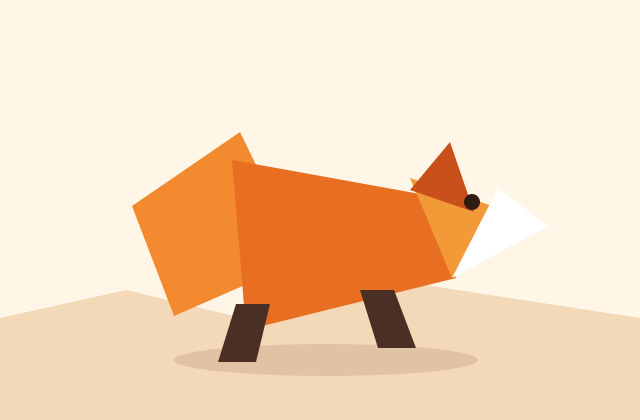
Cozy Animal Pack
Low-Poly Fox
A stylized animal prop for cozy games, woodland scenes and AR previews.
View details- Triangles
- 24
- Texture
- Flat color
- License
- Commercial use
- Formats
- OBJ
Protected STL download
Production export targets
Highlights
- Cut draw calls alongside triangles by merging meshes and sharing one atlas
- Use quadric collapse for general reduction, planar decimation for hard surfaces
- Reduce in steps and check the silhouette after each pass, not just the file size
- Ship LOD chains, full at LOD0, about half at LOD1, a quarter or less at LOD2
- Lock UV seams and important loops around faces and joints before decimating
- Target 1k to 5k tris on mobile and WebGL, 10k to 50k on desktop, hero up to 20k
- Treat VR as the tightest budget because the scene renders once per eye
- Export GLB for web, FBX for Unity and Unreal; assets are commercial-safe, no attribution
Reducing polycount is about performance economics, not just smaller files. Every triangle the GPU processes costs vertex work, and every separate material or mesh costs a draw call, which is often the real bottleneck on mobile, web, and VR. Fewer, denser draw calls beat many tiny ones, so polygon reduction usually pairs with mesh merging and atlasing to bring both triangle and draw-call counts down together. VR is the harshest case because you render the whole scene twice, once per eye, at high refresh rates, so a model that is fine on desktop can tank a headset. Optimizing for the tightest target you support keeps the experience smooth everywhere.
Decimation is the main lever, and different algorithms suit different jobs. Quadric edge-collapse decimation, the kind behind the Blender decimate modifier in collapse mode, removes the least visually important edges first and is the workhorse for general reduction. Planar decimation flattens coplanar faces and is excellent for hard-surface and architectural meshes with large flat areas. A remesh pass can rebuild messy or non-manifold geometry into an even grid before you decimate. Whichever you use, reduce in steps and check the silhouette after each pass, because the outline is what players actually perceive; an interior triangle can vanish unnoticed while an edge of the profile cannot.
Levels of detail are how reduction scales across a whole scene. Instead of one mesh everywhere, you ship a chain such as LOD0 at full budget for close range, LOD1 at roughly half, and LOD2 at a quarter or less for the far distance, and the engine swaps them by screen size. This keeps thousands of objects affordable because distant instances cost almost nothing. Generate LODs from one clean base so they share UVs and textures, and tune the swap distances so transitions are invisible in motion. For very dense fields, billboard impostors can replace geometry entirely at extreme range.
Preserve what the eye notices and spend triangles there. Protect the silhouette, since the outline defines recognizability, and protect UV seams and material boundaries so textures do not stretch or swim after reduction. Many decimation tools expose weights or locked edges; mark important loops to keep, especially around faces, hands, and animated joints where collapsing edges causes ugly deformation. Lock the UV borders, avoid creating non-manifold holes, and keep normals consistent so the lighting stays clean. The aim is a mesh that looks the same at viewing distance but carries a fraction of the geometry.
Know your real targets per platform and reduce to them deliberately. For mobile and WebGL, aim for a hero around 1k to 5k triangles and props at 200 to 800. For desktop and console, 10k to 50k per model is the working range, with a hero up to about 20k. VR sits between, leaning toward the mobile end for standalone headsets because of the double render. Pair geometry budgets with texture discipline: a single shared atlas at 512 to 1024px for props or 1024 to 2048px for a hero, using flat color or baked gradients, keeps memory and draw calls in check. Tools like the Blender decimate modifier, engine LOD importers, and mesh simplifiers all help, but the budget is what makes the decisions.
Export the optimized result to fit the destination. GLB is the self-contained binary for web, Three.js, Godot, and AR. FBX preserves hierarchy, pivots, material slots, and skeletons for Unity and Unreal and carries LOD groups cleanly. OBJ is fine for static interchange without animation, while STL and 3MF target 3D printing and ignore textures. Optimized assets are user-owned, cleared for commercial use, and require no attribution, so you can drop a reduced, budget-fit model straight into a shipping build without any licensing overhead.
Related optimization and export tools
Frequently asked questions
How much can I reduce without it looking worse?
A lot if you protect the silhouette and UV seams. Reduce in steps, check the outline after each pass, and bake detail into a normal map to keep surface richness.
What are good triangle budgets per platform?
Mobile and WebGL: 1k to 5k for a hero, 200 to 800 for props. Desktop and console: 10k to 50k, hero up to 20k. VR leans toward the mobile end.
What are LODs and do I need them?
Levels of detail are reduced copies that swap by screen size. They make large scenes affordable by making distant objects nearly free, so yes for any real scene.
Why is performance still bad after reducing triangles?
Draw calls are likely the bottleneck. Merge meshes and share a single texture atlas so the GPU batches them, not just fewer triangles per object.
Which tools reduce polycount?
The Blender decimate modifier (collapse and planar), remesh, engine LOD importers, and mesh simplifiers. Set a triangle budget first and reduce toward it.
Related
Browse allNeed a custom low-poly model?
Generate one from a text prompt or reference image, then export GLB, FBX, OBJ or STL.
Open the generator