
Text to Low Poly 3D Model Generator
Describe a subject in plain language and the AI builds a clean low poly mesh with baked textures, ready to export and drop into any engine.
Matching downloadable assets
Start with these seed models, then generate variants in the same low-poly direction.
Members unlock protected STL access
Use the free OBJ to test the shape. Subscribe for protected STL downloads now; GLB, FBX, USDZ and Unity are shown as production export targets, not direct library downloads yet.

Nature Starter Pack
Low-Poly Pine Tree
A lightweight forest prop with a trunk, two faceted foliage layers and a clean base pivot for scattering.
View details- Triangles
- 24
- Texture
- Flat color
- License
- Commercial use
- Formats
- OBJ
Protected STL download
Production export targets
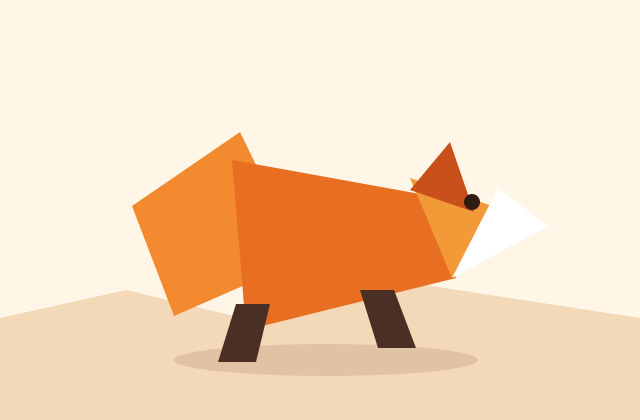
Cozy Animal Pack
Low-Poly Fox
A stylized animal prop for cozy games, woodland scenes and AR previews.
View details- Triangles
- 24
- Texture
- Flat color
- License
- Commercial use
- Formats
- OBJ
Protected STL download
Production export targets
Highlights
- Name one subject per prompt and state the low poly style explicitly for cleaner results
- Target 1k to 5k tris for mobile and WebGL heroes, 200 to 800 for small props
- Use 10k to 50k tris on desktop and console, up to 20k for a single hero asset
- Keep textures on a single 512 to 1024px atlas for props, 1024 to 2048px for heroes
- Export GLB for web, Godot, Three.js, and AR as one self-contained binary
- Export FBX for Unity and Unreal to preserve hierarchy, pivots, and material slots
- Iterate the prompt to fix silhouette and topology rather than regenerating blindly
- All generated assets are user-owned, commercial-safe, and need no attribution
Text to 3D removes the slowest part of asset creation: starting from a blank viewport. Instead of blocking out geometry by hand, you write a short prompt that names a single subject, a style, and a rough complexity, and the generator returns a watertight low poly mesh with materials already applied. A clear prompt like "low poly red fox sitting, flat shaded, stylized, single subject, no background" produces a far better result than a vague one. Name one subject per generation, state the low poly style explicitly, and avoid asking for a whole scene in one shot, because each extra object competes for the same triangle budget and dilutes the silhouette.
Polycount is the single most important constraint to communicate. For mobile and WebGL targets, aim for 1k to 5k triangles for a hero subject and 200 to 800 triangles for small props, so the scene stays smooth on phones and inside a browser tab. Desktop and console projects can comfortably carry 10k to 50k triangles per model, and a single hero asset that the camera lingers on can stretch toward 20k. If you need the same model at several distances, generate one clean base and build LODs so distant copies swap down to a fraction of the tris. Always ask for the lower end of a range first, because adding detail later is cheaper than fighting an over-dense mesh.
Texturing follows the same economy. Low poly assets look best with a single shared atlas, 512 to 1024px for props and 1024 to 2048px for a hero, using flat color or baked gradient fills that keep draw calls low. Flat shading reads as deliberate low poly style rather than an unfinished high poly model, and a baked gradient adds depth without extra geometry. When you prompt, mention the palette and whether you want hard flat facets or soft baked lighting, since that decision shapes both the look and the file size of the final export.
Export format should match where the model is going. GLB is the best default for the web, Godot, Three.js, and AR because it is a self-contained binary that bundles geometry, materials, and textures in one file. FBX is the right call for Unity and Unreal because it preserves hierarchy, pivots, material slots, and any skeleton or animation. OBJ is universal and simple but static, with no animation support, so reserve it for static props and pipeline interchange. STL and 3MF are for 3D printing: they describe a watertight mesh and ignore textures entirely, so generate a solid, manifold version when you plan to print. USDZ is the format to pick for iOS AR Quick Look so the model opens natively on iPhone and iPad.
Treat text to 3D as an iterative loop rather than a one-shot lottery. Generate, inspect the silhouette and topology, then refine the prompt by tightening the subject, adjusting the style words, or lowering the polycount target. Small wording changes often fix the biggest problems, such as splitting a fused base, cleaning up a noisy mesh, or simplifying an overdecorated surface. Keep a short library of prompts that worked so you can reproduce a consistent art style across an entire set of assets.
Licensing is straightforward and friendly to production use. Assets you generate are yours to own, fine for commercial projects, and require no attribution, so you can ship them in games, apps, ads, and client work without tracking credits. That combination of speed, ownership, and clean low poly geometry is what makes prompt to mesh generation a practical first step for indie developers, students, and studios that need many distinct models fast.
From prompt to finished asset
Frequently asked questions
How detailed should my text prompt be?
Specific but focused. Name one subject, one style, a rough polycount, and a palette. Avoid full scenes and add "single subject, no background" to keep the mesh clean.
Which export format should I choose?
GLB for web, Three.js, Godot, and AR; FBX for Unity and Unreal; OBJ for static interchange; STL or 3MF for 3D printing; USDZ for iOS AR Quick Look.
What polycount should I ask for?
Aim for 1k to 5k triangles on mobile and WebGL, 10k to 50k on desktop and console, and use LODs when the same model appears at multiple distances.
Can I use the models commercially?
Yes. Generated assets are user-owned, safe for commercial use, and require no attribution, so you can ship them in games, apps, and client work.
Why does my mesh look too dense or messy?
Lower the polycount target and add style words like flat shaded and stylized. Then iterate the prompt instead of regenerating with the same wording.
Related
Browse allNeed a custom low-poly model?
Generate one from a text prompt or reference image, then export GLB, FBX, OBJ or STL.
Open the generator