
Low Poly Blender
Make, clean up, download, or generate low poly Blender models without getting stuck in topology jargon. This page is built for the searcher who wants a practical Blender-ready workflow and a faster path to a usable 3D asset.
Matching downloadable assets
Start with these seed models, then generate variants in the same low-poly direction.
Members unlock protected STL access
Use the free OBJ to test the shape. Subscribe for protected STL downloads now; GLB, FBX, USDZ and Unity are shown as production export targets, not direct library downloads yet.
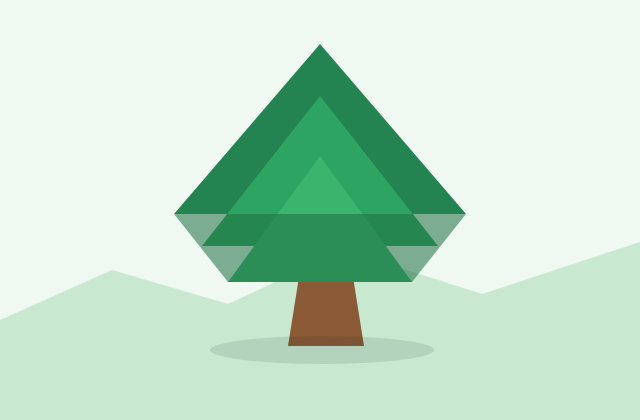
Nature Starter Pack
Low-Poly Pine Tree
A lightweight forest prop with a trunk, two faceted foliage layers and a clean base pivot for scattering.
View details- Triangles
- 24
- Texture
- Flat color
- License
- Commercial use
- Formats
- OBJ
Protected STL download
Production export targets
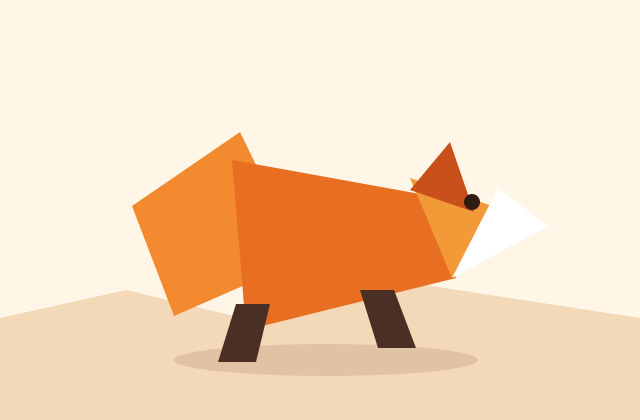
Cozy Animal Pack
Low-Poly Fox
A stylized animal prop for cozy games, woodland scenes and AR previews.
View details- Triangles
- 24
- Texture
- Flat color
- License
- Commercial use
- Formats
- OBJ
Protected STL download
Production export targets
Highlights
- Primary intent: make, reduce, download, or generate a low poly Blender model
- Start with silhouette-first blockouts using cubes, cones, cylinders, and ico spheres
- Use Decimate Collapse for general reduction, Planar for hard-surface flat panels
- Keep Shade Flat for faceted low poly style and fix normals when lighting breaks
- Use one shared 512-1024px atlas for props and 1024-2048px for hero assets
- Export GLB for web and Godot, FBX for Unity and Unreal, OBJ for static interchange
- Generate a Blender-ready base when the blank viewport is the real bottleneck
- Generated assets are user-owned, commercial-safe, and require no attribution
Low poly Blender searches usually come from one of three moments: you want to make a simple stylized model from scratch, you have a dense mesh that needs to become game-ready, or you need a low poly model that can open in Blender right now. The right answer is not only a tutorial and not only a download page. A useful workflow gives you a quick starter asset, a repeatable modeling recipe, polycount targets, shading rules, UV guidance, and export settings for the engine that comes next. Lowpoly3D is designed to cover that whole loop: generate or download a low poly base, inspect it in Blender, simplify or retopologize where needed, then export a clean GLB, FBX, OBJ, STL, or USDZ.
For a from-scratch low poly Blender model, start with the silhouette instead of details. Add a cube, cylinder, cone, or ico sphere and block the subject into a few readable volumes. Keep everything large and angular: a tree can be trunk plus stacked cones, a car can be body plus separate wheels, and a character can be torso, head, limbs, and a few strong accessories. Apply scale early, name objects clearly, and keep the origin at a useful pivot such as the base of a prop or the feet of a character. The model should read correctly in solid viewport mode before you spend time on materials, because low poly style depends on strong shape more than texture complexity.
When you are converting a heavier mesh, Blender’s Decimate modifier is the fastest low poly tool. Collapse mode reduces triangle count by ratio and works well for general props and LODs. Planar mode is better for hard-surface objects with broad flat areas because it removes unnecessary coplanar faces while preserving flat panels. Un-Subdivide can reverse regular subdivision patterns when the source mesh was subdivided cleanly. Decimate is not a replacement for hand retopology on animated characters, faces, or close-up hero assets, but it is excellent for static props, scan cleanup, background assets, and quick prototypes. The practical rule is simple: reduce in steps, check the silhouette after each pass, and stop before the outline starts to collapse.
The classic low poly Blender look comes from faceted lighting. Use Shade Flat when you want visible polygon planes, and reserve Shade Smooth for rounded parts where the mesh actually has enough geometry to support it. If a model looks blobby, it is often smooth shading hiding the planes that make low poly appealing. If it looks broken, recalculate normals, merge doubled vertices, and inspect hard edges. Low poly does not mean careless; clean normals and deliberate edges are what make simple geometry look intentional. For game export, remember that hard edges and split normals can increase vertex count on the GPU, so use them where they improve readability rather than everywhere by habit.
UVs and materials should stay disciplined. A low poly Blender asset often needs only flat material colors, but game projects benefit from one packed texture atlas that keeps draw calls low. Mark seams along natural edges, unwrap or use Smart UV Project for simple props, then pack islands into a 512 to 1024 pixel atlas for small assets or 1024 to 2048 for a hero model. Use flat colors, baked ambient occlusion, or a subtle gradient instead of heavy PBR texture stacks unless the art direction demands them. The goal is a model that looks crisp in Blender and still performs well once hundreds of copies appear in a mobile, WebGL, Unity, Godot, or Unreal scene.
Export format is the last decision. GLB is the best all-purpose format for web, Three.js, Godot, AR previews, and quick Blender round trips because it bundles geometry, materials, and textures in one file. FBX is still the practical choice for Unity and Unreal when hierarchy, pivots, skeletons, and material slots matter. OBJ is universal for static meshes and simple interchange, but it will not carry animation. STL or 3MF is for 3D printing, where you need a watertight mesh and textures are ignored. If you came here because you need the model faster than you can build it manually, open the generator with a Blender-ready prompt, download a seed OBJ, then use Blender for the final cleanup pass.
The biggest low poly Blender mistakes are usually workflow mistakes, not missing features. Beginners often subdivide first and try to remove detail later, smooth every face until the model loses its faceted character, or add a different material to every small part and accidentally create too many draw calls for a game scene. Start lighter than you think, keep one material palette, and duplicate only after the base asset is clean. If the asset is one of many background props, a generated base is usually faster and good enough after a short Blender cleanup. If the asset is a deforming character, a close-up hero weapon, or a model that must match strict art direction, use generation for exploration and then rebuild the final topology by hand.
Low poly Blender workflow
- 1
Pick one target asset
Choose a single subject such as a tree, fox, car, sword, house, or prop. Low poly works best when the silhouette is clear before details are added.
- 2
Block out the silhouette
Use primitive shapes and large angular forms. Apply scale, place the origin at the base or rigging pivot, and keep object names readable.
- 3
Set a triangle budget
Use 200-800 triangles for small props, 1k-5k for mobile or WebGL heroes, and 10k-50k for desktop focal assets that need more detail.
- 4
Simplify or retopologize
Use Decimate for static props and LODs. Retopologize by hand when the mesh deforms, sits near camera, or needs clean animation loops.
- 5
Fix shading and UVs
Use Shade Flat for faceted planes, recalculate normals, merge doubled vertices, unwrap UVs, and pack a simple shared atlas.
- 6
Export the right format
Use GLB for web and Godot, FBX for Unity or Unreal, OBJ for static interchange, and STL or 3MF for 3D printing.
Next paths for low poly Blender users
Frequently asked questions
Is low poly Blender beginner friendly?
Yes. Low poly is one of the best Blender styles for beginners because strong silhouettes, flat shading, and simple materials matter more than complex sculpting. Start with primitives and one subject.
How do I make a model look low poly in Blender?
Use simple angular geometry, Shade Flat for faceted lighting, clean normals, and a limited color palette. Avoid smoothing everything unless a rounded part truly needs it.
Which Blender tool reduces polygon count?
Use the Decimate modifier. Collapse mode reduces by ratio, Planar mode removes coplanar faces on hard-surface objects, and Un-Subdivide can reverse regular subdivision patterns.
Can I use AI-generated low poly models in Blender?
Yes. Generate a model, download GLB, FBX, or OBJ, import it into Blender, then clean normals, simplify topology, unwrap UVs, and export to your engine.
What should I export from Blender?
Export GLB for web, Godot, Three.js, and AR; FBX for Unity and Unreal; OBJ for static interchange; and STL or 3MF for 3D printing.
Related
Browse allNeed a custom low-poly model?
Generate one from a text prompt or reference image, then export GLB, FBX, OBJ or STL.
Open the generator