
Low Poly Models for Blender
Generate low poly models and bring them into Blender to edit, retopologize and re-export. Blender is free, imports GLB, FBX and OBJ, and exports to any engine.
Matching downloadable assets
Start with these seed models, then generate variants in the same low-poly direction.
Members unlock protected STL access
Use the free OBJ to test the shape. Subscribe for protected STL downloads now; GLB, FBX, USDZ and Unity are shown as production export targets, not direct library downloads yet.

Nature Starter Pack
Low-Poly Pine Tree
A lightweight forest prop with a trunk, two faceted foliage layers and a clean base pivot for scattering.
View details- Triangles
- 24
- Texture
- Flat color
- License
- Commercial use
- Formats
- OBJ
Protected STL download
Production export targets
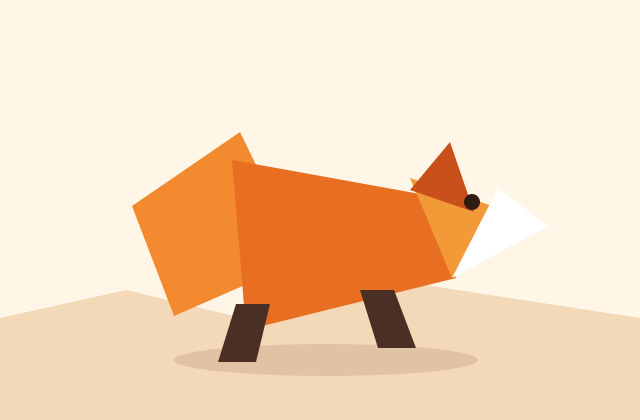
Cozy Animal Pack
Low-Poly Fox
A stylized animal prop for cozy games, woodland scenes and AR previews.
View details- Triangles
- 24
- Texture
- Flat color
- License
- Commercial use
- Formats
- OBJ
Protected STL download
Production export targets
Highlights
- Import GLB, FBX or OBJ into Blender, each free with File then Import.
- Recalculate normals and merge doubled vertices to fix shading on generated meshes.
- Use the Decimate modifier in Collapse or Planar mode to hit an exact triangle budget.
- Retopologize by hand when you need clean, animation friendly edge flow.
- Target 1,000 to 5,000 triangles for web and mobile, 200 to 800 for props.
- Unwrap UVs and pack into one shared 512 to 1024 pixel atlas with flat colors.
- Export GLB for web, FBX for Unity and Unreal, OBJ universal, STL or 3MF for printing.
- Blender is free and AI generated models are user owned, commercial safe, no attribution.
Blender is the free hub where generated low poly models go to be refined, and it reads every common format. Use File then Import to bring in a GLB, which arrives self contained with geometry, materials and textures, or an FBX, which preserves hierarchy and any skeleton, or an OBJ for a simple static mesh with no animation. Once the model is in the viewport you have the full Blender toolset to inspect topology, fix shading, adjust scale and reorganize the object before it ever touches an engine. Because Blender is the lingua franca of 3D, it is the natural place to clean up a generated asset and prepare it for delivery.
Editing a generated model in Blender starts with checking the mesh. Enter Edit Mode to look at the wireframe, recalculate normals with Shift N so faces light correctly, and merge any stray doubled vertices that can cause shading artifacts. If the generated mesh is denser than you want, retopology brings the polycount down deliberately. You can retopologize by hand for a clean, animation friendly edge flow, or for speed apply the Decimate modifier set to Collapse and dial the ratio until the silhouette holds at a lower triangle count. Decimate is the fastest path from a heavy mesh to a true low poly model, and the Planar mode is excellent for flattening coplanar faces on hard surface props.
Polycount targets in Blender depend on where the model is going. For mobile or web export aim for 1,000 to 5,000 triangles on a hero and 200 to 800 on props, for desktop and console you can carry 10,000 to 50,000 triangles on a focal mesh and up to 20,000 on a hero, and for 3D printing the rules invert because you need a watertight, manifold mesh rather than a low count. Blender shows live face and triangle stats in the viewport overlay, so you can decimate to an exact budget. Keeping a few resolution variants lets you export an LOD chain from one source file.
UV unwrapping is where a low poly model earns its clean look, and Blender makes it straightforward. Mark seams along natural edges, then use Unwrap or Smart UV Project to lay the faces flat, and pack the islands into a single shared atlas, 512 to 1024 pixels for props and 1024 to 2048 for a hero. For the classic low poly aesthetic you often do not need a painted texture at all, just assign flat color materials or bake a gradient ramp into the atlas so every object reads as crisp solid faces. A single atlas keeps draw calls low in whatever engine receives the model, which is the whole point of the cleanup pass.
Exporting back out of Blender is the final step and the format depends on the destination. Export GLB for the web, Three.js, Godot or AR because it bundles everything into one file, export FBX for Unity or Unreal to keep hierarchy, pivots, slots and skeleton, export OBJ for a universal static mesh, or export STL or 3MF for 3D printing where the mesh must be watertight and textures are ignored. Apply transforms before export so scale and rotation bake cleanly, and the model lands in the target engine exactly as you intend. Blender is a free tool and the AI generated models you refine in it are fully owned by you, commercial safe and free of attribution.
A rich addon ecosystem makes Blender even more powerful for low poly work. Hard Ops and BoxCutter speed up hard surface blocking, the built in LoopTools helps with clean edge flow, and batch exporters can push a whole kit to GLB or FBX in one click. None of this requires a paid license, and the generated assets you process carry no strings. The practical loop is to generate the model, import GLB or FBX, recalculate normals, decimate or retopologize to budget, unwrap and pack a shared atlas, assign flat materials, apply transforms, and export the right format for your engine, free from prompt to finished asset.
Continue the Blender pipeline
Frequently asked questions
Which formats can Blender import for low poly work?
Blender imports GLB with materials and textures bundled in, FBX with hierarchy and skeleton preserved, and OBJ for a simple static mesh. Use File then Import, and from there you have the full toolset to edit, retopologize and re-export.
How do I reduce the polycount of a generated model?
Apply the Decimate modifier in Collapse mode and lower the ratio until the silhouette holds at the triangle count you want, or use Planar mode to flatten coplanar faces. For animation friendly edge flow, retopologize by hand instead.
Do I need to paint textures for a low poly model in Blender?
Often not. The classic low poly look works with flat color materials or a baked gradient ramp packed into a single shared atlas. Unwrap UVs, pack the islands, and every face reads as a crisp solid color, which also keeps draw calls low.
What format should I export from Blender for my engine?
Export GLB for the web, Three.js, Godot or AR, FBX for Unity or Unreal to keep hierarchy and skeleton, OBJ for a universal static mesh, and STL or 3MF for 3D printing where the mesh must be watertight. Apply transforms before exporting.
Is it free to use Blender with these models?
Yes. Blender is free and open source, and the AI generated models you refine in it are fully owned by you, safe for commercial use and free of attribution requirements. The entire pipeline from prompt to finished asset has no cost.
Related
Browse allNeed a custom low-poly model?
Generate one from a text prompt or reference image, then export GLB, FBX, OBJ or STL.
Open the generator