
Low Poly Models for Roblox
Generate low poly models for Roblox and import them into Studio as MeshParts. Stay under the per mesh triangle limit, scale in studs and pass moderation.
Matching downloadable assets
Start with these seed models, then generate variants in the same low-poly direction.
Members unlock protected STL access
Use the free OBJ to test the shape. Subscribe for protected STL downloads now; GLB, FBX, USDZ and Unity are shown as production export targets, not direct library downloads yet.

Nature Starter Pack
Low-Poly Pine Tree
A lightweight forest prop with a trunk, two faceted foliage layers and a clean base pivot for scattering.
View details- Triangles
- 24
- Texture
- Flat color
- License
- Commercial use
- Formats
- OBJ
Protected STL download
Production export targets
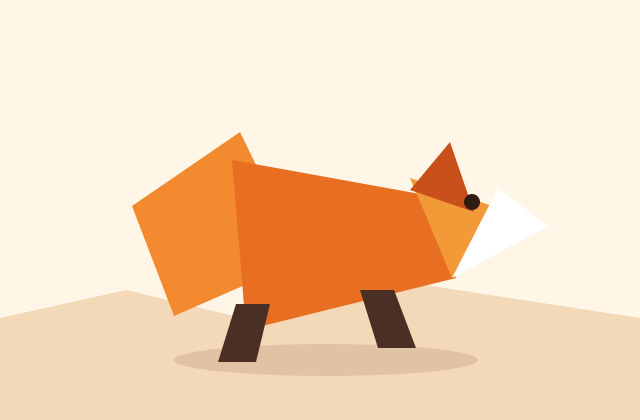
Cozy Animal Pack
Low-Poly Fox
A stylized animal prop for cozy games, woodland scenes and AR previews.
View details- Triangles
- 24
- Texture
- Flat color
- License
- Commercial use
- Formats
- OBJ
Protected STL download
Production export targets
Highlights
- Import to Roblox Studio with the 3D Importer using FBX or OBJ, FBX preferred.
- Stay under the hard 10,000 triangle limit per MeshPart, ideal for low poly props.
- Split complex objects into multiple grouped MeshParts each under the limit.
- Scale in studs, where one stud is about 0.28 meters and an avatar is roughly five studs.
- Upload textures separately and set the asset ID on the MeshPart TextureID property.
- Use one shared flat color atlas of 512 to 1024 pixels per kit to minimize uploads.
- Tint with the MeshPart Color property for quick variants without re-uploading.
- Keep models clean for moderation, and AI generated assets are user owned and commercial safe.
Roblox brings external 3D models in as MeshParts, and Roblox Studio is where the whole process happens. To import, open Studio, use the 3D Importer from the Avatar or Model tab, and select your model file. Roblox accepts FBX and OBJ, with FBX preferred because it can carry the mesh, its pivot and basic material data, while OBJ works for a simple static mesh without animation. The importer previews the asset, reports its triangle count and lets you confirm the scale before it becomes a MeshPart in your place. From there it behaves like any Roblox part you can position, anchor and script.
The single rule you cannot ignore on Roblox is the per mesh triangle limit. A single MeshPart is capped at 10,000 triangles, and the importer will reject or split anything over that ceiling, so your low poly model must come in under it. This is exactly where low poly art shines, because a flat shaded prop at a few hundred to a couple thousand triangles fits comfortably with room to spare. If you have a complex object, split it into multiple MeshParts each under the limit and group them, which also lets you reuse and instance pieces. Keeping meshes lean is not just a guideline here, it is a hard platform constraint.
Scale on Roblox is measured in studs, and getting it right at import time saves a lot of repositioning later. One stud is roughly 0.28 meters, and a standard Roblox character is around five studs tall, so size your generated model against that reference before you import. The 3D Importer lets you set a scale multiplier, and you can also resize the MeshPart afterward, but matching real proportions up front keeps a kit consistent. A door, a chair and a tree all need to read at human scale next to an avatar, so think in studs from the start and your low poly set drops into a place looking correct.
Textures on Roblox are uploaded separately and applied through the MeshPart properties. After import you upload your texture image to Roblox, which assigns it an asset ID, then set that ID on the TextureID property of the MeshPart. For the low poly look a single shared atlas of flat colors works beautifully, 512 to 1024 pixels is plenty, and because the faces are solid colors the texture compresses well and reads crisply at any distance. You can also tint a MeshPart with its Color property for quick variants without a new upload. Keeping one atlas per kit minimizes uploads and keeps the asset library tidy.
Roblox has a UGC pipeline and a moderation system you should design for from the beginning. User generated content like accessories and items can be created and, with the right program access, published to the Marketplace, so a low poly model can become a wearable or a sellable item. Everything uploaded to Roblox passes through automated and human moderation, which checks for inappropriate content, so keep your generated models clean and on theme. Because the assets you generate are AI created and fully owned by you, they are safe to upload and use commercially within Roblox with no attribution required, as long as they meet the platform community standards.
A reliable Roblox loop is to generate the model, confirm it is under 10,000 triangles, export FBX or OBJ, and run it through the Studio 3D Importer. Set the scale in studs against an avatar reference, upload a flat color atlas and assign its TextureID, then anchor or weld the MeshPart into your build. Split anything too dense into grouped MeshParts, test how it reads next to a character, and submit UGC items through the proper channel so they clear moderation. The result is a low poly kit that fits the Roblox platform exactly, from triangle budget to studs to the asset pipeline.
Build your Roblox item library
Frequently asked questions
How do I import a model into Roblox?
Open Roblox Studio, use the 3D Importer from the Avatar or Model tab, and select an FBX or OBJ file. FBX is preferred because it carries the mesh, pivot and basic material data. The importer previews the asset and reports its triangle count before it becomes a MeshPart.
What is the triangle limit for a Roblox mesh?
A single MeshPart is capped at 10,000 triangles, and the importer rejects or splits anything over that. Low poly props at a few hundred to a couple thousand triangles fit easily, and complex objects should be split into multiple grouped MeshParts under the limit.
How do I scale models correctly for Roblox?
Roblox measures in studs, where one stud is about 0.28 meters and a standard avatar is roughly five studs tall. Size your model against that reference, set a scale multiplier in the 3D Importer, and your kit will read at human scale next to a character.
How do textures work on imported Roblox meshes?
Upload the texture image to Roblox separately to get an asset ID, then set that ID on the MeshPart TextureID property. A single flat color atlas of 512 to 1024 pixels works well for low poly, and the Color property can tint a part for quick variants.
Can I publish these models as Roblox UGC?
Yes, through the UGC pipeline with the right program access, since AI generated assets are fully owned by you and commercial safe with no attribution required. Everything passes Roblox moderation, so keep models clean and on theme to clear review.
Related
Browse allNeed a custom low-poly model?
Generate one from a text prompt or reference image, then export GLB, FBX, OBJ or STL.
Open the generator