
Cartoon Low Poly Models
Bring playful, expressive worlds to life with cartoon low poly models built for exaggerated proportions, flat bright colors, and bold toon shading.
Matching downloadable assets
Start with these seed models, then generate variants in the same low-poly direction.
Members unlock protected STL access
Use the free OBJ to test the shape. Subscribe for protected STL downloads now; GLB, FBX, USDZ and Unity are shown as production export targets, not direct library downloads yet.
Cozy Animal Pack
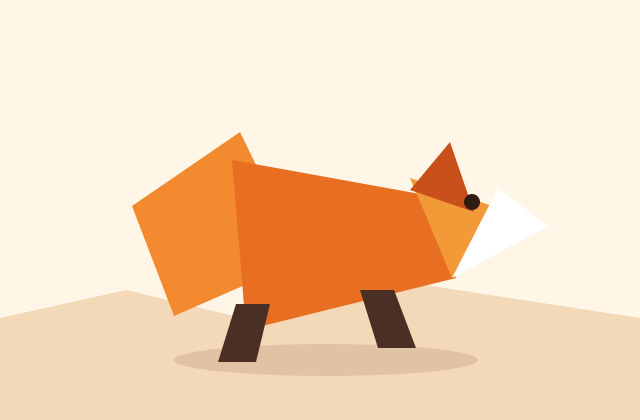
Low-Poly Fox
A stylized animal prop for cozy games, woodland scenes and AR previews.
View details- Triangles
- 24
- Texture
- Flat color
- License
- Commercial use
- Formats
- OBJ
Protected STL download
Production export targets

Nature Starter Pack
Low-Poly Pine Tree
A lightweight forest prop with a trunk, two faceted foliage layers and a clean base pivot for scattering.
View details- Triangles
- 24
- Texture
- Flat color
- License
- Commercial use
- Formats
- OBJ
Protected STL download
Production export targets
Highlights
- Exaggerated playful proportions like big heads and stubby limbs for instant charm
- Flat bright saturated colors that read clearly on any screen
- Single color materials with little or no texture detail to minimize draw calls
- Toon or cel shading that collapses lighting into a few hard bands
- Bold black outlines that make forms pop like a drawn cartoon
- Very low polycounts ideal for mobile, from 200 triangle props to 5000 triangle characters
- Export to GLB, FBX, OBJ, STL, or USDZ for web, engine, AR, or toy printing
- User owned models, free for commercial use with no attribution required
Cartoon low poly is the most performance friendly and broadly appealing style in 3D. It leans on the timeless language of animation: exaggerated proportions, flat bright colors, and clean shapes that read instantly on any screen. Big heads, small bodies, oversized hands, and expressive features turn even a simple mesh into a character with personality. Our generator is tuned to produce that lively, toon shaded look, giving you characters, props, and environments that feel like they stepped out of a Saturday morning cartoon.
Exaggeration is the heart of the cartoon style. Push proportions well beyond realism to amplify charm and readability, a hero with a head as large as the torso, stubby limbs, and a confident pose. Round off shapes so silhouettes stay friendly, and simplify anatomy to the essentials. Because the style is so forgiving, you can keep triangle counts very low while still delivering expressive, lovable characters, which is exactly why it dominates mobile and casual games.
Color and shading define the look more than geometry does. Use flat, bright, highly saturated colors and lean on single color materials with little or no texture detail. This keeps draw calls minimal and the art direction crisp. Apply toon shading, also called cel shading, which collapses lighting into a few hard bands instead of smooth gradients, then add a bold black outline around forms so they pop like a drawn cartoon. The outline is usually an inverted hull or a post process edge, and it instantly upgrades a plain low poly mesh into something stylized and intentional.
Because cartoon assets rely on flat color, you can often skip textures entirely and assign solid material colors per object, which is the cheapest possible setup for mobile and web. When you do want a little variation, a tiny 256 to 512 pixel atlas with simple flat regions is plenty. There is no need for normal maps, roughness maps, or physically based shading, since the toon shader and outline carry the entire aesthetic. This makes cartoon low poly extremely fast to produce and effortless to run on low end hardware.
For polycounts, cartoon assets stay lean. Mobile and WebGL props sit between 200 and 800 triangles, full characters around 1000 to 5000 triangles, and a detailed hero up to 20000 triangles only when a project can afford it. Use LODs in busy scenes so background characters drop to simpler meshes. Export GLB for web, Three.js, Godot, and AR since it bundles geometry, flat materials, and any small textures into one file. Use FBX for Unity and Unreal to preserve hierarchy, pivots, material slots, and skeletal animation. OBJ suits static props, STL or 3MF cover 3D printing of toys and figures, and USDZ handles iOS AR Quick Look.
Cartoon low poly models are the go to choice for mobile games, hyper casual titles, educational apps, animated shorts, advertising mascots, and any project that wants instant charm with minimal performance cost. The bright, friendly look reads across all ages and cultures, which makes it a safe bet for mass market reach. Every model you generate is yours to own and use commercially with no attribution required, so you can populate a whole cartoon world with matching characters and props and ship it freely.
Ship a cartoon character
Frequently asked questions
What makes the cartoon low poly style?
Exaggerated proportions, flat bright saturated colors, toon or cel shading that bands the lighting, and a bold outline around forms. The geometry can stay simple because shading and color do the heavy lifting.
Do cartoon models need textures?
Usually not. Flat single color materials look great and keep draw calls minimal, which is ideal for mobile. If you want variation, a tiny 256 to 512 pixel atlas with flat regions is enough.
How do I get the cartoon outline effect?
Outlines are typically an inverted hull around the mesh or a post process edge detection pass. Either approach draws a bold border that makes the model read like a drawn cartoon.
What polycount works for a mobile game?
Props sit at 200 to 800 triangles and full characters at 1000 to 5000 triangles. Use LODs so background characters drop to simpler meshes in crowded scenes, keeping frame rates high.
Can I sell games made with these cartoon models?
Yes. Every model you generate is yours to own and use commercially with no attribution required, so you can ship them in paid mobile and casual games freely.
Related
Browse allNeed a custom low-poly model?
Generate one from a text prompt or reference image, then export GLB, FBX, OBJ or STL.
Open the generator