
Isometric Low Poly Assets
Isometric low poly is less a subject and more a viewing angle, a self-contained scene built to be seen from one fixed 2:1 camera position, which makes it the natural style for strategy games, city builders and the single-scene diorama pieces that dominate low poly portfolios.
Matching downloadable assets
Start with these seed models, then generate variants in the same low-poly direction.
Members unlock protected STL access
Use the free OBJ to test the shape. Subscribe for protected STL downloads now; GLB, FBX, USDZ and Unity are shown as production export targets, not direct library downloads yet.
Village Starter Pack
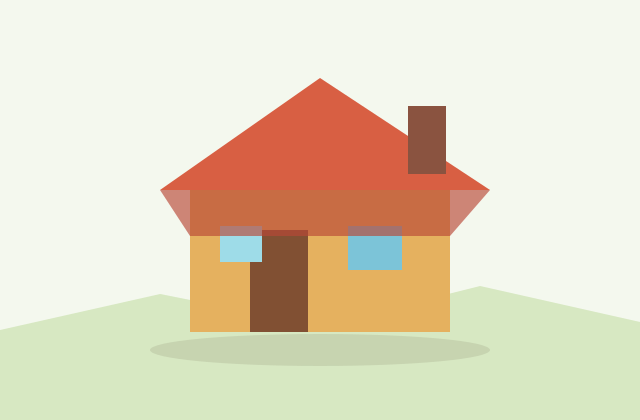
Low-Poly Cottage House
A compact village building for cozy sims, isometric towns and stylized environment blocking.
View details- Triangles
- 18
- Texture
- Flat color
- License
- Commercial use
- Formats
- OBJ
Protected STL download
Production export targets

Nature Starter Pack
Low-Poly Pine Tree
A lightweight forest prop with a trunk, two faceted foliage layers and a clean base pivot for scattering.
View details- Triangles
- 24
- Texture
- Flat color
- License
- Commercial use
- Formats
- OBJ
Protected STL download
Production export targets
Highlights
- Use orthographic projection at roughly a 30-35 degree tilt, not perspective, to get true flat isometric readability
- Detail only the top and two visible side faces; simplify or delete hidden underside geometry
- Compose on a circular or square base plate as one self-contained diorama image
- Use tile-based grids (one unit = one cell) so pieces snap into larger strategy-game maps
- Bake ambient occlusion and one fixed directional key light rather than using real-time lighting
- Small props: 100-500 tris; single building: 500-2,500 tris; full diorama: 3,000-15,000 tris total
- GLB for web portfolios, Three.js and Godot; FBX for Unity/Unreal strategy-game tile systems
- Generated assets are yours to use commercially, no attribution required
True isometric in games almost always means a 2:1 dimetric projection rather than mathematically true isometric, because a 2:1 pixel ratio keeps horizontal and vertical edges crisp on a screen grid, which is why classic strategy and city-builder games standardized on it long before 3D dioramas existed. For a 3D isometric scene the practical takeaway is the same: fix your camera at roughly a 30 to 35 degree downward tilt with orthographic projection rather than perspective, so parallel lines stay parallel and distant objects do not shrink, which is what gives isometric renders their distinctive flat, map-like readability.
Because the camera angle is fixed and known in advance, an isometric low poly asset can cheat in ways a freely-rotatable model cannot. Detail the top and the two visible side faces generously since that is genuinely all the viewer will ever see, and simplify or outright delete geometry on the hidden underside and back faces, which saves real triangles without any visible cost. This is also why isometric dioramas are unusually forgiving for beginners and unusually cheap to render at scale: a whole city built this way can hide an enormous amount of unseen geometry behind the fixed camera constraint.
Composition matters more here than in almost any other low poly style, because an isometric piece is judged as a single self-contained image rather than as an asset seen in motion from arbitrary angles. Build scenes on a circular or square base plate that reads as a complete diorama, and stage a clear visual hierarchy: one tall or bright focal element the eye lands on first, supporting mid-ground elements, and small background details that reward a closer look without competing with the silhouette. Tile-based grids, one unit equals one grid cell, make this staging fast and let individual buildings, roads and props snap together into larger strategy-game maps later.
Lighting an isometric scene almost always means baking rather than relying on real-time light, because the fixed camera angle means you only ever need to get the lighting right from one direction. Bake ambient occlusion into a shared atlas so contact shadows sit naturally where buildings meet the ground and where props cluster together, and add a single warm or cool directional key light baked to match your fixed camera tilt. This combination of flat-shaded faces plus baked occlusion plus one strong bake light is what gives isometric low poly its characteristic warm, crafted, snow-globe quality, and it costs nothing at runtime since none of it is a real light.
Polycount stays modest across the whole style: small props at 100 to 500 triangles, a single building at 500 to 2,500, and a full diorama scene assembled from many such pieces at 3,000 to 15,000 triangles total, since isometric scenes are almost always viewed at a middle distance rather than close up, which means fine surface detail earns very little visual return. Export GLB for web portfolios, Three.js configurators and Godot, since it bundles the whole diorama including baked textures into one file; export FBX for Unity or Unreal strategy-game prototypes where hierarchy and pivots for a tile-grid system matter. Everything generated here is yours to use commercially with no attribution required, so a strategy game, a city builder, or a portfolio-piece diorama built from these assets ships free of any licensing question.
Build a full isometric scene
Frequently asked questions
What camera angle counts as isometric for a low poly scene?
Use orthographic projection with roughly a 30-35 degree downward tilt (a 2:1 dimetric angle in practice, matching classic strategy games), not perspective, so parallel lines stay parallel and the scene reads as flat and map-like.
Why is isometric low poly cheaper to make than a freely-rotatable model?
Because the camera angle is fixed, you only need to detail the top and two visible side faces. The hidden underside and back geometry can be simplified or deleted entirely with zero visible cost, which is a real triangle-count saving.
Should I use real-time lighting or baked lighting for an isometric diorama?
Bake it. Since the camera angle never changes, ambient occlusion and a single directional key light baked into a shared atlas give the classic warm, crafted isometric look at zero runtime cost.
What polycount should an isometric diorama scene use?
Small props run 100 to 500 triangles, a single building 500 to 2,500, and a full assembled diorama scene typically totals 3,000 to 15,000 triangles, since middle-distance viewing makes fine detail a poor use of budget.
Can I use isometric assets in a commercial strategy game?
Yes. Everything generated here is yours to own and use commercially, including in a shipped strategy game, city builder, or portfolio piece, with no attribution required.
Related
Browse allNeed a custom low-poly model?
Generate one from a text prompt or reference image, then export GLB, FBX, OBJ or STL.
Open the generator