
Low Poly Anime Character Style
Low poly anime style is a specific, recognizable visual language, not just 'cartoon but faceted' — it borrows cel-shaded flat lighting ramps, bold graphic outlines and oversized expressive eyes directly from 2D anime art, then translates those exact conventions into a stylized 3D mesh, which is why it reads completely differently from the rounder, exaggerated-proportion Western cartoon look covered elsewhere on this site.
Matching downloadable assets
Start with these seed models, then generate variants in the same low-poly direction.
Members unlock protected STL access
Use the free OBJ to test the shape. Subscribe for protected STL downloads now; GLB, FBX, USDZ and Unity are shown as production export targets, not direct library downloads yet.
Cozy Animal Pack
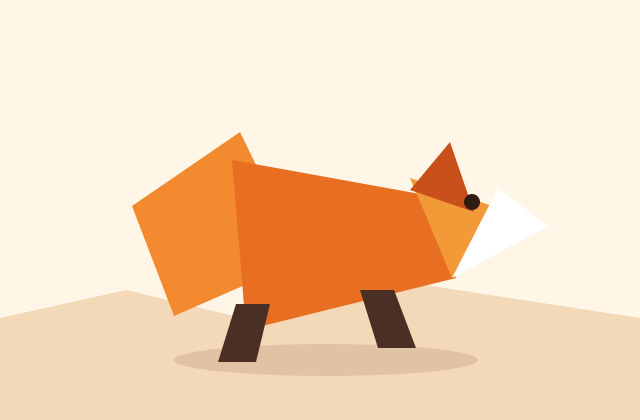
Low-Poly Fox
A stylized animal prop for cozy games, woodland scenes and AR previews.
View details- Triangles
- 24
- Texture
- Flat color
- License
- Commercial use
- Formats
- OBJ
Protected STL download
Production export targets

Nature Starter Pack
Low-Poly Pine Tree
A lightweight forest prop with a trunk, two faceted foliage layers and a clean base pivot for scattering.
View details- Triangles
- 24
- Texture
- Flat color
- License
- Commercial use
- Formats
- OBJ
Protected STL download
Production export targets
Highlights
- Cel-shading uses 2-3 hard-edged flat tone bands (base, shadow, rim-light) instead of a smooth gradient
- Unity URP's built-in Toon Shader package or a custom quantized dot-product node drives the flat shading bands
- Outlines use an inverted-hull duplicate mesh or post-process edge detection, roughly doubling outlined triangle count
- Hair built as 300-1,200 triangles of large flat "wedge" clumps, not individual strands
- Eyes are oversized flat planes with iris, catchlight and lash detail baked into a texture, not modeled
- Mobile/avatar target: 6,000-15,000 triangles; desktop hero character: 15,000-30,000
- One or two material slots (body + face/eye) keeps draw calls and avatar performance rank favorable
- FBX for Unity/Unreal, GLB for Godot/Three.js; import or build a toon shader on the receiving end
Cel-shading is the core technique that separates this style from every other low poly character page here. Instead of the smooth continuous light-to-dark gradient a realistic or generic cartoon material uses, anime-style shading is built from 2 to 3 hard-edged flat tone bands, a base color, a shadow color roughly one or two steps darker, and occasionally a rim-light band, with a sharp visible line between them rather than a blend. In a real-time engine this is usually achieved with a toon ramp sampled by the light angle (Unity's URP ships a built-in Toon Shader package for exactly this, and Unreal implements it via a custom material function that quantizes the dot-product lighting term into steps), so building the character's low poly geometry with clean, distinct large flat faces actually helps the cel-shading read cleanly, since the shading bands align naturally with the model's own facets rather than fighting them.
Outlines are the second signature element. Anime style relies on a bold, consistent-width black or dark outline around the character's silhouette and major interior edges, eyes, hair clumps, clothing seams, most commonly achieved with an inverted-hull technique: a slightly scaled-up duplicate of the mesh rendered back-face-only in solid black behind the real model, or a post-process edge-detection pass in engines that support it. For a low poly base mesh, keep the outline shell's extra geometry lightweight, since it roughly doubles the triangle count of whatever gets outlined, and make sure normals are clean and consistent, since a bad normal on the outline shell shows up as a visible gap or spike in the line.
Hair and eyes carry most of the recognizability. Anime hair is built as a small number of large, flat-shaded "wedge" or "spike" clumps rather than individual strands, which keeps the triangle count low, a full anime hairstyle typically runs 300 to 1,200 triangles, while still reading as voluminous hair from a normal viewing distance, and the same cel-shaded ramp and outline treatment applies to the hair clumps as to the body. Eyes are oversized relative to a realistic human proportion and are usually a flat or slightly curved plane with a baked texture carrying the iris detail, catchlight highlights and eyelash line work directly in the texture rather than as separate geometry, since baking that detail into a 512px eye texture is far cheaper than modeling it.
Polycount and platform budget scale differently here than for a generic character. A mobile or VRChat-adjacent anime character generally targets 6,000 to 15,000 triangles, since the flat cel-shaded faces and simplified hair wedges are already efficient, while a desktop hero character for a visual-novel-style game or a cinematic can run higher, 15,000 to 30,000, mostly spent on cloth folds and additional hair detail rather than the face. Keep the whole character on one or two shared material slots, body plus a separate face and eye material is common since the eye texture needs its own UV space, so draw calls stay low, which matters even more for VRChat where material count directly affects an avatar's performance rank.
Export FBX to carry the skeleton and any toon-shader-driving blend shapes into Unity or Unreal, or GLB for Godot, Three.js and web showcases. Either format preserves the flat cel-shaded base colors correctly, though the actual toon-ramp shading itself is usually reconstructed by a shader in your engine rather than baked into the texture, so plan to set up or import a toon shader on the receiving end rather than expecting the flat-shaded export alone to look cel-shaded without one. Keep clean edge loops at the neck, shoulders and hip if the character will be rigged for VRChat or a game, exactly as with any other low poly character base.
An anime-style original character you generate here is yours outright, so publishing it as a public VRChat avatar, a personal social-media OC, or a paid character commission is fine with no attribution required, and the same cel-shaded, low-triangle discipline that keeps it lightweight in a game engine is exactly what earns it a strong performance rank in avatar-hosting platforms too.
Build and ship the character
Frequently asked questions
How is low poly anime style different from the generic cartoon style?
Anime style specifically borrows cel-shaded hard-edged tone bands, bold graphic outlines and oversized flat-plane eyes from 2D anime art, while a generic cartoon style leans on rounder, more exaggerated proportions without those specific 2D shading conventions.
How do I get the flat cel-shaded look in my engine?
Use a toon shader that quantizes lighting into 2-3 hard bands rather than a smooth gradient. Unity's URP has a built-in Toon Shader package for this; Unreal typically needs a custom material function. The exported low poly color texture is the base layer the toon shader shades.
How are the outlines made?
Most commonly an inverted-hull technique: a slightly scaled-up duplicate of the mesh rendered as solid black, back-faces only, behind the real model. This roughly doubles the outlined mesh's triangle count, so budget for it.
What polycount should an anime character target?
6,000 to 15,000 triangles for mobile or an avatar-bound character, and 15,000 to 30,000 for a desktop hero character in a visual-novel-style or cinematic context, mostly spent on cloth and hair rather than the face.
Can I use a generated anime character as my avatar or sell it?
Yes. The character is yours to use commercially with no attribution required, whether as a public avatar, a personal OC, or a paid commission.
Related
Browse allNeed a custom low-poly model?
Generate one from a text prompt or reference image, then export GLB, FBX, OBJ or STL.
Open the generator