
Low Poly Assets for Unreal Engine 5
Generate low poly models for Unreal Engine 5. FBX import, sensible LODs, material instances and collision, with a clear note on when low poly does not need Nanite.
Matching downloadable assets
Start with these seed models, then generate variants in the same low-poly direction.
Members unlock protected STL access
Use the free OBJ to test the shape. Subscribe for protected STL downloads now; GLB, FBX, USDZ and Unity are shown as production export targets, not direct library downloads yet.

Nature Starter Pack
Low-Poly Pine Tree
A lightweight forest prop with a trunk, two faceted foliage layers and a clean base pivot for scattering.
View details- Triangles
- 24
- Texture
- Flat color
- License
- Commercial use
- Formats
- OBJ
Protected STL download
Production export targets
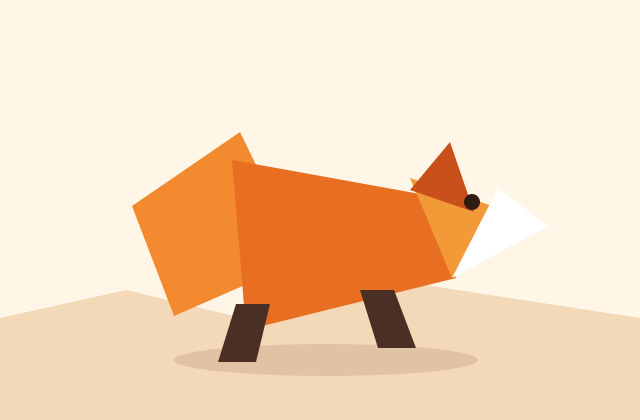
Cozy Animal Pack
Low-Poly Fox
A stylized animal prop for cozy games, woodland scenes and AR previews.
View details- Triangles
- 24
- Texture
- Flat color
- License
- Commercial use
- Formats
- OBJ
Protected STL download
Production export targets
Highlights
- Import FBX into UE5 to carry hierarchy, pivots, slots, collision and skeleton through.
- Skip Nanite for low poly meshes, since simple geometry renders cheaply without it.
- Use traditional LODs, auto generated or hand authored, with screen size thresholds.
- Build one master material and spawn material instances per asset for low shader cost.
- Pair instanced materials with a shared 512 to 1024 pixel flat color atlas.
- Generate simple collision or author UCX hulls instead of per triangle collision.
- Use Lumen and a post process volume for soft stylized lighting on flat faces.
- AI generated assets are user owned, commercial safe and need no attribution.
Unreal Engine 5 imports FBX as its primary mesh format, and FBX is the right choice for a low poly asset because it carries the transform hierarchy, pivots, named material slots, collision meshes and any skeleton or animation through into the editor. When you drag an FBX into the Content Browser, the FBX Import Options dialog appears and lets you decide how much of that data UE5 should bring in. GLB and OBJ can be imported with plugins or the Interchange pipeline, but FBX remains the path of least resistance for static meshes, skeletal meshes and modular kits where slot names and pivots matter.
The most important UE5 specific decision for low poly art is whether to use Nanite at all, and the honest answer is usually no. Nanite is a virtualized geometry system built for film grade meshes with millions of triangles, and it shines when you import dense photoscanned rocks or hero props. A low poly asset at a few thousand triangles gains little from Nanite and in some cases costs more overhead than it saves, because traditional rendering of simple meshes is already extremely cheap. For flat shaded low poly content, leave Nanite disabled and rely on traditional LODs instead, which keeps the pipeline simple and the look intact.
Traditional LODs are how you scale a low poly scene in UE5. In the Static Mesh editor you can let the engine auto generate LOD levels with a reduction percentage per level, or import your own LOD meshes for full control over how the silhouette simplifies. For a hero around 10,000 to 20,000 triangles, three or four LODs that drop to a few hundred triangles in the distance keep draw distance cheap, while props at 200 to 800 triangles may need only one or two levels. Set screen size thresholds so the swap happens off camera, and the stylized look holds up at every range without the cost of Nanite.
Materials in UE5 are built around the master material and material instance pattern, which is ideal for low poly kits. Create one master material with parameters for base color, a flat or gradient texture sample and a small amount of roughness, then spawn material instances that only change those parameters per asset. This means dozens of props share one compiled shader and differ only in their atlas reference or tint, which keeps shader complexity and draw cost low. A single shared atlas, 512 to 1024 pixels for props and 1024 to 2048 for a hero, painted with flat colors or baked gradients, pairs perfectly with instanced materials for a clean stylized result.
Collision is the part teams most often forget on imported assets. In the FBX Import Options you can ask UE5 to generate simple collision, or you can author a low poly collision hull named with the UCX prefix in your source tool so UE5 picks it up automatically. For most low poly props a few box or capsule primitives are far cheaper than per triangle collision and behave better in physics. Set the collision complexity to use simple collision for queries and reserve complex collision for cases that truly need it. Getting this right early prevents characters from clipping through your stylized world later.
The stylized strength of UE5 is what makes low poly assets sing here. Lumen gives you dynamic global illumination that wraps soft bounce light around flat low poly faces, and a post process volume lets you push color, bloom and a slight outline for a storybook feel. Because the assets you generate are AI created they are fully owned by you, safe for commercial games shipped on any platform and free of attribution, so you can build a whole stylized UE5 world from generated kits. The loop is simple: generate, export FBX, import with simple collision, build traditional LODs, skip Nanite, and drive everything from instanced materials over a shared atlas.
Round out your UE5 pipeline
Frequently asked questions
Do low poly assets need Nanite in UE5?
Usually no. Nanite is virtualized geometry built for meshes with millions of triangles. A low poly asset at a few thousand triangles gains little and can cost extra overhead, so leave Nanite disabled and use traditional LODs instead. The simple meshes already render very cheaply.
What format should I import into Unreal Engine 5?
Use FBX. It carries the transform hierarchy, pivots, named material slots, collision meshes and skeleton into the editor through the FBX Import Options dialog. GLB and OBJ work via plugins or Interchange, but FBX is the path of least resistance.
How do I set up LODs for a low poly mesh?
In the Static Mesh editor either auto generate LOD levels with a reduction percentage each, or import your own LOD meshes. Give a hero three or four levels and props one or two, then set screen size thresholds so the swap happens off camera.
How should I handle materials for a low poly kit?
Create one master material with base color, texture and roughness parameters, then spawn material instances that change only those values per asset. Dozens of props then share one compiled shader and differ only by atlas or tint, keeping draw cost low.
Can I ship a commercial UE5 game with these assets?
Yes. AI generated assets are fully owned by you, safe for commercial release on any platform and free of attribution requirements. You can build an entire stylized UE5 world from generated kits without licensing concerns.
Related
Browse allNeed a custom low-poly model?
Generate one from a text prompt or reference image, then export GLB, FBX, OBJ or STL.
Open the generator