
Image to Low Poly 3D Model Converter
Upload a single reference image and the AI reconstructs a clean low poly mesh with matching textures, turning concept art or a photo into a model you can export and edit.
Matching downloadable assets
Start with these seed models, then generate variants in the same low-poly direction.
Members unlock protected STL access
Use the free OBJ to test the shape. Subscribe for protected STL downloads now; GLB, FBX, USDZ and Unity are shown as production export targets, not direct library downloads yet.
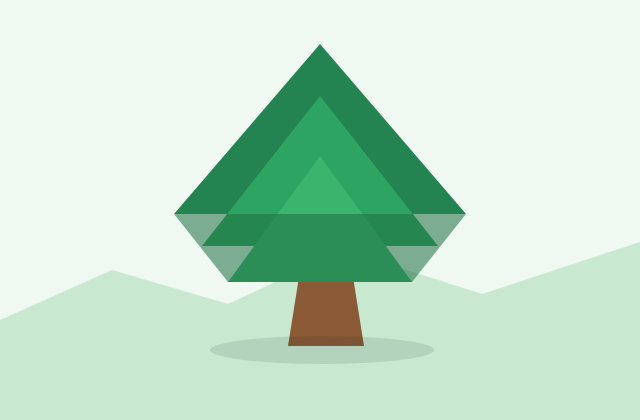
Nature Starter Pack
Low-Poly Pine Tree
A lightweight forest prop with a trunk, two faceted foliage layers and a clean base pivot for scattering.
View details- Triangles
- 24
- Texture
- Flat color
- License
- Commercial use
- Formats
- OBJ
Protected STL download
Production export targets
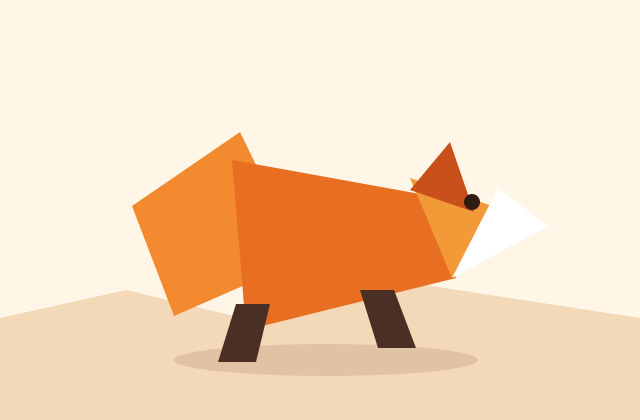
Cozy Animal Pack
Low-Poly Fox
A stylized animal prop for cozy games, woodland scenes and AR previews.
View details- Triangles
- 24
- Texture
- Flat color
- License
- Commercial use
- Formats
- OBJ
Protected STL download
Production export targets
Highlights
- Feed one clean, well-lit, centered subject on a plain background for best results
- Prefer a three-quarter angle over a flat front view so the AI reads real depth
- Retopologize and decimate the reconstruction toward a tidy game-ready mesh
- Hold 1k to 5k tris for mobile heroes, 200 to 800 for props, 10k to 50k on desktop
- Bake source color onto a single 512 to 2048px atlas and flatten baked highlights
- Export GLB for web and AR, FBX for Unity and Unreal, USDZ for iOS AR Quick Look
- Use the concept-art to model flow to skip the slowest handoff in production
- Generated models are user-owned, commercial-safe, and need no attribution
Image to 3D is the fastest bridge from a flat picture to an editable model. You upload one reference, a photo or a piece of concept art, and the AI infers volume, depth, and surface color to build a low poly mesh that resembles the source. The biggest quality lever is the input itself: a single clean subject, well lit, centered, and isolated against a plain background gives the AI the clearest signal. Busy photos with multiple objects, harsh shadows, motion blur, or a cluttered background force the model to guess, which shows up as fused geometry or smeared textures. When you can, shoot or pick a three-quarter angle that reveals form, since a flat front-on view hides depth the AI has to invent.
What you get back is a starting mesh, not always a final game asset, so plan a short cleanup pass. AI reconstruction can leave slightly heavy or uneven topology, so retopologize toward a tidy, game-ready mesh and decimate to your target. For mobile and WebGL, hold a hero around 1k to 5k triangles and props at 200 to 800; for desktop and console, 10k to 50k is comfortable, with a camera-facing hero stretching to about 20k. Generating LODs from the cleaned base keeps distant copies cheap. The goal is to preserve the silhouette that made the source recognizable while shedding the noise that reconstruction tends to add.
Texturing from an image has a natural advantage: color comes straight from the source, so the model arrives with a believable base albedo. Bake that down onto a single shared atlas, 512 to 1024px for props or 1024 to 2048px for a hero, and simplify toward flat color or a baked gradient to fit a low poly look and keep draw calls low. If the input lighting was strong, flatten the baked highlights so the texture reads cleanly under your own scene lighting rather than carrying the photo studio with it. A clean UV layout on the retopologized mesh makes this bake far more predictable.
Export to match your destination. GLB is the self-contained binary of choice for the web, Three.js, Godot, and AR, bundling geometry, materials, and textures in one file. FBX preserves hierarchy, pivots, material slots, and any skeleton for Unity and Unreal. OBJ is the universal static interchange format with no animation. STL and 3MF describe a watertight mesh for 3D printing and ignore textures, so make the model manifold before printing a photo-derived figure. USDZ is the pick for iOS AR Quick Look, which is ideal when the whole point was to view a real object in AR on an iPhone.
The standout workflow for this tool is concept-art to model. An artist sketches or paints a character, prop, or environment piece, and image to 3D turns that 2D vision into an editable base in minutes, collapsing the slowest handoff in a production pipeline. It is equally useful for digitizing a physical object from a phone photo, prototyping from a single render, or giving a level designer rough blockout volumes drawn straight from mood boards. Iterate by improving the input, crop tighter, brighten, remove background, before blaming the mesh.
Licensing stays simple and production-friendly. Models you generate are user-owned, cleared for commercial use, and require no attribution, so a concept piece can move all the way to a shipped asset without legal friction. That makes image to 3D a dependable step for indie teams turning art into playable content and for anyone who would rather start from a picture than a blank viewport.
Clean up the reconstruction
Frequently asked questions
What makes a good input image?
A single subject, well lit, centered, and isolated on a plain background. A three-quarter angle reveals depth, while cluttered or blurry photos cause fused geometry.
Is the output ready for a game immediately?
Treat it as a strong starting mesh. A short retopology and decimation pass cleans the topology and hits your exact triangle budget before shipping.
Where do the textures come from?
Color is sampled from your image, then baked onto a shared atlas. Flatten any strong studio highlights so it reads well under your own scene lighting.
Can I convert concept art, not just photos?
Yes, that is a primary use. The tool turns 2D character, prop, and environment art into an editable 3D base in minutes for production pipelines.
Which format works for AR on iPhone?
Export USDZ for iOS AR Quick Look so the model opens natively, or GLB for cross-platform web AR. Both bundle geometry and textures together.
Related
Browse allNeed a custom low-poly model?
Generate one from a text prompt or reference image, then export GLB, FBX, OBJ or STL.
Open the generator