
Low Poly Robot 3D Model Generator
Create hard-surface low poly robots and mecha in seconds, with modular limbs and joints kept separate so they are ready to rig and animate. Every model exports clean to your engine of choice.
Matching downloadable assets
Start with these seed models, then generate variants in the same low-poly direction.
Members unlock protected STL access
Use the free OBJ to test the shape. Subscribe for protected STL downloads now; GLB, FBX, USDZ and Unity are shown as production export targets, not direct library downloads yet.

Nature Starter Pack
Low-Poly Pine Tree
A lightweight forest prop with a trunk, two faceted foliage layers and a clean base pivot for scattering.
View details- Triangles
- 24
- Texture
- Flat color
- License
- Commercial use
- Formats
- OBJ
Protected STL download
Production export targets
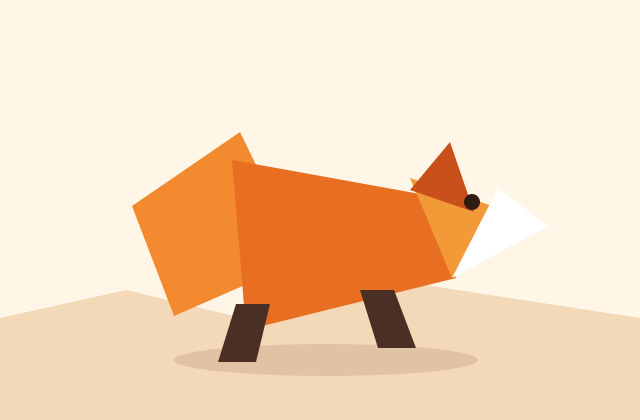
Cozy Animal Pack
Low-Poly Fox
A stylized animal prop for cozy games, woodland scenes and AR previews.
View details- Triangles
- 24
- Texture
- Flat color
- License
- Commercial use
- Formats
- OBJ
Protected STL download
Production export targets

Vehicle Starter Pack
Low-Poly Arcade Car
A simple separated-wheel vehicle mesh for racing prototypes, traffic fillers and WebGL demos.
View details- Triangles
- 30
- Texture
- Material slots
- License
- Commercial use
- Formats
- OBJ
Protected STL download
Production export targets
Highlights
- Hard-surface mecha design with chamfered plates that read clean at low triangle counts
- Modular separated limbs, ball-joint shoulders, and hinged knees ready to rig and animate
- Mobile and WebGL budget of 2k-6k triangles, hero and cinematic robots at 10k-25k
- Emissive panels on chest, visor, and joints driven by a dedicated emissive map
- Single shared atlas at 512-1024px for mobile units, 1024-2048px for hero models
- FBX preserves skeleton and pivots for Unity and Unreal rigging workflows
- GLB for web, Three.js, Godot, and AR; STL or 3MF for 3D printing a desk figure
- Build LOD chains so robot swarms stay performant on screen
Robots are one of the most rewarding subjects for low poly art because their hard-surface forms read beautifully even at a low triangle budget. Chamfered armor plates, blocky shoulder pads, and angular leg housings keep silhouettes crisp without the smooth organic curves that usually demand dense topology. Our generator leans into that strength: it produces faceted, panel-lined mecha that look intentional and stylized rather than starved of detail, so a 3,000-triangle robot can still feel menacing and complete on screen.
The defining feature for animators is modularity. We keep limbs, joints, the torso, and the head as separated mesh parts wherever it matters, with ball-joint shoulders and hinged knees that have a natural pivot point. That separation is what lets you bind the model to a skeleton and animate a walk cycle, a weapon raise, or an idle hum without the geometry tearing at the seams. If you plan to rig in Unity or Unreal, export to FBX, which preserves the hierarchy, pivots, material slots, and any skeleton or animation data so the rig drops straight into your project.
Polycount is tuned to the target platform. For mobile and WebGL games we recommend roughly 2,000 to 6,000 triangles per robot, which keeps draw calls and vertex processing affordable when several mechs share the screen. A hero robot intended for cinematics, a boss reveal, or a close-up menu turntable can climb to 10,000 to 25,000 triangles, where extra cuts on the chest, vents, and joint covers add believable mechanical density. Build a small LOD chain so distant units automatically swap to the cheaper mesh and your frame budget stays under control.
Sci-fi robots come alive with emissive detail. The generator places glowing panels on the chest, the visor, the back thrusters, and the joint gaps, all driven by an emissive map so they read as self-lit even in a dark scene. Because the base color stays flat or lightly baked into a single shared atlas, you keep draw calls low while still getting that energized mecha look. Atlas resolution sits around 512 to 1024 pixels for mobile robots and 1024 to 2048 for hero units, so texture memory never spikes.
For formats, choose by destination. GLB is the self-contained binary that bundles geometry, materials, and textures into one file, ideal for the web, Three.js, Godot, and AR viewers. FBX is the right call for Unity and Unreal because of its rich hierarchy and animation support. OBJ works as a universal static exchange format when you only need geometry and no animation. If you want to 3D print a desktop figure of your mech, export STL or 3MF, which produce a watertight printable mesh while ignoring textures. Every asset you generate is yours to use commercially with no attribution required, so ship it in your game, your demo reel, or your store page freely.
A practical workflow looks like this: generate the robot, confirm the limb separation matches your rig plan, bake or accept the shared atlas, then export FBX for engine work or GLB for web and AR. Drop it onto a humanoid or custom skeleton, wire the emissive channel into your material, and add a simple LOD so swarms of enemy units stay performant. From there you can recolor the accent palette, swap weapons onto the arm sockets, or kitbash parts from multiple generated robots into a unique boss.
Expand the mecha kit
Frequently asked questions
Can I rig and animate the generated robot?
Yes. Limbs and joints are kept as separated parts with natural pivots, so you can bind the model to a skeleton and animate walks, attacks, and idles. Export FBX to carry the hierarchy and any skeleton into Unity or Unreal.
What polycount should I target for a robot?
Use 2,000 to 6,000 triangles for mobile and WebGL units where many robots share the screen, and 10,000 to 25,000 for a hero or cinematic mech. Add LODs so distant units drop to a cheaper mesh automatically.
How do the glowing panels work?
Emissive areas on the chest, visor, and joints are driven by an emissive map, so they appear self-lit in dark scenes. The base color stays on a single shared atlas to keep draw calls low.
Which export format is best for my engine?
Use FBX for Unity and Unreal because it preserves hierarchy, pivots, and skeletons. Use GLB for web, Three.js, Godot, and AR. Use OBJ for static geometry exchange, and STL or 3MF for 3D printing.
Can I use these robots commercially?
Yes. AI-generated assets are owned by you and are fine for commercial use in games, apps, demos, and store pages, with no attribution required.
Related
Browse allNeed a custom low-poly model?
Generate one from a text prompt or reference image, then export GLB, FBX, OBJ or STL.
Open the generator