
Low Poly Fox 3D Model
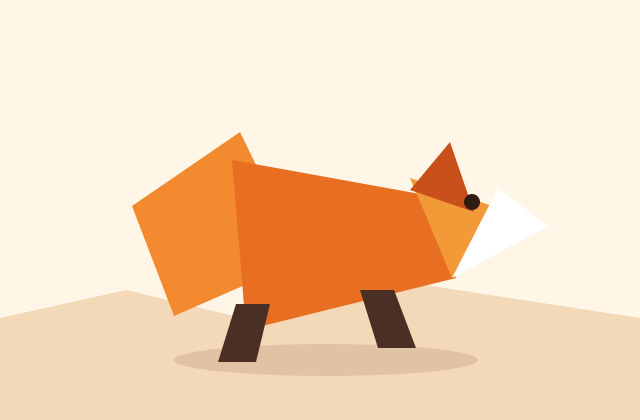
A stylized low poly fox is a favorite for games, AR and 3D-printed figurines alike, with its sharp ears, pointed snout and bushy tail reading instantly even at very low triangle counts.
Matching downloadable assets
Start with these seed models, then generate variants in the same low-poly direction.
Members unlock protected STL access
Use the free OBJ to test the shape. Subscribe for protected STL downloads now; GLB, FBX, USDZ and Unity are shown as production export targets, not direct library downloads yet.
Cozy Animal Pack
Low-Poly Fox
A stylized animal prop for cozy games, woodland scenes and AR previews.
View details- Triangles
- 24
- Texture
- Flat color
- License
- Commercial use
- Formats
- OBJ
Protected STL download
Production export targets

Nature Starter Pack
Low-Poly Pine Tree
A lightweight forest prop with a trunk, two faceted foliage layers and a clean base pivot for scattering.
View details- Triangles
- 24
- Texture
- Flat color
- License
- Commercial use
- Formats
- OBJ
Protected STL download
Production export targets

Vehicle Starter Pack
Low-Poly Arcade Car
A simple separated-wheel vehicle mesh for racing prototypes, traffic fillers and WebGL demos.
View details- Triangles
- 30
- Texture
- Material slots
- License
- Commercial use
- Formats
- OBJ
Protected STL download
Production export targets
Highlights
- Static fox reads clearly at 400 to 1,500 triangles
- Animated game fox: 1,500 to 4,000 tris; desktop hero up to ~15,000
- Print as watertight STL or 3MF; paint orange, white and dark paws
- Angular planes hide layer lines and catch light on prints
- Unfolds into a papercraft net of fold-and-glue panels
- GLB or USDZ places a virtual fox figurine in AR
- FBX keeps the rig for Unity and Unreal; GLB for Godot and Three.js
- Great for forest scenes, companions and woodland RPGs
The fox has a silhouette that low poly geometry loves: triangular ears, a narrow muzzle and a thick tail that flares to a tip. Because those shapes are so distinctive, a fox stays recognizable at a remarkably low budget. A static fox prop can read clearly at 400 to 1,500 triangles, and an animated fox for a mobile game generally wants 1,500 to 4,000 triangles so the tail and legs deform smoothly. On desktop you can model a hero fox up to roughly 10,000 to 15,000 triangles and let LOD levels swap in lighter versions as it runs off into the distance.
Foxes are a hugely popular 3D-printing subject, and the faceted low poly style is part of why. A printed low poly fox shows off crisp angular planes that catch light cleanly and hide the layer lines that smooth models struggle with. Export the model as STL or 3MF, which give a slicer a watertight mesh to work from; color and texture data are ignored on the print itself, so plan to paint the warm orange body, white chest and dark paws by hand if you want them. The pointed ears and tail can be the only spots that need a touch of support, depending on the pose you print.
The same fox unfolds into a clean papercraft net, where each flat face becomes a panel you cut, fold and glue. This makes a low poly fox a great DIY decoration or classroom project. For augmented reality the fox shines as a virtual figurine: a GLB loads through model-viewer on Android and a USDZ works with AR Quick Look on iOS, letting someone place a little fox on their desk and walk around it. Keep the mesh light and bake the orange-and-white coloring into a single 1024px atlas so it tracks smoothly on phones.
In games the fox is a natural fit for forest scenes, cozy adventure titles, companion or pet systems and woodland RPGs. When you rig one, keep enough edge loops around the hips, shoulders and base of the tail so a run cycle does not pinch, and put the origin at the paws on the ground so the fox spawns standing. Export FBX for Unity and Unreal to keep the skeleton and animation clips, or GLB for Godot and Three.js. A simple capsule collider around the body is usually all the physics a fox character needs.
A handful of fox variations, sitting, standing and mid-run, gives a scene life without much cost, and you can tint the same mesh for a red fox, an arctic fox or a stylized fantasy spirit. When you generate a fox with the AI tool the result is yours to keep, so printing and selling the figurines, listing a paper template or shipping the fox in a commercial game are all fine with no attribution required. Start from the prefilled prompt, adjust the pose, fur color or tail shape, then download a game-ready GLB or FBX, or a print-ready STL for a fox figurine.
Round out the woodland cast
Frequently asked questions
Is a low poly fox good for 3D printing?
Very. The angular faceted planes catch light cleanly and hide layer lines. Export STL or 3MF for a watertight print, then paint the orange body and white chest by hand.
How many polygons does a game fox need?
A static prop fox works at 400 to 1,500 triangles. An animated fox wants 1,500 to 4,000 on mobile, and a desktop hero fox can go up to about 15,000 with LOD.
Can I put a fox in AR?
Yes. Use a GLB with model-viewer on Android or a USDZ with AR Quick Look on iOS to place a virtual fox figurine on a real surface.
Does the fox come rigged for animation?
Generated game-ready foxes can include a skeleton; export as FBX for Unity and Unreal or GLB for Godot and Three.js to keep the rig and animation clips intact.
Can I sell printed fox figurines I generate?
Yes. You own AI-generated models, so selling printed figurines, paper templates or shipping the fox in a commercial game is fine without attribution.
Related
Browse allNeed a custom low-poly model?
Generate one from a text prompt or reference image, then export GLB, FBX, OBJ or STL.
Open the generator