
Low Poly Animal 3D Models
Find or generate stylized low poly animals that work as game creatures, AR figurines and 3D-printable figures, with the right format and polycount for whatever you are making.
Matching downloadable assets
Start with these seed models, then generate variants in the same low-poly direction.
Members unlock protected STL access
Use the free OBJ to test the shape. Subscribe for protected STL downloads now; GLB, FBX, USDZ and Unity are shown as production export targets, not direct library downloads yet.
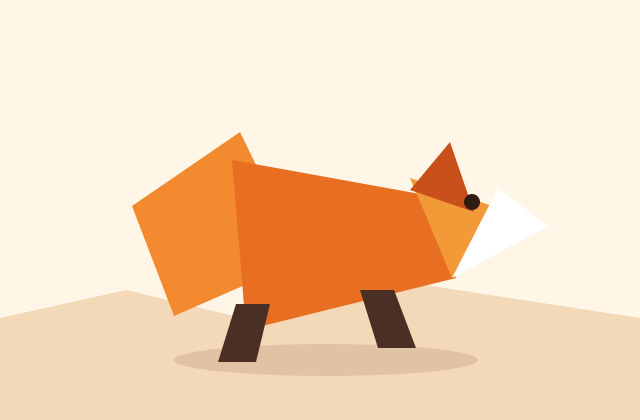
Cozy Animal Pack
Low-Poly Fox
A stylized animal prop for cozy games, woodland scenes and AR previews.
View details- Triangles
- 24
- Texture
- Flat color
- License
- Commercial use
- Formats
- OBJ
Protected STL download
Production export targets

Nature Starter Pack
Low-Poly Pine Tree
A lightweight forest prop with a trunk, two faceted foliage layers and a clean base pivot for scattering.
View details- Triangles
- 24
- Texture
- Flat color
- License
- Commercial use
- Formats
- OBJ
Protected STL download
Production export targets

Vehicle Starter Pack
Low-Poly Arcade Car
A simple separated-wheel vehicle mesh for racing prototypes, traffic fillers and WebGL demos.
View details- Triangles
- 30
- Texture
- Material slots
- License
- Commercial use
- Formats
- OBJ
Protected STL download
Production export targets
Highlights
- Static prop: 200 to 2,000 tris; animated mobile creature: 1,500 to 5,000
- Desktop or console hero animal up to 20,000 tris with LOD
- Export watertight STL or 3MF for clean 3D printing
- Faceted low poly geometry prints without smooth-curve support issues
- Unfolds into flat nets for papercraft templates
- GLB or USDZ places an AR animal figurine on Android or iOS
- FBX for Unity and Unreal rigs; GLB for Godot and Three.js
- AI-generated animals are yours to print, sell or ship commercially
Low poly animals cover an enormous range, from a tiny bird perched on a fence to a galloping horse, and the triangle budget should follow that range. A small static animal prop can live happily at 200 to 2,000 triangles, while an animated creature that walks or runs in a mobile game usually wants 1,500 to 5,000 triangles to deform cleanly. On desktop or console you can push a hero animal toward 8,000 to 20,000 triangles and rely on LOD swaps so distant copies fall back to a cheaper mesh. Matching the budget to the role keeps your scene fast without sacrificing the shapes that make the animal recognizable.
One of the strongest uses for a low poly animal is 3D printing, and the format matters a lot here. For a printable figurine you want STL or 3MF, both of which describe a watertight surface that a slicer can turn into clean layers; textures are simply ignored on a single-color print. Faceted low poly geometry is genuinely well suited to printing because the flat planes hide layer lines and print without the support headaches of smooth organic curves. If you plan to paint the figure afterward, the crisp edges give you natural boundaries to follow.
The same animal model serves a papercraft and AR audience too. Low poly meshes unfold neatly into flat nets, so a fox, deer or owl exports beautifully for paper model templates where every face becomes a fold-and-glue panel. For augmented reality, a GLB or USDZ file lets people place a virtual animal figurine on a real table through model-viewer on Android or AR Quick Look on iOS. Keeping the mesh light and using a single 1024px atlas means the figure loads and tracks smoothly even on older phones.
For games, an animated animal needs a little setup care. Keep the topology clean around the legs and jaw so a skeleton deforms without pinching, and place the origin at the feet on the ground plane so the creature stands correctly when spawned. Export as FBX for Unity and Unreal to carry the rig, skin weights and animation clips intact, or as GLB for Godot and Three.js where skeletal animation is also fully supported. Decide your facing axis once and apply it to every animal in a set so flocks and herds all move in the same direction.
Whether you are populating a forest, a farm, a zoo builder or a children educational app, a small library of stylized animals goes a long way, and variety reads better than a single perfect model repeated. When you generate an animal with the AI tool you own the output completely, so it is fine to print and sell the figures, bundle them in an asset pack or ship them in a commercial game without attribution. Start from the prefilled prompt, adjust the species, pose or color palette, and download a game format or a print-ready STL depending on where the animal is headed.
More companions and next steps
Frequently asked questions
Can I 3D print these low poly animals?
Yes. Export STL or 3MF for a watertight, single-color print. The faceted low poly surfaces actually print cleaner than smooth curves and need fewer supports.
What polycount should an animated game animal use?
Aim for 1,500 to 5,000 triangles on mobile so the rig deforms smoothly, and up to about 20,000 on desktop or console where you can add LOD levels.
Do these work for AR figurines?
Yes. Use a GLB for Android and model-viewer or a USDZ for iOS AR Quick Look, and keep the mesh light so it loads and tracks well on phones.
Can the models be used for papercraft?
Absolutely. Low poly meshes unfold into flat nets where each face becomes a fold-and-glue panel, which is ideal for printable paper model templates.
Are the generated animals free to sell?
Yes. You own AI-generated models outright, so selling printed figures, bundling them in packs or shipping them in a game is fine with no attribution.
Related
Browse allNeed a custom low-poly model?
Generate one from a text prompt or reference image, then export GLB, FBX, OBJ or STL.
Open the generator