
Low Poly Dog 3D Model
A low poly dog is the single most requested companion animal in stylized games and desk figurines, and its floppy or perked ears, wagging tail and stocky legs stay instantly readable at a very low triangle budget.
Matching downloadable assets
Start with these seed models, then generate variants in the same low-poly direction.
Members unlock protected STL access
Use the free OBJ to test the shape. Subscribe for protected STL downloads now; GLB, FBX, USDZ and Unity are shown as production export targets, not direct library downloads yet.

Nature Starter Pack
Low-Poly Pine Tree
A lightweight forest prop with a trunk, two faceted foliage layers and a clean base pivot for scattering.
View details- Triangles
- 24
- Texture
- Flat color
- License
- Commercial use
- Formats
- OBJ
Protected STL download
Production export targets
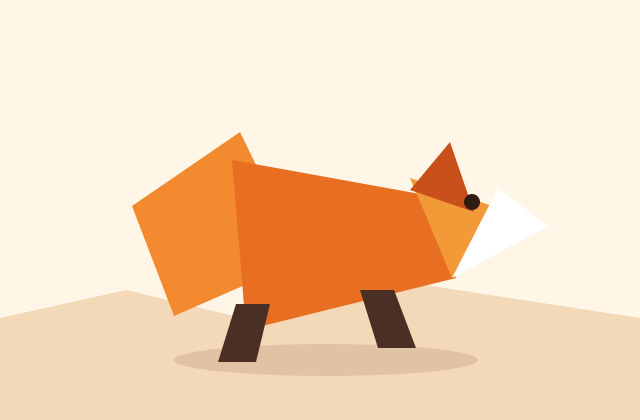
Cozy Animal Pack
Low-Poly Fox
A stylized animal prop for cozy games, woodland scenes and AR previews.
View details- Triangles
- 24
- Texture
- Flat color
- License
- Commercial use
- Formats
- OBJ
Protected STL download
Production export targets

Vehicle Starter Pack
Low-Poly Arcade Car
A simple separated-wheel vehicle mesh for racing prototypes, traffic fillers and WebGL demos.
View details- Triangles
- 30
- Texture
- Material slots
- License
- Commercial use
- Formats
- OBJ
Protected STL download
Production export targets
Highlights
- Static sitting/standing dog reads clearly at 400 to 1,500 triangles
- Animated game dog: 1,500 to 4,000 tris; desktop companion hero up to ~12,000
- Print as watertight STL or 3MF; sitting pose avoids thin-overhang supports
- Angular facets hide layer lines better than smooth organic curves
- Unfolds into a papercraft net of fold-and-glue panels
- GLB or USDZ places a virtual AR dog on a real floor or sofa
- FBX keeps the rig for Unity and Unreal; GLB for Godot and Three.js
- Great for companions, farm sims, guard-dog enemies and town-life ambiance
Dogs read differently from cats and foxes because breed shape carries so much of the personality: a stocky bulldog, a lanky greyhound and a fluffy shiba all need slightly different proportions even at the same low polycount. A static sitting or standing dog prop reads clearly at 400 to 1,500 triangles, and an animated dog for a mobile or indie game generally wants 1,500 to 4,000 triangles so the legs, spine and tail can bend without the mesh pinching at the hips and shoulders. On desktop a hero companion dog, the kind that follows the player and gets a close camera, can run 6,000 to 12,000 triangles with LOD levels swapping in a cheaper body for anything more than a few meters away.
Dogs are, alongside cats, the single most popular 3D-printed animal figurine on marketplaces like Etsy and Cults3D, and the faceted low poly style is a real practical advantage here rather than just an aesthetic choice: flat angular planes hide layer lines far better than smooth organic curves, and a sitting or lying pose gives the print a wide flat base with no thin overhangs. Export STL or 3MF for a watertight single-shell mesh; a standing dog with an upright tail or raised paw will usually need a little support under those thin protruding parts, so if printability matters more than pose, keep the tail low and the legs together.
The same low poly dog unfolds cleanly into a papercraft net, which is a genuinely popular gift and classroom-project format because the flat triangular faces of the ears, muzzle and haunches become natural fold lines. For augmented reality, a dog is one of the most requested figures to place in a room: export GLB for Android through model-viewer, or USDZ for iOS AR Quick Look, and keep the whole mesh under a single 1024px atlas so it loads and tracks smoothly even on a mid-range phone.
In games, dogs work as player companions, farm and pet-sim animals, guard-dog enemies, and background town-life creatures that make a scene feel alive. When rigging, keep clean edge loops around the shoulders, hips and the base of the tail so a trot or run cycle does not crease the mesh, and put the origin at the paws on the ground plane so the dog spawns standing correctly. Export FBX for Unity and Unreal to carry the skeleton and animation clips, or GLB for Godot and Three.js where skeletal animation is equally well supported. Decide one facing axis and apply it to every dog you generate so a pack all runs in the same direction without extra correction in code.
A handful of coat-color and pose variants, sitting, standing, mid-bark, turns one dog into a believable pack or an entire pet shelter without extra modeling cost, since the same base mesh can be retextured for a labrador, a husky or a scruffy mutt. Everything you generate with the AI tool here is yours to keep, so printing and selling the figurines, publishing a papercraft template, or shipping the dog inside a commercial game are all fine with no attribution required. Start from the prefilled prompt, adjust the breed proportions, ear shape or coat color, then download a game-ready GLB or FBX, or a print-ready STL for a dog figurine.
Take your dog further
Frequently asked questions
Is a low poly dog good for 3D printing?
Yes. Export STL or 3MF for a watertight print. A sitting or lying pose gives a wide flat base with no thin overhangs, while a standing dog with a raised tail or paw usually needs a little support.
How many triangles does a game-ready dog need?
A static prop dog works at 400 to 1,500 triangles. An animated companion dog wants 1,500 to 4,000 on mobile, and a desktop hero companion can reach about 12,000 with LOD.
Can I place a dog in AR?
Yes. Use a GLB with model-viewer on Android or a USDZ with AR Quick Look on iOS to place a virtual dog on a real floor or sofa for photos.
Does the dog come rigged for a walk or run cycle?
Generated game-ready dogs can include a skeleton with clean loops at the shoulders, hips and tail base. Export FBX for Unity and Unreal or GLB for Godot and Three.js to keep the rig and any animation clips intact.
Can I sell printed dog figurines I generate?
Yes. AI-generated models are owned by you, so selling printed figurines, papercraft templates or shipping the dog in a commercial game is fine without attribution.
Related
Browse allNeed a custom low-poly model?
Generate one from a text prompt or reference image, then export GLB, FBX, OBJ or STL.
Open the generator