
Low Poly VRChat Avatar Pipeline
Getting a custom character into VRChat is widely considered the most confusing step in the whole low poly creation journey, but a low triangle and material budget is actually the single biggest advantage a low poly avatar has over a realistic one.
Matching downloadable assets
Start with these seed models, then generate variants in the same low-poly direction.
Members unlock protected STL access
Use the free OBJ to test the shape. Subscribe for protected STL downloads now; GLB, FBX, USDZ and Unity are shown as production export targets, not direct library downloads yet.

Nature Starter Pack
Low-Poly Pine Tree
A lightweight forest prop with a trunk, two faceted foliage layers and a clean base pivot for scattering.
View details- Triangles
- 24
- Texture
- Flat color
- License
- Commercial use
- Formats
- OBJ
Protected STL download
Production export targets
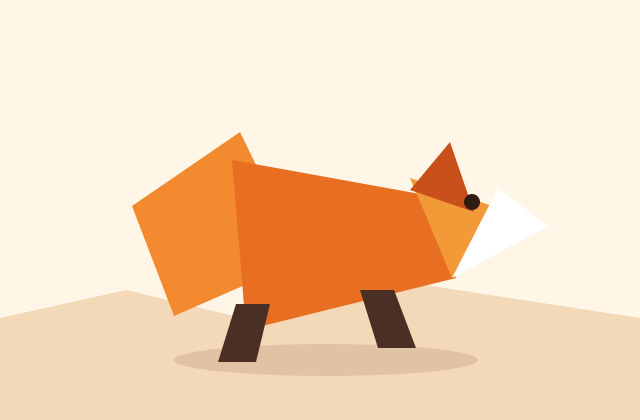
Cozy Animal Pack
Low-Poly Fox
A stylized animal prop for cozy games, woodland scenes and AR previews.
View details- Triangles
- 24
- Texture
- Flat color
- License
- Commercial use
- Formats
- OBJ
Protected STL download
Production export targets
Highlights
- Low poly naturally lands in the Excellent Performance Rank band: 5k-15k tris, 1-3 materials
- Rig with a standard humanoid bone hierarchy in Blender so Unity Humanoid auto-mapping works
- Export FBX to carry skeleton, skin weights and blend shapes into Unity
- Install VRChat Creator Companion, import FBX as Humanoid, add the VRC Avatar Descriptor
- Build viseme blend shapes for lip sync plus a handful of expression shapes for the emote menu
- One shared material/atlas (1024-2048px) matters more here than triangle count for ranking
- Emissive accents on the same atlas are nearly free performance-wise and read well in dark worlds
- Test with Build & Test locally before publishing; avatars are user-owned and commercially usable
VRChat avatars are judged on a Performance Rank that buckets every uploaded avatar into Excellent, Good, Medium, Poor or Very Poor based on triangle count, skinned mesh count, material count, bone count and a handful of other factors, and this rank directly controls whether other users even see your avatar at its full detail in a crowded world. A low poly character starts from a huge structural advantage here: where a realistic avatar has to fight to stay under roughly 20,000 triangles and 10 materials for a Good rank, a well-built low poly avatar naturally lands in the 5,000 to 15,000 triangle range with 1 to 3 materials, which puts it solidly in Excellent territory with room to spare for a few accessories.
The pipeline runs through three tools in sequence, and each one has a specific job. Model and rig the character in Blender, keeping a single humanoid armature with the standard bone names VRChat expects (Hips, Spine, Chest, Neck, Head, and mirrored arm and leg chains), since a non-standard skeleton fails Unity's Humanoid avatar auto-mapping and forces manual bone assignment later. Export as FBX, which is the format that reliably carries the skeleton, skin weights and blend shapes into Unity. Then in Unity, install the VRChat Creator Companion, create a new Avatars project, import the FBX, set the Rig to Humanoid in the import inspector, and drag the model into the scene to add the VRC Avatar Descriptor component that turns a plain rigged mesh into an uploadable avatar.
Blend shapes deserve special attention because VRChat leans on them heavily for face expressions and visemes, the mouth shapes that drive lip sync. Build at minimum a set of viseme blend shapes on the head mesh (VRChat can auto-generate simplified ones if you only supply a jaw-open shape, but dedicated visemes look far better) plus a handful of expression shapes for the built-in emote menu. Keep these on the same mesh as the head to avoid VRChat needing to guess which mesh to target, and keep the total blend shape count modest since each one adds to the avatar's performance cost calculation.
A single shared texture atlas is even more valuable here than in a typical game asset, because VRChat's performance ranking penalizes material count directly, not just triangle count. Aim for one material covering the whole low poly avatar, painted with flat colors or a baked gradient at 1024 to 2048px, since that single choice alone can be the difference between a Good and an Excellent rank. If you want glowing accents, a modest emissive channel on that same atlas is nearly free performance-wise and reads dramatically in VRChat's often dark or moody worlds.
Once the avatar descriptor, view position and colliders are configured, the VRChat SDK panel inside Unity handles the actual upload, including a build-and-test step that lets you try the avatar locally before publishing. Set the avatar to public only once you are happy, since VRChat currently has no simple way to unpublish and republish under the same ID without going through support. Everything modeled and rigged here is yours to own commercially, so a low poly original character you generate and rig can become your public VRChat avatar, a friend's gift avatar, or a paid avatar commission with no attribution required, and the low triangle budget that made it Excellent-ranked in VRChat is exactly the same discipline that makes it a good asset everywhere else on this site.
Build the rest of the pipeline
Frequently asked questions
Why is low poly a good style for a VRChat avatar?
VRChat grades avatars on a Performance Rank driven mainly by triangle count and material count. A low poly avatar naturally sits in the 5,000-15,000 triangle, 1-3 material range that earns an Excellent rank, while a realistic avatar has to fight hard to get there.
What bone names does VRChat need for Humanoid rigging?
A standard humanoid hierarchy including Hips, Spine, Chest, Neck, Head and mirrored arm/leg chains. Using these names lets Unity auto-map the rig to Humanoid; a non-standard skeleton requires manual bone assignment.
Do I need separate visemes for lip sync?
VRChat can generate a simplified viseme set from a single jaw-open blend shape, but building the full viseme set on the head mesh gives noticeably better lip sync and is worth the extra modeling time.
How many materials should a low poly VRChat avatar use?
Aim for one shared material and atlas covering the whole avatar. Material count is weighted heavily in the Performance Rank calculation, so consolidating to one material is often the single biggest ranking win available.
Can I sell a low poly avatar I generate and rig here?
Yes. Generated models are yours to use commercially with no attribution, so a rigged VRChat avatar can be published publicly, gifted, or sold as a commission.
Related
Browse allNeed a custom low-poly model?
Generate one from a text prompt or reference image, then export GLB, FBX, OBJ or STL.
Open the generator