
Gradient Low Poly Style
Gradient low poly style is about controlled color travel across faceted surfaces, not soft cozy palettes or cartoon outlines: the geometry stays angular while vertex colors or baked ramps make each plane feel luminous.
Matching downloadable assets
Start with these seed models, then generate variants in the same low-poly direction.
Members unlock protected STL access
Use the free OBJ to test the shape. Subscribe for protected STL downloads now; GLB, FBX, USDZ and Unity are shown as production export targets, not direct library downloads yet.

Nature Starter Pack
Low-Poly Pine Tree
A lightweight forest prop with a trunk, two faceted foliage layers and a clean base pivot for scattering.
View details- Triangles
- 24
- Texture
- Flat color
- License
- Commercial use
- Formats
- OBJ
Protected STL download
Production export targets
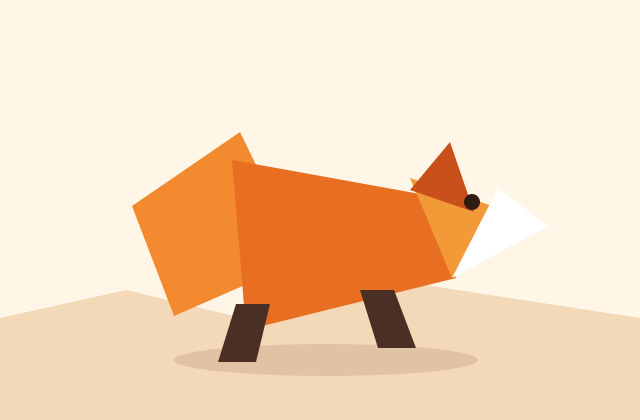
Cozy Animal Pack
Low-Poly Fox
A stylized animal prop for cozy games, woodland scenes and AR previews.
View details- Triangles
- 24
- Texture
- Flat color
- License
- Commercial use
- Formats
- OBJ
Protected STL download
Production export targets
Highlights
- Small gradient props: 300-1,500 triangles
- Hero gradient assets: 3,000-8,000 triangles with broad readable facets
- Use vertex colors or a baked ramp texture for color travel
- Multiply gradient by baked ambient occlusion for grounded contact shadows
- Three.js materials must enable vertexColors to display vertex-color gradients
- Unity URP Shader Graph can blend vertex color with a ramp texture
- One 512px ramp texture can drive an entire asset kit
- Different from anime cel bands: gradients are continuous, not hard-stepped
The core technique is a vertex-color or texture-baked gradient ramp, usually flowing from warm light to cool shadow across large polygon faces. For small props, 300 to 1,500 triangles is enough because the gradient carries depth without extra bevels. Hero assets can use 3,000 to 8,000 triangles, but the key is broad readable facets; if the mesh is too dense, the gradient becomes smooth and loses the low poly character.
A practical shader setup stores base hue variation in vertex colors, multiplies it by a baked ambient occlusion map, and keeps roughness high so the asset does not become glossy. In Three.js, vertex colors need `vertexColors` enabled on the material; in Unity, a simple URP shader graph can read vertex color and blend it with a ramp texture. This is different from cozy low poly, which is mostly subject matter and pastel palette, and different from anime style, which uses hard cel bands rather than continuous ramps.
Palette discipline matters. Pick two or three hue anchors, such as coral to peach to teal, and lock value contrast so every asset in a kit shares the same light direction. Avoid random rainbow gradients on every object; a tree, car and house can all share the same warm-top/cool-bottom logic while still using different local colors. A single 512px ramp texture can drive an entire kit, or you can use pure vertex colors for texture-free GLB exports.
Use GLB for web and AR because vertex colors travel well in compact files, and FBX for Unity or Unreal if the receiving shader is already set up to read vertex color. Generated gradient low poly assets are yours to use commercially with no attribution required, including games, UI hero scenes, product visuals and paid asset packs.
Apply the gradient look
Frequently asked questions
What makes gradient low poly different from cozy low poly?
Cozy low poly is primarily about subject matter and soft palette. Gradient low poly is a shader and color workflow using vertex-color or baked ramps across faceted surfaces.
Should gradient low poly use vertex colors or textures?
Use vertex colors for compact GLB files and simple web delivery. Use a small ramp texture when you need art-directable color bands shared across many assets.
Why does a dense mesh hurt the gradient style?
Too many tiny polygons make the gradient look smooth and generic. Broad facets let the ramp travel visibly across planes while preserving the low poly identity.
How do I show vertex colors in Three.js?
Enable vertexColors on the material when loading the GLB. Without that flag, the mesh may render with a flat default material instead of the stored gradient colors.
Can I use generated gradient assets commercially?
Yes. Generated gradient low poly assets are yours to use commercially with no attribution required, including games, product visuals and asset packs.
Related
Browse allNeed a custom low-poly model?
Generate one from a text prompt or reference image, then export GLB, FBX, OBJ or STL.
Open the generator