
Low Poly Texture
"Low poly texture" usually means one of two very different things depending on who is asking: a flat-shaded material with no image at all, or a painted or baked texture atlas — and picking the wrong one for your project either wastes art time or wastes a chunk of your performance budget.
Matching downloadable assets
Start with these seed models, then generate variants in the same low-poly direction.
Members unlock protected STL access
Use the free OBJ to test the shape. Subscribe for protected STL downloads now; GLB, FBX, USDZ and Unity are shown as production export targets, not direct library downloads yet.
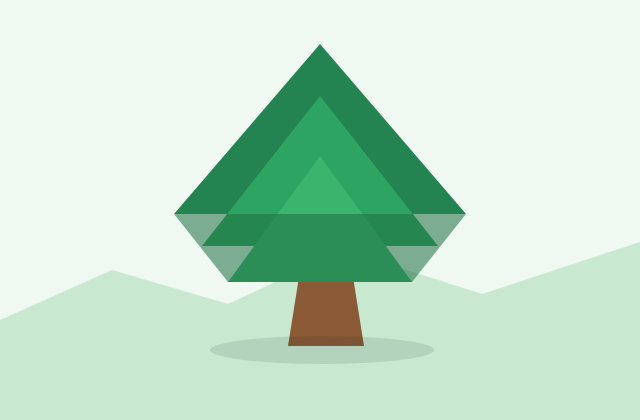
Nature Starter Pack
Low-Poly Pine Tree
A lightweight forest prop with a trunk, two faceted foliage layers and a clean base pivot for scattering.
View details- Triangles
- 24
- Texture
- Flat color
- License
- Commercial use
- Formats
- OBJ
Protected STL download
Production export targets
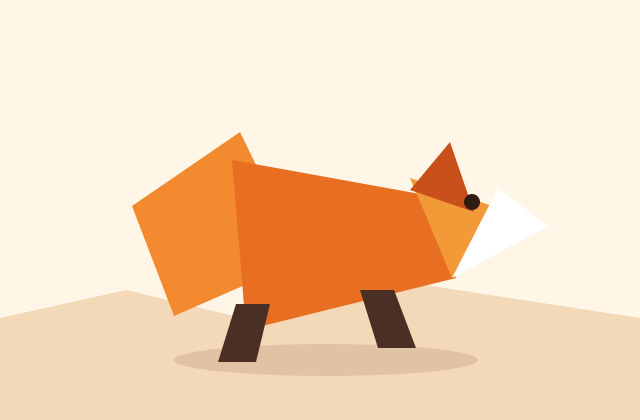
Cozy Animal Pack
Low-Poly Fox
A stylized animal prop for cozy games, woodland scenes and AR previews.
View details- Triangles
- 24
- Texture
- Flat color
- License
- Commercial use
- Formats
- OBJ
Protected STL download
Production export targets
Highlights
- Flat-shaded = solid per-face color material, no UV image, the cheapest possible option
- Textured = UV-unwrapped mesh plus a painted or baked image, adds depth at a texture-memory cost
- Gradient/AO bake: a soft 2-4 tone light-to-dark ramp baked into a small shared atlas
- Shared atlas sizing: 512-1024px for props, 1024-2048px for a hero object
- Pack every object's UV islands into one atlas to cut draw calls, not one texture per object
- Mark seams and Smart UV Project before baking or hand-painting in Texture Paint mode
- GLB embeds the texture in the file; FBX/OBJ need the image shipped and re-linked separately
- Both flat-shaded and textured outputs are yours to use commercially, no attribution required
Flat-shaded low poly has no texture image whatsoever. Each face gets a solid color material, sometimes with a per-vertex color, and the entire look comes from the geometry itself, the angular facets catching light differently as they turn, plus flat or "toon" shading that removes smooth gradients between lit and unlit areas. This is the cheapest possible material in any engine: no UV unwrap is strictly required, no texture memory is spent, and draw calls stay minimal because dozens of objects can share one plain color material. It is also the purest version of the classic low poly aesthetic, and the right default whenever performance or a stark geometric look matters more than surface richness.
Textured low poly adds a UV-unwrapped image on top of the geometry, and the most common technique is not a fully painted texture but a baked gradient or ambient occlusion pass: a soft light-to-dark ramp, sometimes as simple as two to four flat tones, baked into a small shared atlas so faces near "ground contact" or in creases read slightly darker than exposed top surfaces. This adds a surprising amount of perceived depth and material richness for almost no extra draw-call cost, since it is still one shared image, and it is the technique behind most modern stylized low poly games rather than the flat-vertex-color look of retro PS1-era titles.
Atlas sizing follows the same rule regardless of whether the content is a gradient bake or a fully painted texture: pack every object in a kit, or at least every object of a similar scale, into one shared image rather than giving each object its own texture. A practical default is 512 to 1024 pixels for props and 1024 to 2048 pixels for a hero object, sized up only when a close-camera focal asset genuinely needs the extra resolution. One shared atlas across a forest of trees or a village of buildings means the GPU caches a single texture instead of dozens, which is the real performance reason texturing low poly content is approached this way instead of per-object unique textures.
Producing either style in Blender follows a short, repeatable sequence. Mark seams along natural edges and use Smart UV Project or manual unwrapping to lay the mesh flat without stretching, then either bake an ambient occlusion or gradient pass onto that UV layout for the depth-shading technique, or switch to Texture Paint mode to hand-paint additional flat color regions and detail directly onto the unwrapped mesh. Either path ends with the same result: one shared image file referenced by every object's material, ready to export alongside the mesh.
File format has real consequences here. GLB bundles the mesh, material and texture image into a single self-contained binary, so a textured GLB just works the moment it is loaded in a browser, Godot or an AR viewer with no missing-texture risk. FBX and OBJ reference the texture as a separate image file that must be shipped alongside the model and re-linked on import, which is the most common reason a "missing texture, pink material" error shows up after moving an FBX between machines or engines. Whichever style and format you choose, models generated here, textured or flat-shaded, are yours to use commercially with no attribution required.
Texture a low poly model in four steps
- 1
Decide flat-shaded or textured
Choose based on target platform and budget: flat-shaded for the cheapest, most classic look, or textured when you want gradient depth or painted detail.
- 2
Unwrap and pack a shared atlas
Mark seams along natural edges, use Smart UV Project, and pack every object in the kit into one shared atlas rather than a unique texture per object.
- 3
Bake or paint the texture
Bake an ambient occlusion or gradient pass for cheap depth, or switch to Texture Paint mode for hand-painted flat color regions and detail.
- 4
Export with the atlas attached
GLB embeds the texture automatically; FBX and OBJ need the image file shipped alongside the model and re-linked on import.
Apply the right texture approach
Frequently asked questions
What does "low poly texture" actually mean — do I need one?
It can mean either a flat-shaded material with no image, or a painted/baked texture atlas. You do not strictly need one: flat-shaded is the cheapest, most classic low poly look and works with zero texture memory.
Is flat-shaded or textured better for mobile and WebGL?
Flat-shaded is cheapest since it needs no texture memory and minimal draw calls. A gradient or AO bake on one small shared atlas is the best middle ground, adding depth for very little extra cost.
How do I bake a gradient texture for a low poly model?
Unwrap the mesh with Smart UV Project, then bake an ambient occlusion or a 2-4 tone light-to-dark gradient pass onto that UV layout in Blender, packed into a small shared atlas.
What atlas size should I use for a low poly texture?
512 to 1024 pixels for props is standard, and 1024 to 2048 pixels for a hero object that sits close to the camera. Share one atlas across a whole kit rather than a unique texture per object.
Can I generate a low poly model with a texture already applied?
Yes. The generator has a texture toggle: turn it on for a textured result, or leave it off for pure flat-shaded materials with no image.
Related
Browse allNeed a custom low-poly model?
Generate one from a text prompt or reference image, then export GLB, FBX, OBJ or STL.
Open the generator