
Decimate Mesh
Mesh decimation is the fastest way to reduce triangle count, but it is a blunt tool unless you know which edges to protect and which assets should be retopologized instead.
Matching downloadable assets
Start with these seed models, then generate variants in the same low-poly direction.
Members unlock protected STL access
Use the free OBJ to test the shape. Subscribe for protected STL downloads now; GLB, FBX, USDZ and Unity are shown as production export targets, not direct library downloads yet.
Nature Starter Pack
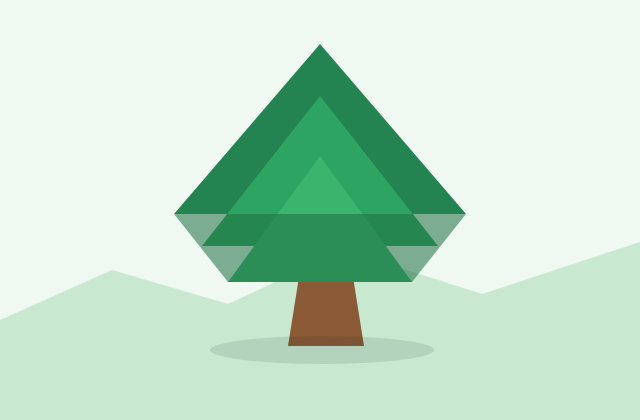
Low-Poly Pine Tree
A lightweight forest prop with a trunk, two faceted foliage layers and a clean base pivot for scattering.
View details- Triangles
- 24
- Texture
- Flat color
- License
- Commercial use
- Formats
- OBJ
Protected STL download
Production export targets
Cozy Animal Pack
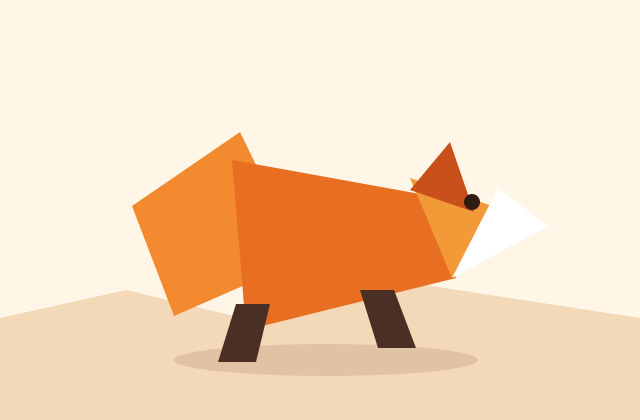
Low-Poly Fox
A stylized animal prop for cozy games, woodland scenes and AR previews.
View details- Triangles
- 24
- Texture
- Flat color
- License
- Commercial use
- Formats
- OBJ
Protected STL download
Production export targets
Highlights
- Collapse decimation removes edges with the least measured surface error
- Planar decimation is best for hard surfaces and large flat low poly faces
- Un-subdivide only helps when the dense mesh came from a subdivided base
- Static props can often lose 40-70 percent of triangles when the silhouette is protected
- Do not decimate deformation loops around faces, hands, elbows or knees
- Lock UV borders and material seams to prevent texture stretching
- Recalculate normals after decimation and inspect flat-shaded faces
- Use decimation for static LODs; use retopology for animated hero assets
Decimation removes geometry from an existing mesh without rebuilding the topology by hand. Collapse-style decimation, the common quadric error method behind many tools, removes edges that least affect the surface mathematically. Planar decimation removes unnecessary triangles on nearly flat surfaces, which is excellent for hard-surface props, buildings and faceted rocks. Un-subdivide tries to reverse subdivision patterns and is useful only when the dense mesh came from an orderly subdivided base.
The safe cases are static props, background scatter and LOD versions where deformation is irrelevant. A low poly rock, crate, ruined wall or city block can often lose 40 to 70 percent of its triangles if the silhouette is protected. The unsafe cases are faces, hands, elbows, knees and any skinned character area where edge loops drive deformation. Decimation there can collapse loops that an animator needs, causing pinching that no normal map can hide.
The practical workflow is incremental. Duplicate the mesh, apply transforms, triangulate if the target engine will triangulate anyway, then reduce in small steps while watching the outline from the camera distances where the asset appears. Lock UV borders and material seams when the tool allows it, because collapsing a UV island edge can create texture stretching even if the geometry looks fine in solid view. After decimation, recalculate normals and inspect flat-shaded faces for accidental smoothing changes.
Decimation is different from full polycount optimization. It cuts triangles, but it will not automatically reduce draw calls, merge materials, resize textures or create a clean riggable topology. Use it as a fast reduction step for static geometry, as an LOD generator input, or as a first pass before manual cleanup. If the mesh will animate close to camera, use retopology instead and bake high-frequency detail from the source.
Choose the reduction method
Frequently asked questions
Is decimation the same as retopology?
No. Decimation removes existing geometry automatically. Retopology builds a new intentional mesh with clean loops, which is better for animation and hero assets.
How much can I decimate safely?
For static props, 40 to 70 percent reduction can work if the silhouette holds. Characters and deformation areas need much more caution.
Which decimation mode should I use in Blender?
Use Collapse for general reduction, Planar for hard surfaces with flat regions, and Un-subdivide only for meshes that came from subdivision.
Why did my texture stretch after decimation?
The decimator probably collapsed UV island borders or material seams. Lock seams when possible and inspect the textured result, not just solid shading.
Can decimation make a model game-ready?
Only partly. It reduces triangles, but you still need material cleanup, texture sizing, collision, LODs and export checks.
Related
Browse allNeed a custom low-poly model?
Generate one from a text prompt or reference image, then export GLB, FBX, OBJ or STL.
Open the generator