
glTF to GLB Converter
glTF and GLB are not two different formats in the way FBX and OBJ are; they are the same underlying JSON scene description in two different packagings, and converting one to the other is really a question of when to keep a model as human-readable, git-diffable files and when to ship it as one compact binary.
Matching downloadable assets
Start with these seed models, then generate variants in the same low-poly direction.
Members unlock protected STL access
Use the free OBJ to test the shape. Subscribe for protected STL downloads now; GLB, FBX, USDZ and Unity are shown as production export targets, not direct library downloads yet.
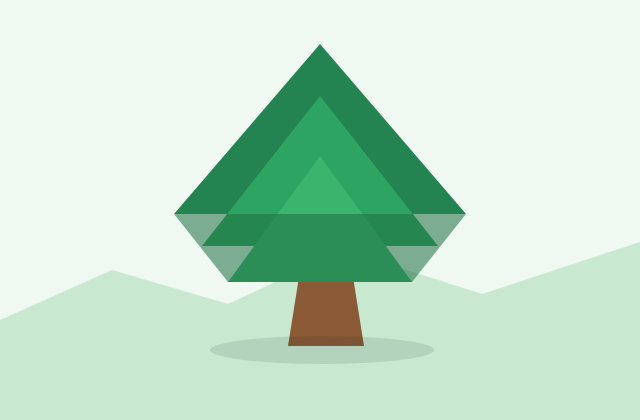
Nature Starter Pack
Low-Poly Pine Tree
A lightweight forest prop with a trunk, two faceted foliage layers and a clean base pivot for scattering.
View details- Triangles
- 24
- Texture
- Flat color
- License
- Commercial use
- Formats
- OBJ
Protected STL download
Production export targets
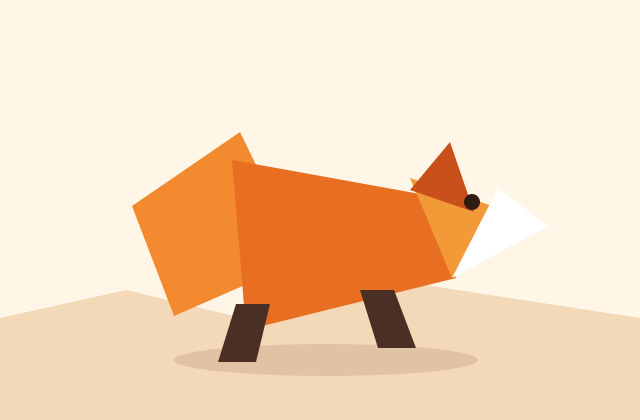
Cozy Animal Pack
Low-Poly Fox
A stylized animal prop for cozy games, woodland scenes and AR previews.
View details- Triangles
- 24
- Texture
- Flat color
- License
- Commercial use
- Formats
- OBJ
Protected STL download
Production export targets
Highlights
- glTF and GLB describe the exact same JSON scene data — the difference is packaging, not format
- Loose .gltf ships as JSON + a separate .bin buffer + loose texture files, at least three files that must travel together
- GLB packs the JSON, binary buffer and every texture into one self-contained file with a small header
- Text .gltf JSON is human-readable and git-diffable — useful during active development, not for shipping
- Blender's glTF export offers Separate, Embedded, or Binary (.glb) — pick Binary to produce a single GLB
- Loose .gltf triggers multiple separate network requests (JSON + buffer + each texture); GLB loads as one
- Production web/game delivery should default to GLB for first-load speed unless deliberately streaming textures separately
- The same commercial license applies regardless of packaging, no attribution required
A plain .gltf file is JSON text describing the scene graph, nodes, materials and accessor layout, and it almost always ships alongside a separate .bin file holding the raw vertex and index buffers, plus loose image files (.png or .jpg) for any textures, so a single "model" is really a folder of three or more files that all have to travel together and stay correctly cross-referenced. GLB is the binary container version of the exact same data: the JSON, the binary buffer and every texture are packed into one self-contained file with a small header, which is why a GLB survives being renamed, moved, or emailed as a single attachment while a loose .gltf project breaks the moment its .bin or texture files go missing.
The text-based .gltf format has genuine advantages during development that are worth understanding before defaulting to GLB everywhere: you can open the .gltf JSON directly in a text editor to inspect the exact scene hierarchy, node transforms or material values without any 3D tool, and because it is plain text, a .gltf file diffs meaningfully in git, so a version-control system can show you exactly which node or material value changed between two commits, something a binary GLB can never do. Some studios deliberately keep source-of-truth models as loose .gltf during active editing for this diffability, then convert to GLB only for the final shipped build.
Blender handles both directions of this conversion natively: File then Export then glTF 2.0 (.glb/.gltf) presents a Format dropdown with exactly three choices, glTF Separate (the loose .gltf + .bin + textures folder), glTF Embedded (a single .gltf file with everything base64-encoded inline, rarely useful since it loses GLB's size efficiency without gaining loose-file editability), and glTF Binary (.glb), so converting a separate glTF project into a single GLB is simply re-exporting with the last option selected, or re-importing the .gltf and exporting as .glb if you only have the finished files rather than the original Blender project.
Production web and game delivery should default to GLB specifically because of loading behavior: a browser or engine fetching a loose .gltf triggers multiple separate network requests, one for the JSON, one for the binary buffer, one per texture, each with its own round-trip latency, while a single GLB loads as one request with everything already packed together, which matters directly for the first-load speed this site's other web and AR pages already emphasize. The one exception worth knowing is progressive or streaming loaders that intentionally want separate texture requests to prioritize geometry first; that specific optimization pattern is the rare case where staying with separate glTF files is a deliberate choice rather than an oversight.
Whichever packaging you ship, the model itself carries the same license: AI-generated assets on this site are yours to use commercially with no attribution required, so converting a development-time .gltf project into a production-ready GLB, or the reverse for easier version-control diffing, introduces no additional licensing question, only the packaging decision described above.
Round out the format toolkit
Frequently asked questions
Is glTF a different format from GLB?
No, they describe the same underlying JSON scene data. .gltf is typically a loose JSON file plus a separate .bin buffer and texture files; .glb packs all of that into one self-contained binary file.
Why would I keep a model as loose .gltf files instead of converting to GLB?
The plain-text .gltf JSON is human-readable and diffs meaningfully in git, so some studios keep it as the editable source-of-truth during active development, then convert to GLB only for the final shipped build.
How do I convert a .gltf project to a single .glb in Blender?
Use File > Export > glTF 2.0 (.glb/.gltf) and choose the Binary (.glb) option from the Format dropdown, instead of Separate or Embedded, to pack the JSON, buffer and textures into one file.
Does GLB load faster than loose .gltf files on the web?
Usually yes. A loose .gltf triggers separate network requests for the JSON, the binary buffer, and each texture, while a single GLB loads as one request, which typically means faster first-load time.
Can I use a converted GLB commercially?
Yes. Generated models are yours to use commercially with no attribution required, regardless of whether you ship them as loose glTF files or a packed GLB.
Related
Browse allNeed a custom low-poly model?
Generate one from a text prompt or reference image, then export GLB, FBX, OBJ or STL.
Open the generator