
Low Poly Generator
This low poly generator turns a written prompt or a reference image into a flat-shaded, game-ready 3D model in a couple of minutes, and it is the exact same pipeline behind every model on this site, not a stripped-down demo version of it.
Matching downloadable assets
Start with these seed models, then generate variants in the same low-poly direction.
Members unlock protected STL access
Use the free OBJ to test the shape. Subscribe for protected STL downloads now; GLB, FBX, USDZ and Unity are shown as production export targets, not direct library downloads yet.

Nature Starter Pack
Low-Poly Pine Tree
A lightweight forest prop with a trunk, two faceted foliage layers and a clean base pivot for scattering.
View details- Triangles
- 24
- Texture
- Flat color
- License
- Commercial use
- Formats
- OBJ
Protected STL download
Production export targets
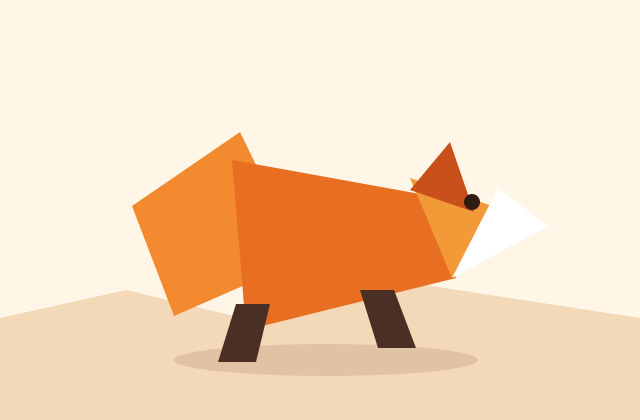
Cozy Animal Pack
Low-Poly Fox
A stylized animal prop for cozy games, woodland scenes and AR previews.
View details- Triangles
- 24
- Texture
- Flat color
- License
- Commercial use
- Formats
- OBJ
Protected STL download
Production export targets
Highlights
- Two input modes: text-to-3D from a written prompt, or image-to-3D from a reference photo
- Target polygon count control: lower values push the mesh toward a chunkier low-poly look
- Optional texture toggle: generate a textured model or keep pure flat-shaded materials
- Seed field for reproducible results, or randomize to explore fresh variations
- Live interactive GLB preview in the browser before you commit to a download
- Export GLB, FBX, OBJ, STL/3MF or USDZ for engines, the web, 3D printing or AR
- Credit-based generation with automatic credit refunds if a provider attempt fails
- Generated models are yours, commercial use included, no attribution required
"Low poly generator," "low poly creator" and "low polygon generator" all describe the same tool searched with slightly different wording, and all three point at the same two entry points here: text-to-3D, where you describe the object you want in a sentence, and image-to-3D, where you upload a reference photo or concept sketch and the generator infers a low-poly mesh that matches its silhouette. Neither mode requires any prior 3D modeling skill. You are not editing a mesh by hand, you are describing or showing the generator what you want and letting an AI mesh-generation model handle the geometry.
The output is not a fixed style; you control how low-poly it actually is. A target polygon count control lets you push the result toward a chunkier, more angular look at a lower value, or allow more surface detail at a higher one, and a separate texture toggle decides whether the model comes back as pure flat-shaded materials or with a generated texture applied. A seed field makes results reproducible: regenerate with the same seed and prompt to get the same mesh again, or hit randomize to explore fresh variations of the same idea without retyping the prompt.
Before you spend a download, the generator renders the result into an interactive GLB viewer directly in your browser so you can rotate it, check the silhouette and confirm the topology holds up at your target polycount. Once you are happy, export GLB for the web, Godot, Three.js and AR viewers; FBX for Unity and Unreal, which preserves hierarchy and pivots; OBJ as a universal static fallback; STL or 3MF for 3D printing; or USDZ for iOS AR Quick Look. Every export comes from the same generated mesh, so you only generate once per asset.
Generation runs on a credit system, and if the underlying provider fails mid-generation the credits for that attempt are refunded automatically rather than silently lost, which matters when you are iterating through several prompt variations back to back. Every model you generate is saved to your account's generation history with its original prompt, provider and download links, so you can find a specific asset again weeks later instead of re-prompting from scratch. This is exactly the workflow behind creators who prototype a full scene, several props plus a hero character, in a single afternoon instead of a week of manual modeling.
Image-to-3D is worth calling out specifically because it solves a different problem than text-to-3D: instead of describing an object in words, you hand the generator a photo, a piece of concept art, or even a rough sketch, and it produces a low-poly mesh that matches the shape you already have in mind rather than one it invents from a text description. That is the fastest path when you already know exactly what the silhouette should look like and do not want to iterate on wording. Whichever mode you use, everything the generator produces is yours to keep, including for commercial games, apps and products, with no attribution required.
Generate a low poly model in four steps
- 1
Describe it or upload a reference
Switch between text-to-3D and image-to-3D. For text, describe the object in a sentence; for image, upload a photo, concept art or sketch that shows the shape you want.
- 2
Set the polycount and texture toggle
Drag the target polygon count lower for a chunkier, more angular low-poly result or higher for more surface detail, and decide whether you want a generated texture or flat-shaded materials.
- 3
Generate and preview in the browser
The model renders and loads into an interactive GLB viewer so you can rotate it and check the silhouette and topology before spending a download.
- 4
Download or refine further
Export GLB, FBX, OBJ, STL or USDZ directly, or send the GLB into Blender for additional cleanup, retopology or a final polycount pass.
Go deeper on each input mode
Frequently asked questions
Is a "low poly generator" the same tool as a "low poly creator"?
Yes. Both phrases describe the same generator on this site — text-to-3D and image-to-3D input modes that produce a flat-shaded, game-ready low-poly mesh. "Low polygon generator" is the same tool as well, just a different way of phrasing the search.
Can this low polygon generator work from a photo instead of text?
Yes. Switch to image-to-3D and upload a reference photo, concept art or sketch. The generator infers a low-poly mesh that matches the shape you provided instead of one built from a text description.
Can I control how low-poly the output actually is?
Yes. A target polygon count control lets you push toward a chunkier, more angular result at a lower value or allow more detail at a higher one, and a separate toggle decides whether the model gets a texture or stays flat-shaded.
What happens if a generation attempt fails?
Credits for that attempt are refunded automatically. You are not charged for a failed provider call, which matters when you are iterating through several prompt or image variations.
Can I use models from this generator in a commercial project?
Yes. Every model you generate is fully owned by you, safe for commercial games, apps and products, and requires no attribution.
Related
Browse allNeed a custom low-poly model?
Generate one from a text prompt or reference image, then export GLB, FBX, OBJ or STL.
Open the generator