
Monochrome Low Poly Style
Monochrome low poly is not an unfinished grey material: it is a value-design style where silhouette, plane breaks and lighting hierarchy replace hue as the main readable signal.
Matching downloadable assets
Start with these seed models, then generate variants in the same low-poly direction.
Members unlock protected STL access
Use the free OBJ to test the shape. Subscribe for protected STL downloads now; GLB, FBX, USDZ and Unity are shown as production export targets, not direct library downloads yet.

Nature Starter Pack
Low-Poly Pine Tree
A lightweight forest prop with a trunk, two faceted foliage layers and a clean base pivot for scattering.
View details- Triangles
- 24
- Texture
- Flat color
- License
- Commercial use
- Formats
- OBJ
Protected STL download
Production export targets
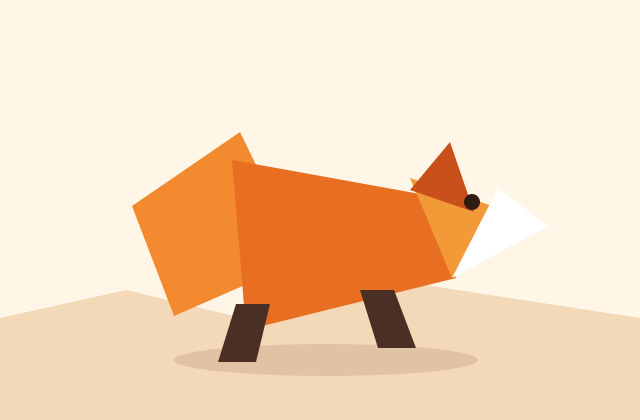
Cozy Animal Pack
Low-Poly Fox
A stylized animal prop for cozy games, woodland scenes and AR previews.
View details- Triangles
- 24
- Texture
- Flat color
- License
- Commercial use
- Formats
- OBJ
Protected STL download
Production export targets
Highlights
- Monochrome icon prop: 100-500 triangles
- Vehicle/building object: 800-3,000; hero character/creature: 3,000-9,000
- Use a limited 5-7 step grey ramp rather than arbitrary grey values
- Test after tone mapping because ACES/exposure can compress mid-greys
- Primary planes need light, mid and dark value groups for readability
- Thin bevel or inset edge accents can separate grey shapes without cartoon outlines
- Check renderer output color space in Three.js for stable greys
- GLB works for web portfolios; FBX fits Unity/Unreal greybox-to-final workflows
The style works across very different poly budgets because color is removed from the problem. A monochrome icon prop can be 100 to 500 triangles, an architectural object or vehicle 800 to 3,000, and a hero character or creature 3,000 to 9,000 depending on animation. The important rule is value separation: primary planes need distinct light, mid and dark groups so the asset remains readable without color labels.
The non-obvious technical detail is color management. Use a limited 5 to 7 step grey ramp in linear color space, then test the rendered result after tone mapping because bloom, exposure and ACES filmic curves can compress mid-greys and destroy separation. In Unity or Unreal, lock albedo values and let lighting do only a small amount of work; in Three.js, check the renderer output color space so a carefully chosen grey ramp does not shift unexpectedly in the browser.
Edges can be handled with geometry, not only outlines. A very thin dark bevel or inset plane around key forms can separate overlapping grey shapes while staying different from cartoon outline style. Avoid full black outlines on every object unless the page goal is a graphic ink look; monochrome low poly usually feels more architectural and editorial when the edge accents are sparse and tied to function, like door seams, vehicle windows or character armor plates.
Export GLB for web portfolios, UI scenes and AR previews, or FBX when the monochrome assets are part of a Unity or Unreal greybox-to-final workflow. Generated monochrome low poly assets are yours to use commercially with no attribution required, including product mockups, game prototypes, editorial visuals and paid asset packs.
Use value as the design system
Frequently asked questions
Is monochrome low poly just an untextured grey model?
No. It is a deliberate value-design style using planned light, mid and dark groups. An untextured grey material usually lacks the value separation needed for readability.
How many grey values should I use?
A 5-7 step grey ramp is usually enough. Too many grey values become muddy, while too few make complex objects hard to read.
Why do my grey values look different after export?
Tone mapping and output color space can shift or compress greys. Test after ACES/exposure in engines and verify Three.js output color space in the browser.
Should monochrome low poly use outlines?
Use sparse dark bevels or inset accents first. Full black outlines push the result toward cartoon style, while monochrome low poly usually relies on value and silhouette.
Can I use generated monochrome assets commercially?
Yes. Generated monochrome low poly assets are yours to use commercially with no attribution required, including product visuals, prototypes and paid packs.
Related
Browse allNeed a custom low-poly model?
Generate one from a text prompt or reference image, then export GLB, FBX, OBJ or STL.
Open the generator