
GLB Compressor
GLB compression is a delivery step: the goal is not the smallest possible file, but the best balance of download size, decode time and visual stability on the devices that will load the model.
Matching downloadable assets
Start with these seed models, then generate variants in the same low-poly direction.
Members unlock protected STL access
Use the free OBJ to test the shape. Subscribe for protected STL downloads now; GLB, FBX, USDZ and Unity are shown as production export targets, not direct library downloads yet.

Nature Starter Pack
Low-Poly Pine Tree
A lightweight forest prop with a trunk, two faceted foliage layers and a clean base pivot for scattering.
View details- Triangles
- 24
- Texture
- Flat color
- License
- Commercial use
- Formats
- OBJ
Protected STL download
Production export targets
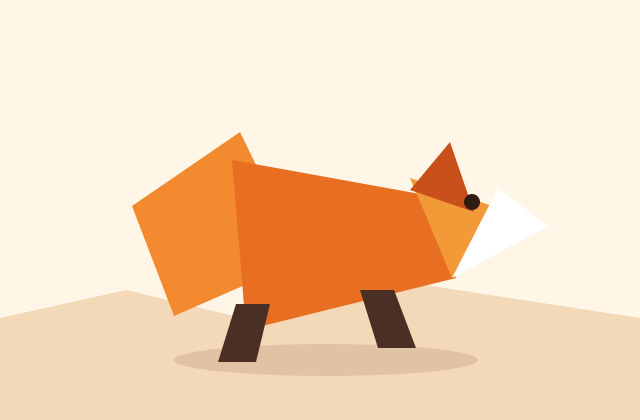
Cozy Animal Pack
Low-Poly Fox
A stylized animal prop for cozy games, woodland scenes and AR previews.
View details- Triangles
- 24
- Texture
- Flat color
- License
- Commercial use
- Formats
- OBJ
Protected STL download
Production export targets
Highlights
- Profile whether geometry buffers or embedded textures dominate the GLB size
- Draco can produce smaller geometry but may decode slower on phones
- Meshopt is often better for interactive web scenes because decode is fast
- Quantize positions, normals, tangents and UVs carefully, then inspect artifacts
- A low poly 600-triangle prop can still be huge if it embeds a 2048px PNG
- Use WebP or KTX2/Basis for textures when the target loader supports them
- Remove unused PBR maps from intentionally flat-shaded low poly models
- Measure final bytes and first-frame time, not file-size reduction alone
A GLB file usually contains three weight classes: geometry buffers, material JSON and embedded textures. On low poly assets, geometry is often not the largest part; a 600-triangle object with a 2048px PNG can be heavier than a 20k-triangle mesh with a 1024px compressed texture. Start by checking what dominates the file before choosing a compressor, because geometry compression will not fix a texture-heavy GLB.
Draco and meshopt solve the geometry part differently. Draco generally produces very small geometry streams, but decoding can be CPU-heavy and needs the loader to ship a Draco decoder. Meshopt compression is designed for fast GPU-friendly decode and pairs well with vertex-cache optimization; it is often the practical default for interactive web scenes. For a product viewer or configurator, shaving 200 KB is not useful if it adds a visible decode stall on mid-range phones.
Quantization reduces the precision of vertex attributes before or during compression. Positions, normals, tangents and UVs rarely need full 32-bit floats for a small low poly prop, but overdoing it can make straight edges shimmer, UV seams crawl or baked normals look dented. Test quantized output in the engine, not only in a file-size report, because the wrong normal precision can look fine in a neutral viewer and bad under your actual lights.
Texture compression is often the real win. Resize texture atlases to the actual viewing need, convert color maps to WebP for broad web use or KTX2/Basis when your GLB loader supports GPU-native transcoding, and avoid embedding unused metallic, roughness or normal maps for intentionally flat-shaded models. A good GLB compressor pipeline records both file size and first-frame time so the final choice is based on user experience, not just an impressive percentage reduction.
Compress in context
Frequently asked questions
What is the best GLB compression method?
There is no universal best. Draco often gives smaller geometry, while meshopt often gives faster decode. For web scenes, test both on the target phone or laptop.
Why is my compressed GLB still large?
Textures probably dominate the file. Resize the atlas and consider WebP or KTX2/Basis before expecting geometry compression to solve the size.
Can compression damage a low poly model?
Yes. Aggressive quantization can move vertices, roughen silhouettes, or cause UV seam artifacts. Inspect the final GLB under your actual lighting.
Should I use Draco for every GLB?
No. Draco requires decoder support and can add CPU decode cost. Use it when download size matters more than decode latency, and measure the tradeoff.
Does GLB compression reduce draw calls?
Not by itself. Compression reduces bytes. Draw calls come from mesh and material structure, so merge materials and primitives separately.
Related
Browse allNeed a custom low-poly model?
Generate one from a text prompt or reference image, then export GLB, FBX, OBJ or STL.
Open the generator