
Retopology
Retopology is the deliberate rebuild step that turns an attractive but messy sculpt, scan or generated mesh into a low poly asset that deforms, unwraps, bakes and exports predictably.
Matching downloadable assets
Start with these seed models, then generate variants in the same low-poly direction.
Members unlock protected STL access
Use the free OBJ to test the shape. Subscribe for protected STL downloads now; GLB, FBX, USDZ and Unity are shown as production export targets, not direct library downloads yet.

Nature Starter Pack
Low-Poly Pine Tree
A lightweight forest prop with a trunk, two faceted foliage layers and a clean base pivot for scattering.
View details- Triangles
- 24
- Texture
- Flat color
- License
- Commercial use
- Formats
- OBJ
Protected STL download
Production export targets
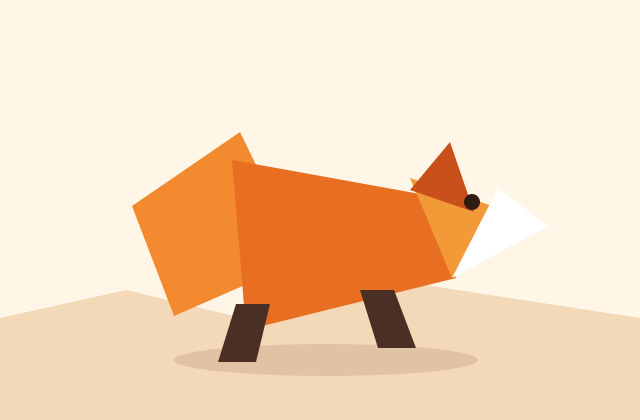
Cozy Animal Pack
Low-Poly Fox
A stylized animal prop for cozy games, woodland scenes and AR previews.
View details- Triangles
- 24
- Texture
- Flat color
- License
- Commercial use
- Formats
- OBJ
Protected STL download
Production export targets
Highlights
- Retopology rebuilds a new intentional mesh; decimation only removes existing triangles
- Spend topology on silhouette, deformation zones and visible bevels
- Characters need loops around eyes, mouth, shoulders, elbows, knees and hands
- Static props can use fewer loops and more triangular low poly shapes
- Bake-ready low props often land around 200-2,000 triangles
- Animated characters commonly target 5k-20k triangles depending on distance
- Triangulate before baking if the engine will triangulate on import
- Use manual retopo only where deformation, UVs or bakes would otherwise fail
The main difference between retopology and decimation is intent. Decimation removes triangles from the existing surface; retopology draws a new mesh over the source with edge flow chosen for the final use. A static rock can tolerate triangulated automatic reduction, but a shoulder, eyelid or hand needs loops that follow bending anatomy. Clean retopology is why a 7k-triangle character can animate better than a messy 50k-triangle scan.
For game assets, start by protecting the silhouette and all deformation zones. Characters need circular loops around eyes and mouth, support loops around elbows and knees, and enough shoulder geometry to rotate without collapsing. Hard-surface props need edges placed along visible bevels and material breaks, not randomly across flat panels. A good low poly mesh is not evenly dense; it spends triangles where the camera, silhouette and animation demand them.
Retopology is also the foundation for baking. The low mesh should sit close to the high mesh, have clean non-overlapping UVs, and leave enough padding between islands for mipmaps. Triangulate before baking if the engine will triangulate on import, because changing triangle diagonals after the bake can alter tangent-space normals. A bake-ready retopo cage for props often lands around 200 to 2,000 triangles, while animated characters commonly sit between 5k and 20k depending on camera distance.
Use manual retopology for hero assets, animated characters, VRChat avatars, hands, faces and anything that will be inspected close up. Use automatic remesh or decimation for background static objects and first-pass LODs. The production trick is not to retopologize everything by hand; it is to spend manual topology only where poor edge flow would create visible deformation, bad UVs or unstable normal bakes.
Retopology pipeline
Frequently asked questions
When should I retopologize instead of decimate?
Retopologize anything that deforms, sits close to camera, needs clean UVs or must bake details reliably. Decimate static background geometry and rough LODs.
Does a low poly model need quads?
Not everywhere. Quads are valuable for deformation and editable edge flow, while static faceted props can finish as triangulated meshes.
What triangle count should a retopologized character use?
A practical range is 5k to 20k triangles, with the lower end for mobile and crowds and the higher end for close hero characters.
Why did my normal bake look wrong after retopology?
Common causes are an offset cage, overlapping UVs, too little padding, or triangulating after the bake instead of before it.
Can automatic retopology replace manual retopo?
It can help with rough static assets, but manual edge flow is still better for faces, hands, shoulders and any hero deformation area.
Related
Browse allNeed a custom low-poly model?
Generate one from a text prompt or reference image, then export GLB, FBX, OBJ or STL.
Open the generator