
STL to OBJ Converter
STL to OBJ conversion is useful when a printable triangle shell needs to be edited, retopologized or textured, but it cannot restore the UVs, materials or object names STL never stored.
Matching downloadable assets
Start with these seed models, then generate variants in the same low-poly direction.
Members unlock protected STL access
Use the free OBJ to test the shape. Subscribe for protected STL downloads now; GLB, FBX, USDZ and Unity are shown as production export targets, not direct library downloads yet.

Nature Starter Pack
Low-Poly Pine Tree
A lightweight forest prop with a trunk, two faceted foliage layers and a clean base pivot for scattering.
View details- Triangles
- 24
- Texture
- Flat color
- License
- Commercial use
- Formats
- OBJ
Protected STL download
Production export targets
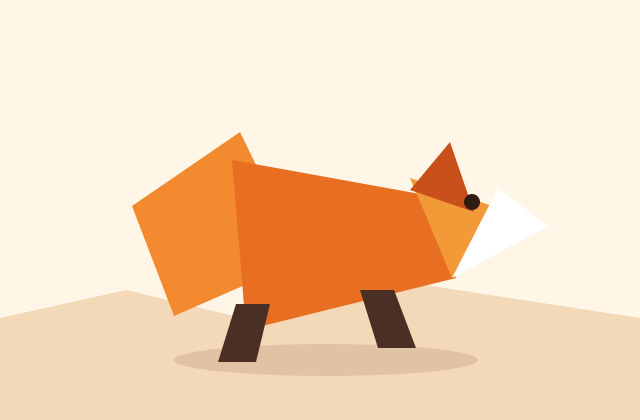
Cozy Animal Pack
Low-Poly Fox
A stylized animal prop for cozy games, woodland scenes and AR previews.
View details- Triangles
- 24
- Texture
- Flat color
- License
- Commercial use
- Formats
- OBJ
Protected STL download
Production export targets
Highlights
- STL stores raw triangles and normals only; no UVs, materials, hierarchy or object names
- OBJ can hold UVs, groups, normals and MTL material references
- Conversion creates an editable container but cannot recover missing STL data
- Check units immediately because STL is commonly interpreted as millimeters
- Dense STL triangle soup often needs decimation, remeshing or retopology
- Repair non-manifold edges, duplicate internal faces and thin sliver triangles
- Rebuild materials and UVs after conversion if the asset will be textured
- Use OBJ as an editing bridge, then export GLB or FBX for engines when needed
STL is one of the simplest 3D formats: it stores triangle positions and face normals, usually with no reliable unit declaration, no UVs, no material assignments, no hierarchy and no object names. OBJ can store UV coordinates, vertex normals, groups and material references through a companion MTL file. Converting STL to OBJ therefore creates a more editable container, but it does not magically recover missing authoring data.
The first technical issue is scale. Many slicers treat STL numbers as millimeters, while game and DCC workflows often expect meters or generic scene units. A figurine STL that is 80 units tall may import into Blender as 80 meters if the unit context is wrong, or into a game pipeline far larger than expected. Always set scene units and measure a known dimension after import before retopology or UV work begins.
The second issue is topology. STL is already triangulated and often contains dense, irregular triangles optimized for slicing rather than editing. For a low poly game asset, converting to OBJ is only the first step; you may still need decimation, remeshing or full retopology to get clean edge flow and sensible UV islands. If the STL came from a scan or sculpt, expect non-manifold edges, duplicate internal faces or very thin triangles that must be cleaned before export.
Once the OBJ is created, rebuild the missing surface data deliberately. Assign new materials, unwrap UVs, bake or paint textures, and recalculate normals so the mesh shades predictably. OBJ is a good intermediate format for static editing and texturing, but if the final destination is web or an engine, the cleaned asset will usually continue to GLB or FBX after materials and UVs are rebuilt.
Continue after STL conversion
Frequently asked questions
Can STL to OBJ restore textures?
No. STL does not store UVs or texture references, so conversion cannot restore them. You must unwrap and assign materials again.
Why is my converted OBJ the wrong size?
STL has no reliable unit declaration and slicers often assume millimeters. Set scene units and measure a known dimension after import.
Is STL to OBJ good for game assets?
It can be the first step, but STL topology is usually dense triangle soup. Decimate, remesh or retopologize before using it in a game.
Will object names survive from STL?
Usually no. STL does not carry a useful scene hierarchy or named groups, so you should rename and organize objects after conversion.
Should I export OBJ or GLB after editing?
Use OBJ for static interchange during editing. Export GLB for web/Godot/AR or FBX for Unity/Unreal once UVs and materials are rebuilt.
Related
Browse allNeed a custom low-poly model?
Generate one from a text prompt or reference image, then export GLB, FBX, OBJ or STL.
Open the generator