
UV Unwrap Low Poly Models
A low poly UV unwrap is successful when it supports the rendering budget: one atlas, readable colors, stable seams, enough padding for mipmaps and no wasted pixels on hidden faces.
Matching downloadable assets
Start with these seed models, then generate variants in the same low-poly direction.
Members unlock protected STL access
Use the free OBJ to test the shape. Subscribe for protected STL downloads now; GLB, FBX, USDZ and Unity are shown as production export targets, not direct library downloads yet.
Nature Starter Pack
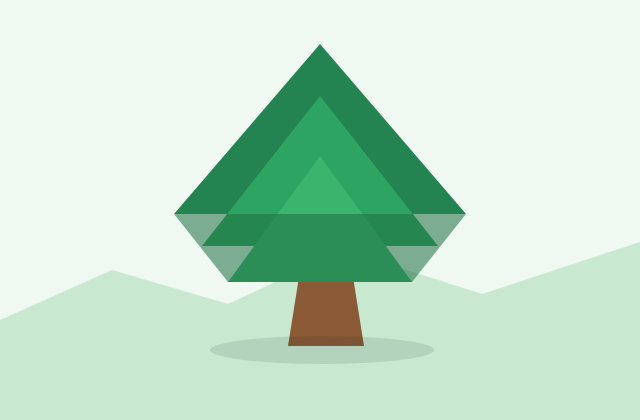
Low-Poly Pine Tree
A lightweight forest prop with a trunk, two faceted foliage layers and a clean base pivot for scattering.
View details- Triangles
- 24
- Texture
- Flat color
- License
- Commercial use
- Formats
- OBJ
Protected STL download
Production export targets
Cozy Animal Pack
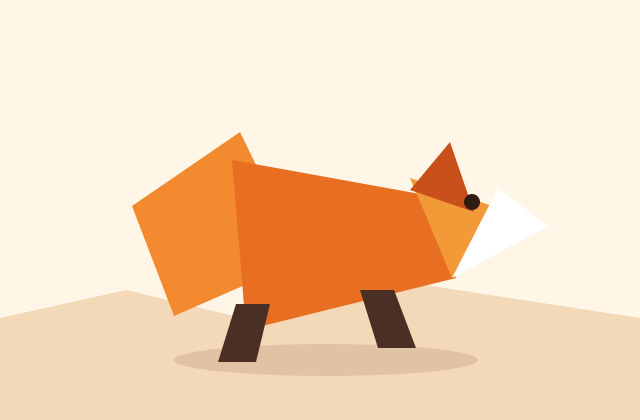
Low-Poly Fox
A stylized animal prop for cozy games, woodland scenes and AR previews.
View details- Triangles
- 24
- Texture
- Flat color
- License
- Commercial use
- Formats
- OBJ
Protected STL download
Production export targets
Highlights
- Use one 512-1024px atlas for most prop kits to keep draw calls low
- Flat-color UVs can reuse color blocks; baked gradients need unique UV space
- Place seams on underside edges, hard material breaks and natural panel lines
- Avoid seams through large visible gradients because mipmaps can bleed
- Use 4-8px padding on a 1024px atlas, more for heavy WebGL minification
- Allocate texel density by camera importance, not only real object size
- Keep UVs even when using vertex colors if light baking or AO is needed
- Do not change UVs after normal or AO baking unless you rebake maps
Low poly art often looks simple, but UV layout still matters because it controls draw calls and texture memory. A single 512 or 1024px atlas can cover a full prop kit if color regions are packed deliberately, while separate materials for every color multiply draw calls in Unity, WebGL and mobile engines. For flat-color assets, UV islands can be compact and reuse color blocks; for baked gradients or light maps, islands need unique space and consistent orientation.
Seam placement should follow natural breaks: underside edges, hard material changes, clothing seams, roof corners, armor panels and back-facing edges. Avoid seams across large visible gradients because mipmaps can bleed color at distance. Add padding between islands, typically 4 to 8 pixels on a 1024px atlas and more if the asset will be minified heavily in WebGL. When using texture atlases across a kit, leave enough gutter that compression and mipmaps do not pull neighboring colors into the island.
Texel density should match camera importance, not object size alone. A hero sword handle seen close up may deserve more UV area than the underside of a house roof. For mobile and WebGL, 512px props and 1024px hero props are usually enough for flat-shaded low poly art; 2048px is best reserved for characters, vehicles or close inspection assets. If the style uses vertex colors instead of textures, UVs may still be needed for light baking, AO or export compatibility.
A practical workflow is to mark seams, unwrap, straighten hard-surface islands, pack to a target atlas, then test with a checker texture and the final color map. Look for stretching on bevels, mirrored text, inconsistent gradient directions and mip bleed around thin islands. UV unwrap comes before normal baking and final GLB/FBX export, because changing UVs after a bake invalidates the texture maps that depend on that layout.
UVs in the full asset pipeline
Frequently asked questions
Do low poly models need UVs?
Usually yes. Even if the model uses flat colors or vertex colors, UVs are needed for atlases, baked gradients, AO, light maps and many export workflows.
What texture size should I use?
Use 512px for small props, 1024px for hero props or kits, and 2048px only for close characters or inspection assets.
Where should I place UV seams?
Place seams on hidden edges, underside faces, hard material breaks and natural panel boundaries. Avoid cutting through prominent gradients or faces.
Why do colors bleed at distance?
Mipmaps and compression sample neighboring pixels when islands have too little padding. Increase gutter space and avoid placing contrasting colors too close.
Can I unwrap after baking normals?
No. Normal, AO and gradient bakes depend on the UV layout. If you change UVs afterward, rebake the maps.
Related
Browse allNeed a custom low-poly model?
Generate one from a text prompt or reference image, then export GLB, FBX, OBJ or STL.
Open the generator