
Low Poly Models for React Three Fiber
React Three Fiber wraps Three.js in React's component and hook model, which solves the awkward manual scene-graph bookkeeping vanilla Three.js requires but introduces its own specific patterns, useGLTF caching, Suspense boundaries and JSX-generated components, that a low poly model needs to be exported and structured correctly to take full advantage of.
Matching downloadable assets
Start with these seed models, then generate variants in the same low-poly direction.
Members unlock protected STL access
Use the free OBJ to test the shape. Subscribe for protected STL downloads now; GLB, FBX, USDZ and Unity are shown as production export targets, not direct library downloads yet.

Nature Starter Pack
Low-Poly Pine Tree
A lightweight forest prop with a trunk, two faceted foliage layers and a clean base pivot for scattering.
View details- Triangles
- 24
- Texture
- Flat color
- License
- Commercial use
- Formats
- OBJ
Protected STL download
Production export targets
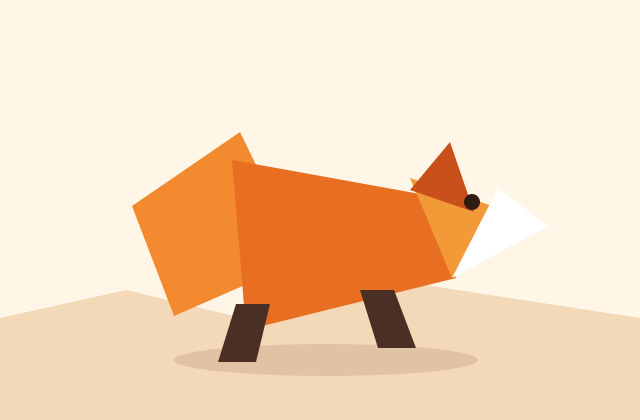
Cozy Animal Pack
Low-Poly Fox
A stylized animal prop for cozy games, woodland scenes and AR previews.
View details- Triangles
- 24
- Texture
- Flat color
- License
- Commercial use
- Formats
- OBJ
Protected STL download
Production export targets
Highlights
- drei's useGLTF hook wraps GLTFLoader with automatic URL-keyed caching — load once, reuse across components
- useGLTF must be called inside a Suspense boundary with a fallback; calling it outside throws rather than waiting silently
- gltfjsx converts a GLB into a JSX component file with named <mesh>/<group> nodes preserved from Blender
- A generated component gives direct JSX access to named sub-parts (a chest lid, individual armor pieces) for interaction
- drei's <Instances>/<Instance> render many copies through one InstancedMesh — the correct choice for dozens/hundreds of repeated props
- drei's <Clone> reuses geometry/materials without instancing's draw-call savings, useful only for a handful of independent copies
- Flat-shaded baked-material low poly assets usually need only one ambient + directional light, not a full PBR rig
- drei's useAnimations wraps Three.js's AnimationMixer and exposes named clips as React-friendly actions
The standard way to load a GLB in React Three Fiber is drei's useGLTF hook, which wraps Three.js's own GLTFLoader but adds automatic caching keyed by URL, so calling useGLTF('/model.glb') from five different components in the same scene loads and parses the file only once rather than five times, a meaningful difference for a scene using the same low poly rock or barrel mesh repeatedly. Because loading is asynchronous, useGLTF must be called inside a component wrapped in React's Suspense, with a fallback (commonly drei's Html loader or a simple placeholder mesh) shown while the GLB streams in, which is the single most common setup mistake newcomers hit: a useGLTF call outside Suspense throws rather than silently waiting.
The gltfjsx command-line tool, run once during development rather than at runtime, converts a GLB into a ready-made JSX component file, generating explicit <mesh> and <group> nodes with the geometry and material references already wired up, node names preserved from Blender, and even TypeScript types when requested. This is the recommended production path for any low poly model with more than a trivial hierarchy, since a generated component gives you direct JSX access to individual named parts, a chest's separately-pivoted lid, a knight's individual armor pieces, for per-part animation or interaction, rather than digging through the raw useGLTF scene graph via string-based node lookups at runtime.
Instancing repeated low poly props, exactly the pattern this site's rocks, trees and barrels are built around, has a dedicated drei helper: <Instances> and <Instance> render many copies of the same geometry and material through a single THREE.InstancedMesh under the hood, which is dramatically cheaper than mounting fifty separate <mesh> components from the same GLB. Drei's simpler <Clone> component reuses a loaded GLTF's geometry and material references without instancing's draw-call savings, useful for a handful of repeated objects with independent per-instance state, but Instances is the correct choice once a scene needs dozens or hundreds of the same low poly rock or foliage clump.
Because a low poly model here already ships with baked flat-color or gradient materials rather than a full PBR texture set, most React Three Fiber scenes need little beyond a single ambientLight and directionalLight, or an <Environment> preset from drei for a soft ambient fill, rather than a complex lighting rig; over-lighting a flat-shaded low poly asset with multiple realistic lights tends to wash out the faceted look that makes the style read clearly in the first place. Keep animation mixing (a rigged character's walk cycle, a chest lid opening) through drei's useAnimations hook, which wraps Three.js's AnimationMixer and exposes named clips directly as React-friendly actions.
Low poly assets and React Three Fiber pair naturally for interactive product pages, portfolio 3D showcases, configurator experiences built in a modern web stack, and game prototypes that want React's component model rather than a traditional game-engine editor. Everything generated here is yours to use commercially with no attribution required, so a GLB loaded through useGLTF, cloned via gltfjsx, or instanced through drei can ship inside a commercial React application without any additional licensing step.
Round out the web pipeline
Frequently asked questions
How do I load a GLB model in React Three Fiber?
Use drei's useGLTF hook, which wraps Three.js's GLTFLoader and automatically caches by URL. It must be called inside a component wrapped in React's Suspense with a loading fallback, since the load is asynchronous.
What does gltfjsx do and why use it?
gltfjsx is a command-line tool that converts a GLB into a ready-made JSX component with named mesh and group nodes preserved from Blender. It is the recommended production path for any model with more than a trivial hierarchy, since it gives direct JSX access to individual named parts.
How do I render dozens of the same low poly prop efficiently?
Use drei's <Instances> and <Instance> components, which render many copies of one geometry and material through a single InstancedMesh. This is dramatically cheaper than mounting many separate mesh components from the same GLB.
What is the difference between drei's <Clone> and <Instances>?
<Clone> reuses a loaded model's geometry and materials without instancing's draw-call savings, fine for a handful of independent copies. <Instances> is the correct choice once a scene needs dozens or hundreds of repeated objects.
Can I use generated low poly models in a commercial React Three Fiber app?
Yes. Generated models are yours to use commercially with no attribution required, whether loaded via useGLTF, converted with gltfjsx, or rendered through drei's instancing helpers.
Related
Browse allNeed a custom low-poly model?
Generate one from a text prompt or reference image, then export GLB, FBX, OBJ or STL.
Open the generator