
Low Poly Bird 3D Model
A low poly bird succeeds or fails on the wing silhouette: the body can be tiny, but the wing planes, tail fan and beak need to read clearly from above, from the side, and during a fast flap cycle.
Matching downloadable assets
Start with these seed models, then generate variants in the same low-poly direction.
Members unlock protected STL access
Use the free OBJ to test the shape. Subscribe for protected STL downloads now; GLB, FBX, USDZ and Unity are shown as production export targets, not direct library downloads yet.
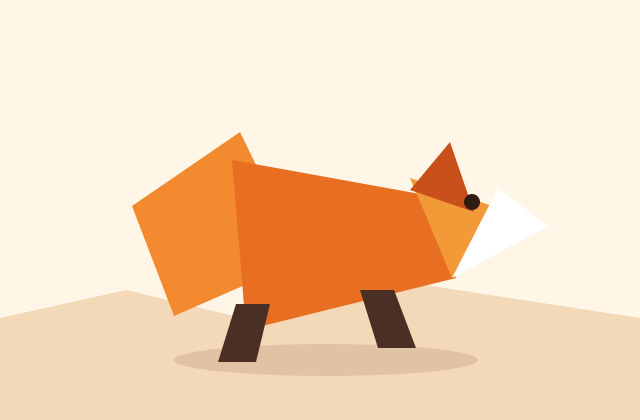
Cozy Animal Pack
Low-Poly Fox
A stylized animal prop for cozy games, woodland scenes and AR previews.
View details- Triangles
- 24
- Texture
- Flat color
- License
- Commercial use
- Formats
- OBJ
Protected STL download
Production export targets

Nature Starter Pack
Low-Poly Pine Tree
A lightweight forest prop with a trunk, two faceted foliage layers and a clean base pivot for scattering.
View details- Triangles
- 24
- Texture
- Flat color
- License
- Commercial use
- Formats
- OBJ
Protected STL download
Production export targets

Vehicle Starter Pack
Low-Poly Arcade Car
A simple separated-wheel vehicle mesh for racing prototypes, traffic fillers and WebGL demos.
View details- Triangles
- 30
- Texture
- Material slots
- License
- Commercial use
- Formats
- OBJ
Protected STL download
Production export targets
Highlights
- Perched/background bird: 300-900 triangles
- Animated game bird: 1,200-3,500 triangles; hero bird: 5,000-8,000 with LODs
- Wing rig needs shoulder, elbow and wrist bones, not one flap bone
- Outer wing should use 3-5 feather fan controls for spread and tuck poses
- Tail fan bone chain supports banking and steering silhouettes
- One 512-1024px atlas covers body, markings, beak and feet
- GLB works well for web/AR; FBX preserves animation clips for Unity/Unreal
- Perched poses print better than flying poses unless a support rod is added
A small perched bird or background flock member reads clearly at 300 to 900 triangles, because most of the recognizable form is carried by the beak, wing outline and tail fan. A game-ready animated bird should usually sit between 1,200 and 3,500 triangles so each wing has enough segments to fold, spread and bank without collapsing into a flat paddle. A close hero bird, such as a companion hawk or magical owl, can use 5,000 to 8,000 triangles with LODs, but spend the extra budget on wing edge breaks and head markings rather than individual feathers.
The non-obvious rigging detail is that a convincing bird wing is not one arm bone with a flap animation. It needs a shoulder, elbow and wrist chain, plus 3 to 5 feather fan controls or deformers along the outer wing so the trailing edge can spread during a downstroke and tuck during the upstroke. If the wrist does not fold inward, the bird will look like a paper airplane even when the body bobs correctly. Keep the wing mesh as broad flat planes with clean hinge loops at shoulder and wrist, then use a short tail fan bone chain for steering poses.
Birds often appear in groups, so material strategy matters. Put the body, wing markings, beak and feet on one 512px or 1024px atlas, then generate color variants that share the same skeleton and UVs. In Unity, Godot or Three.js, a flock should reuse one base mesh with different material tint values rather than unique geometry for every bird. For AR or educational scenes, export GLB and keep the real-world scale believable: a sparrow-sized model placed at eagle scale feels wrong instantly because users compare it to real furniture and hands.
Use FBX when you need skeletal animation clips for Unity or Unreal, and GLB for Godot, WebGL, Three.js and AR previews. For 3D printing, pick a perched pose rather than a mid-flight pose unless you plan to add a transparent support rod, because thin wings and legs do not survive handling without extra thickness. Everything generated here is yours to use commercially with no attribution required, so a bird flock can ship in a game, appear in a paid nature kit, or become a printed desk figurine.
Build the animal scene
Frequently asked questions
How many triangles should a low poly bird use?
A perched or background bird works at 300-900 triangles. An animated game bird needs 1,200-3,500 so the wings fold cleanly, while a close hero bird can use 5,000-8,000 with LODs.
What makes a bird wing rig look believable?
Use shoulder, elbow and wrist bones plus 3-5 outer feather fan controls. The wrist must fold inward and the trailing edge must spread and tuck; otherwise the bird reads as a rigid paper glider.
Can I make a whole flock from one bird model?
Yes. Use one shared skeleton and UV layout, then make color variants through material tints or atlas regions so dozens of birds render cheaply without unique geometry.
Is a low poly bird good for 3D printing?
Yes, but perched poses are safer. Flying poses need thicker wings, thicker legs, or a support rod because thin extended wings are fragile after printing.
Can I use generated bird models commercially?
Yes. Generated bird models are yours to use commercially with no attribution required, including in shipped games, paid asset packs and printed figurines.
Related
Browse allNeed a custom low-poly model?
Generate one from a text prompt or reference image, then export GLB, FBX, OBJ or STL.
Open the generator