
Low Poly Cloud 3D Model
A low poly cloud looks simple, but it sits in the most visible part of a scene and can ruin performance if every puff is unique. Good clouds use a strong silhouette, repeated lobes and the right choice between mesh, billboard and skybox.
Matching downloadable assets
Start with these seed models, then generate variants in the same low-poly direction.
Members unlock protected STL access
Use the free OBJ to test the shape. Subscribe for protected STL downloads now; GLB, FBX, USDZ and Unity are shown as production export targets, not direct library downloads yet.

Nature Starter Pack
Low-Poly Pine Tree
A lightweight forest prop with a trunk, two faceted foliage layers and a clean base pivot for scattering.
View details- Triangles
- 24
- Texture
- Flat color
- License
- Commercial use
- Formats
- OBJ
Protected STL download
Production export targets
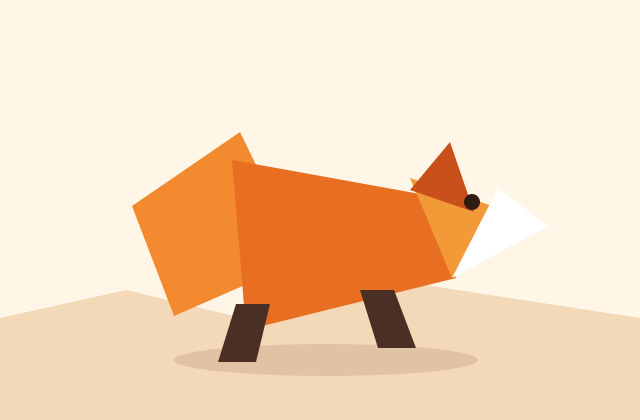
Cozy Animal Pack
Low-Poly Fox
A stylized animal prop for cozy games, woodland scenes and AR previews.
View details- Triangles
- 24
- Texture
- Flat color
- License
- Commercial use
- Formats
- OBJ
Protected STL download
Production export targets

Vehicle Starter Pack
Low-Poly Arcade Car
A simple separated-wheel vehicle mesh for racing prototypes, traffic fillers and WebGL demos.
View details- Triangles
- 30
- Texture
- Material slots
- License
- Commercial use
- Formats
- OBJ
Protected STL download
Production export targets
Highlights
- Small decorative cloud: 60-180 triangles
- Mobile/WebGL midground cloud: 250-800 triangles
- Desktop fly-through cloud bank: 1,500-4,000 triangles per LOD cluster
- Use billboard cards or skyboxes for distant non-interactive clouds
- Cloud origin should sit at visual center of mass for wind-path animation
- Apply lobe transforms so culling bounds do not pop at screen edges
- Solid opaque cloud meshes avoid alpha-blend sorting halos in WebGL
- Use projected blob shadows instead of expensive real-time cloud shadows
A tiny decorative cloud mesh can be 60 to 180 triangles, built from a few faceted lobes. A midground floating cloud for a mobile or WebGL scene usually sits between 250 and 800 triangles, while a close fly-through cloud bank on desktop can use 1,500 to 4,000 triangles per cluster if it is broken into LODs. For a distant sky, do not model every cloud: use flat billboard cards or a skybox texture, because a cloud that never receives player interaction does not need three-dimensional volume.
Clouds have a special pivot requirement. Put the object origin at the visual center of mass rather than the bottom, because clouds are positioned in 3D space, animated along wind paths and often rotated around their centers for subtle drift. If the cloud is made from separate lobes, keep their transforms applied after arranging the puff cluster so the combined bounding box stays stable for culling. Bad bounds are a common reason clouds pop out of view at screen edges.
The non-obvious rendering issue is transparency sorting. Many stylized clouds are tempting to build as semi-transparent planes, but alpha blending sorts poorly when cards overlap and can create flickering halos in WebGL. A solid low poly cloud mesh with flat white and blue-grey materials often looks cleaner and renders in the opaque pass. If you must use billboard clouds, prefer alpha-tested edges over heavy alpha blending, and keep them in a dedicated sky layer so they never intersect gameplay geometry.
Lighting should be simple and consistent. Use one bright top material, one side material and one cooler underside material rather than relying on real-time shadows from every cloud lobe. Real-time cloud shadows are expensive and often noisy in stylized scenes; if the design needs moving shadows, project a simple transparent blob or use a shader mask on the ground instead of enabling shadow casting on every cloud mesh.
Low poly clouds fit sky islands, cozy farm scenes, racing horizons, AR weather toys and WebGL hero backgrounds. Export GLB for browser and Godot scenes, FBX for Unity and Unreal sky layers, or use generated cloud meshes as source assets for a baked skybox. Generated cloud models are yours for commercial use with no attribution required.
Complete the sky and scene
Frequently asked questions
How many triangles should a low poly cloud use?
Small decorative clouds can use 60-180 triangles. Mobile or WebGL midground clouds usually need 250-800, and close desktop cloud banks can use 1,500-4,000 per cluster with LODs.
Should clouds be 3D meshes or billboard cards?
Use 3D meshes for nearby readable clouds and billboard cards or a skybox for distant clouds that never interact with the player.
Where should a cloud pivot be?
Put the origin at the cloud center of mass, not the bottom. Clouds drift and rotate in space, so center pivots produce cleaner wind-path animation.
Why do transparent cloud cards flicker in WebGL?
Alpha-blended planes can sort incorrectly when they overlap. Opaque faceted cloud meshes or alpha-tested billboards in a separate sky layer are more predictable.
Can I use generated clouds commercially?
Yes. Generated cloud models and sky assets are yours to use in commercial games, WebGL scenes, AR demos and asset packs with no attribution required.
Related
Browse allNeed a custom low-poly model?
Generate one from a text prompt or reference image, then export GLB, FBX, OBJ or STL.
Open the generator