
Low Poly Castle 3D Model
A castle is rarely a single object in a real production: it is a modular kit of repeating wall, tower and gatehouse pieces, and treating it that way is what keeps a fortress that dominates a skyline from also dominating your triangle budget.
Matching downloadable assets
Start with these seed models, then generate variants in the same low-poly direction.
Members unlock protected STL access
Use the free OBJ to test the shape. Subscribe for protected STL downloads now; GLB, FBX, USDZ and Unity are shown as production export targets, not direct library downloads yet.

Nature Starter Pack
Low-Poly Pine Tree
A lightweight forest prop with a trunk, two faceted foliage layers and a clean base pivot for scattering.
View details- Triangles
- 24
- Texture
- Flat color
- License
- Commercial use
- Formats
- OBJ
Protected STL download
Production export targets
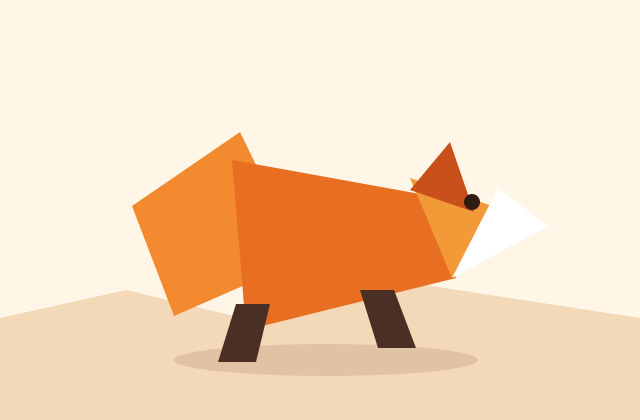
Cozy Animal Pack
Low-Poly Fox
A stylized animal prop for cozy games, woodland scenes and AR previews.
View details- Triangles
- 24
- Texture
- Flat color
- License
- Commercial use
- Formats
- OBJ
Protected STL download
Production export targets
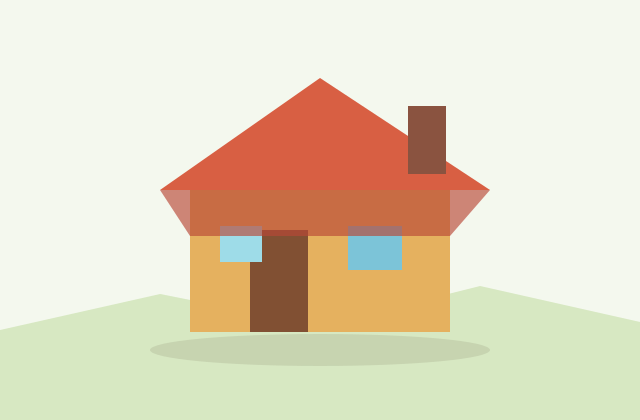
Village Starter Pack
Low-Poly Cottage House
A compact village building for cozy sims, isometric towns and stylized environment blocking.
View details- Triangles
- 18
- Texture
- Flat color
- License
- Commercial use
- Formats
- OBJ
Protected STL download
Production export targets
Highlights
- Wall segment module: 300-800 triangles; corner tower: 1,500-3,000; gatehouse: 2,000-4,000
- Full walkable castle from repeated kit pieces: 8,000-25,000 triangles total
- Skyline-only background castle: a few hundred triangles or a flat billboard card
- Godot MultiMeshInstance3D batches repeated merlons/torches in one draw call
- Unity SRP Batcher + GPU instancing rewards a small reused-mesh kit
- Portcullis pivots from the top of the grille; drawbridge pivots at the hinge line
- Single shared 1024px atlas for stone, wood gate and metal accents
- Model moat/lake as a separate flat plane with its own collider
Polycount for a castle depends entirely on how close the camera gets and how much of it is walkable. A single repeating wall segment with battlements reads clearly at 300 to 800 triangles, a corner tower runs 1,500 to 3,000, and a gatehouse with a portcullis and arch detail lands around 2,000 to 4,000. Assemble a full walkable castle from a kit of these pieces and the whole scene typically totals 8,000 to 25,000 triangles, still cheap because most of that budget is repeated geometry rather than unique modeling. A castle that only needs to read as a skyline landmark far in the background can drop to a few hundred triangles as a blocked-out silhouette, or even a flat billboard card if the player never approaches it.
Because a castle is fundamentally repetitive, the engines you target reward that repetition directly rather than just tolerating it. Godot's MultiMeshInstance3D node exists almost exactly for this case: it draws hundreds of repeated merlons, torches or wall segments in a single draw call while each instance still keeps its own transform, which is dramatically cheaper than instancing the same prefab hundreds of times through the normal scene tree. Unity gets a similar win from its SRP Batcher and GPU instancing, since a castle built from a small kit of unique meshes (one wall type, one tower type, one gate) reuses so few materials that batching does most of the work automatically. Export FBX for Unity and Unreal to keep each wall, tower and gate as a separate importable object; export GLB for Godot, the web and AR so the whole kit bundles into one file with baked materials intact.
A portcullis or drawbridge needs its own mesh, separated from the gatehouse body, with the pivot placed deliberately rather than left at the mesh center. A portcullis pivots from the top of the grille so it can translate straight down along a track when raised or lowered by script or animation; a drawbridge pivots along its hinge line at the base of the gate opening so it swings up and down correctly. Skipping this separation is the single most common reason a "finished" castle gate looks static and dead in-engine even after a rigger adds an animation clip to it.
Texturing stays deliberately restrained: a single shared 1024x1024 atlas usually covers the stone wall surface, a wooden door and gate material, and a small set of metal accents for hinges, chains and torch brackets. Flat-shaded stone tones with a baked gradient for weathering or moss reads far better at a distance than a photoreal PBR stone texture, which tends to turn into visual noise once the castle is scaled down to fit a skyline. If the castle sits beside water, model the moat or lake as a flat plane with its own simple collider rather than folding water collision into the castle mesh itself.
Low poly castles anchor fantasy RPG capital cities, tower-defense and siege game centerpieces, tabletop VTT battle-map dioramas, and isometric strategy-map landmarks. Everything generated here is yours to use commercially with no attribution required, so a castle you generate can headline a shipped RPG, a paid asset pack, or a printed tabletop terrain piece without any licensing question. Generate one keep you like, then request matching wall and tower variants so an entire fortified city shares the same stone color, battlement style and proportions.
Build out the fortress
Frequently asked questions
How many triangles should a low poly castle be?
It depends on proximity: individual wall/tower/gate modules run 300-4,000 triangles each, a full walkable castle assembled from a kit totals 8,000-25,000, and a distant skyline-only castle can drop to a few hundred triangles or a flat billboard.
Why build a castle from repeated modules instead of one mesh?
Repetition is what real engines reward: Godot's MultiMeshInstance3D and Unity's SRP Batcher both draw a small kit of reused wall/tower/gate meshes far more cheaply than one giant unique mesh, and modules also let you resize or reshape the fortress layout without re-modeling.
How should a portcullis or drawbridge be rigged?
Keep it as its own mesh separate from the gatehouse body. A portcullis needs its pivot at the top of the grille so it slides straight down a track; a drawbridge needs its pivot at the hinge line at the base of the opening so it swings correctly.
What format should I export a modular castle kit in?
FBX for Unity and Unreal keeps each wall, tower and gate as a separate importable object with its hierarchy intact. GLB is the better choice for Godot, the web and AR since it bundles the whole kit with materials into one file.
Can I use a generated castle in a commercial game or asset pack?
Yes. Generated castle models are yours to use commercially with no attribution required, including in a shipped RPG, a paid asset pack, or printed tabletop terrain.
Related
Browse allNeed a custom low-poly model?
Generate one from a text prompt or reference image, then export GLB, FBX, OBJ or STL.
Open the generator