
Low Poly Furniture and Interior Prop Generator
Generate low poly furniture props for architectural visualization, life sims, and interior scenes, built at real-world scale with base pivots so they sit flat and place cleanly.
Matching downloadable assets
Start with these seed models, then generate variants in the same low-poly direction.
Members unlock protected STL access
Use the free OBJ to test the shape. Subscribe for protected STL downloads now; GLB, FBX, USDZ and Unity are shown as production export targets, not direct library downloads yet.

Nature Starter Pack
Low-Poly Pine Tree
A lightweight forest prop with a trunk, two faceted foliage layers and a clean base pivot for scattering.
View details- Triangles
- 24
- Texture
- Flat color
- License
- Commercial use
- Formats
- OBJ
Protected STL download
Production export targets
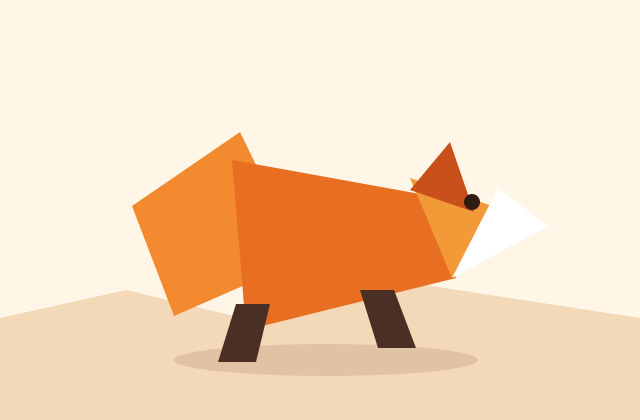
Cozy Animal Pack
Low-Poly Fox
A stylized animal prop for cozy games, woodland scenes and AR previews.
View details- Triangles
- 24
- Texture
- Flat color
- License
- Commercial use
- Formats
- OBJ
Protected STL download
Production export targets

Vehicle Starter Pack
Low-Poly Arcade Car
A simple separated-wheel vehicle mesh for racing prototypes, traffic fillers and WebGL demos.
View details- Triangles
- 30
- Texture
- Material slots
- License
- Commercial use
- Formats
- OBJ
Protected STL download
Production export targets
Highlights
- Cohesive modular furniture sets so pieces mix and match across a room
- Built at true real-world scale so they place correctly in archviz, sims, and AR
- Pivot at the base of each piece so furniture sits flush and snaps to the floor
- Modest budget of 200-2,000 triangles per piece to furnish whole interiors
- Single shared atlas at 1024-2048px with flat color and baked ambient occlusion
- Recolor atlas regions for fabric and wood-tone variants without new geometry
- USDZ for iOS AR Quick Look and GLB for Android and web AR placement
- FBX preserves base pivots and slots for Unity and Unreal archviz scenes
Furniture is the backbone of any interior scene. Whether you are dressing a room for archviz, filling a house in a life sim, or staging a showroom, the sofa, table, bookshelf, and lamp are what make a space feel lived-in. Our generator produces these interior props as clean faceted forms in cohesive sets, so a sofa and its matching armchair, or a dining table and its chairs, share a consistent style. Designing furniture as modular sets means you can mix and match pieces to furnish an entire home from a small, coordinated library.
For furniture, real-world scale is not optional, it is essential. A chair has to be the height a character can sit on, a table has to clear the chairs, and a doorway has to admit a sofa. Our models are built to true real-world dimensions so they drop into an architectural scene or a sim grid without rescaling, and so AR placement looks correct. Pair that with a pivot point set at the base of each piece, which is what lets furniture sit flush on the floor and snap to a grid or surface without floating or sinking.
Polycount stays modest because interior props do not need dense geometry to read well, typically 200 to 2,000 triangles per piece. A simple stool might be a couple hundred triangles, an upholstered sofa with cushions and a detailed bookshelf reaching toward the upper end. That budget lets you furnish a full room, or a whole apartment building of repeated units, while keeping the scene light. For larger interiors, build LODs so distant rooms swap to cheaper meshes and the frame budget holds.
Texturing follows the shared-atlas approach that keeps interiors performant. Wood grain, fabric, metal, and upholstery details bake into a single atlas, around 1024 to 2048 pixels, with flat color and baked ambient occlusion giving each piece soft, grounded shading. Because a whole furniture set can share one material, a furnished room stays at a low draw-call count even when it is packed with props. Recoloring atlas regions lets you offer the same sofa in several fabrics or the same table in different wood tones, expanding a set without new geometry.
AR is a standout use case for furniture, which is why format matters here. Export USDZ for iOS AR Quick Look so a shopper can place a sofa in their living room through the camera and check that it fits at real-world scale, and use GLB for Android and web AR as a self-contained binary. For archviz and sim engines, FBX is the right choice in Unity and Unreal because it preserves the base pivots, material slots, and hierarchy of a furniture set. OBJ covers static exchange, and STL or 3MF let you 3D print a miniature for a model or dollhouse. Everything you generate is yours commercially with no attribution required.
A practical workflow: generate the furniture set, verify each piece is at real-world scale with its pivot at the base, and confirm the set shares one atlas. Place pieces against a floor or grid where the base pivots snap them flush, batch repeated items in larger interiors, and export USDZ and GLB for AR or FBX for an archviz scene. Recolor atlas regions to offer fabric and wood variants, add LODs for big buildings, and you have a flexible furniture library that scales from a single room to an entire complex.
Furnish the rest of the room
Frequently asked questions
Why does real-world scale matter for furniture?
A chair must be sittable, a table must clear its chairs, and a sofa must fit a doorway. Models are built to true dimensions so they drop into archviz and sim scenes without rescaling and so AR placement looks correct.
Where is the pivot on each piece?
The pivot is set at the base of each piece, which lets furniture sit flush on the floor and snap cleanly to a grid or surface without floating or sinking into the geometry.
How many triangles is a furniture prop?
Usually 200 to 2,000 triangles per piece. A simple stool sits at the low end while an upholstered sofa or detailed bookshelf reaches the upper end. Add LODs for large interiors.
Can I place these in AR?
Yes. Export USDZ for iOS AR Quick Look and GLB for Android and web AR. Because the models are at real-world scale, a shopper can place a sofa in a room through the camera and confirm it fits.
Are the furniture models free for commercial use?
Yes. AI-generated furniture props are owned by you and are free to use commercially with no attribution required, including in archviz projects, sim games, and AR shopping apps.
Related
Browse allNeed a custom low-poly model?
Generate one from a text prompt or reference image, then export GLB, FBX, OBJ or STL.
Open the generator