
Flat Shaded Low Poly Style
Flat-shaded low poly is the purest version of the aesthetic: every polygon keeps its own normal, every edge is allowed to catch light, and the model reads through planes rather than painted detail.
Matching downloadable assets
Start with these seed models, then generate variants in the same low-poly direction.
Members unlock protected STL access
Use the free OBJ to test the shape. Subscribe for protected STL downloads now; GLB, FBX, USDZ and Unity are shown as production export targets, not direct library downloads yet.

Nature Starter Pack
Low-Poly Pine Tree
A lightweight forest prop with a trunk, two faceted foliage layers and a clean base pivot for scattering.
View details- Triangles
- 24
- Texture
- Flat color
- License
- Commercial use
- Formats
- OBJ
Protected STL download
Production export targets
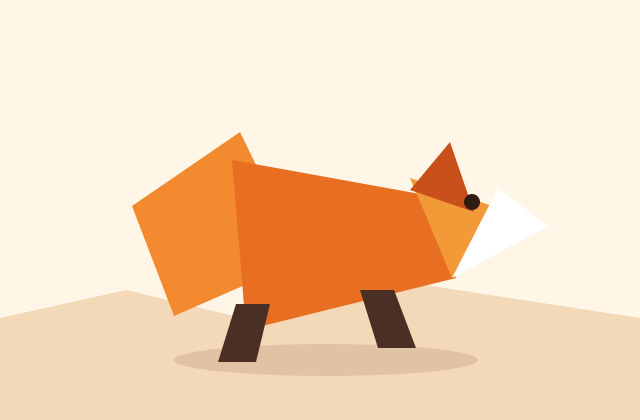
Cozy Animal Pack
Low-Poly Fox
A stylized animal prop for cozy games, woodland scenes and AR previews.
View details- Triangles
- 24
- Texture
- Flat color
- License
- Commercial use
- Formats
- OBJ
Protected STL download
Production export targets
Highlights
- Small flat-shaded props: 100-800 triangles
- Characters: 2,000-6,000; hero vehicles/creatures: 4,000-12,000
- Flat shading needs split or hard normals per face
- Smooth normals erase the faceted low poly look
- Blender export should preserve custom normals into GLB/FBX
- Use high roughness and limited specular for clean planar light
- 512px atlas for props; 1024px for character or vehicle kits
- Avoid normal maps when the goal is a pure planar surface
The style works best when geometry is intentionally sparse. Small props usually sit at 100 to 800 triangles, characters at 2,000 to 6,000, and hero vehicles or creatures at 4,000 to 12,000 depending on animation needs. The goal is not the lowest possible number; it is the clearest silhouette with enough large planes for the light to describe the form.
The technical rule is normals. Flat shading requires split or hard normals per face, while smooth shading averages normals across adjacent faces and erases the faceted look. In Blender, use Shade Flat or mark sharp edges and Auto Smooth deliberately; in glTF/GLB export, keep custom normals so the receiving engine does not recompute them into a soft look. This makes the page distinct from gradient style, which can still use flat faces but focuses on color ramps.
Materials should be boring on purpose: high roughness, limited specular, one shared atlas or pure material colors. A 512px atlas is enough for most props, while 1024px handles a character or vehicle kit. Avoid normal maps unless the page goal is high-poly-to-low-poly baking, because normal maps can visually contradict the intentionally planar surface and make a flat-shaded asset look confused.
Export GLB for web, Godot and AR, or FBX for Unity and Unreal when you need pivots, skeletons and hierarchy preserved. Generated flat-shaded low poly assets are yours to use commercially with no attribution required, including games, education apps, prototypes and paid packs. Keep one lighting direction and one normal policy across a set so the assets look authored together.
Keep the classic faceted look
Frequently asked questions
What does flat shaded mean in low poly?
Each polygon keeps its own face normal instead of averaging with neighbors. That makes every plane catch light separately and creates the classic faceted look.
Why did my low poly model become smooth after export?
The exporter or engine probably recomputed smooth normals. Preserve custom normals, mark sharp edges, or use Shade Flat before exporting GLB or FBX.
Should flat-shaded low poly use normal maps?
Usually no. Normal maps can contradict the planar surface. Use them only when the goal is a deliberate high-poly-to-low-poly baked hybrid.
What polycount fits the flat-shaded style?
Small props often use 100-800 triangles, characters 2,000-6,000, and hero creatures or vehicles 4,000-12,000 depending on animation and camera distance.
Can I use generated flat-shaded assets commercially?
Yes. Generated flat-shaded low poly assets are yours to use commercially with no attribution required, including games, prototypes and paid packs.
Related
Browse allNeed a custom low-poly model?
Generate one from a text prompt or reference image, then export GLB, FBX, OBJ or STL.
Open the generator