
3D Model Converter
A useful 3D model converter is not just a file extension switcher; it decides which parts of the asset must survive for the destination: animation, pivots, UVs, PBR materials, print scale, or a single web-friendly binary.
Matching downloadable assets
Start with these seed models, then generate variants in the same low-poly direction.
Members unlock protected STL access
Use the free OBJ to test the shape. Subscribe for protected STL downloads now; GLB, FBX, USDZ and Unity are shown as production export targets, not direct library downloads yet.

Nature Starter Pack
Low-Poly Pine Tree
A lightweight forest prop with a trunk, two faceted foliage layers and a clean base pivot for scattering.
View details- Triangles
- 24
- Texture
- Flat color
- License
- Commercial use
- Formats
- OBJ
Protected STL download
Production export targets
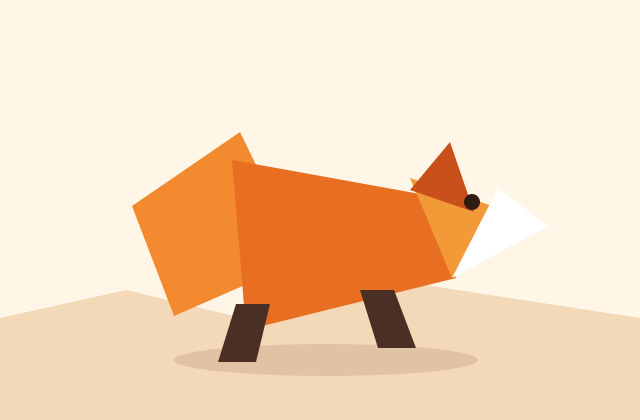
Cozy Animal Pack
Low-Poly Fox
A stylized animal prop for cozy games, woodland scenes and AR previews.
View details- Triangles
- 24
- Texture
- Flat color
- License
- Commercial use
- Formats
- OBJ
Protected STL download
Production export targets
Highlights
- GLB for web, Godot, Babylon.js, A-Frame, Three.js and AR delivery
- FBX for Unity and Unreal when hierarchy, pivots, rigs or clips matter
- OBJ for static interchange only; it cannot preserve skeletons or animation
- STL for 3D printing only; UVs, materials and names are discarded
- Check axis and unit conversion: FBX centimeters can become a 100x scale bug
- Pack loose FBX/OBJ textures before exporting self-contained formats
- Verify triangle count after conversion because quads get triangulated
- Preserve atlas and material count so a low poly asset stays cheap to render
The right conversion target depends on what the receiving tool actually reads. GLB is the best default for web, Godot, Three.js, Babylon.js, A-Frame and AR because it packs meshes, materials and textures into one binary file using meters, +Y up and a right-handed coordinate system. FBX remains the practical bridge for Unity and Unreal because it preserves hierarchy, named material slots, pivots, armatures and animation clips better than OBJ. OBJ is the universal static interchange fallback, but it carries no skeleton or animation. STL is for slicers and printers, not games, because it discards UVs, materials and object names.
The most common converter failures are axis, unit and texture-path problems. An FBX exported from a centimeter-based DCC scene can become 100 times too large when converted to GLB if the unit scale is ignored, while a Z-up OBJ can arrive in a Y-up engine lying on its side. GLB embeds textures by design, but FBX and OBJ often reference loose files next to the model; converting them without packing textures creates a file that looks fine on the artist machine and broken everywhere else. A proper converter check always includes dimensions, orientation, origin, normals and texture resolution.
For low poly assets, conversion should also preserve performance intent. A prop that was designed as one mesh with one 1024px atlas should not become five materials and five draw calls after export. Keep static props around 200 to 800 triangles for mobile and WebGL, hero props around 1k to 5k, and character assets in the 5k to 20k range depending on distance and animation needs. If the converter triangulates quads, compare the triangle count after export rather than trusting the source face count.
Use Blender as the visual inspection hub when quality matters: import the source, apply transforms, check scale in meters, recalculate normals if shading flips, pack or unpack textures deliberately, and export to the destination format. Command-line converters such as gltf-transform, assimp and engine-specific import pipelines are excellent for batch work once the rules are proven, but the first conversion in a new pipeline should always be inspected in a viewer or engine before hundreds of files are processed.
Pick the exact conversion path
Frequently asked questions
Which 3D format should I convert to for the web?
Use GLB for most web delivery. It is a single binary file that carries geometry, materials and textures and loads cleanly in Three.js, Babylon.js, A-Frame and Godot.
Which format should I use for Unity or Unreal?
Use FBX when you need pivots, hierarchy, armatures, skin weights or animation clips. Static GLB imports can work, but FBX remains the more predictable engine pipeline format.
Why did my converted model become huge or rotated?
That is usually an axis or unit mismatch. glTF uses meters and +Y up, while FBX and OBJ files can come from centimeter-based or Z-up scenes.
Will conversion preserve my textures?
Only if the converter can find and pack the source images. GLB embeds textures, but FBX and OBJ often reference loose image files that must travel with the model.
Can one converter preserve everything?
No. STL cannot keep materials, OBJ cannot keep animation, and FBX material models do not map perfectly to glTF PBR. Pick the target based on what must survive.
Related
Browse allNeed a custom low-poly model?
Generate one from a text prompt or reference image, then export GLB, FBX, OBJ or STL.
Open the generator