
FBX to OBJ Converter
Converting FBX to OBJ is the one format conversion on this site that is deliberately, unavoidably lossy in a specific way: OBJ has no concept of a skeleton, animation clip or even a single bone, so any rigged FBX character has to be reduced to one frozen static pose before it can become an OBJ at all.
Matching downloadable assets
Start with these seed models, then generate variants in the same low-poly direction.
Members unlock protected STL access
Use the free OBJ to test the shape. Subscribe for protected STL downloads now; GLB, FBX, USDZ and Unity are shown as production export targets, not direct library downloads yet.

Nature Starter Pack
Low-Poly Pine Tree
A lightweight forest prop with a trunk, two faceted foliage layers and a clean base pivot for scattering.
View details- Triangles
- 24
- Texture
- Flat color
- License
- Commercial use
- Formats
- OBJ
Protected STL download
Production export targets
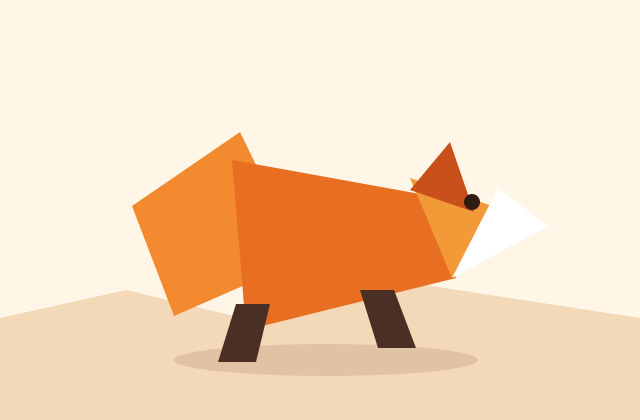
Cozy Animal Pack
Low-Poly Fox
A stylized animal prop for cozy games, woodland scenes and AR previews.
View details- Triangles
- 24
- Texture
- Flat color
- License
- Commercial use
- Formats
- OBJ
Protected STL download
Production export targets
Highlights
- OBJ has no skeleton, skin or animation-clip support at all — nothing rig-related survives this conversion
- The practical question is always which single pose to freeze, not how much animation to preserve
- Bake a neutral T-pose/A-pose for print references or sculpting bases; bake a specific action pose for a frozen static prop
- Blender: scrub to the target frame, then Object > Apply > Visual Geometry to Mesh to bake deformed positions permanently
- Basic materials (diffuse color, specular, texture reference) survive via OBJ's companion .mtl file
- Separately-named object parts (armor pieces, a hinged lid) need explicit per-object export to stay distinguishable
- Use FBX to GLB instead whenever the destination actually needs animation
- AI-generated models carry the same commercial license regardless of which pose gets baked, no attribution required
OBJ predates skeletal animation as a common real-time technique and was never extended to support it, so there is no conversion setting, no plugin and no clever export flag that carries a skeleton, skin weights or an animation clip through to OBJ. This makes FBX to OBJ fundamentally different from FBX to GLB or FBX to STL: it is not a matter of what happens to survive imperfectly, nothing rig-related survives at all, and the practical question is always which single pose to freeze before exporting, not how much animation to keep.
The right pose to bake depends entirely on why you need an OBJ in the first place. For a 3D-print reference or a sculpting base, freeze the character in its neutral bind pose (T-pose or A-pose) so the proportions read correctly without any pose-driven distortion. For a game-ready static prop, a mannequin, statue, or frozen NPC background decoration, bake whatever specific action pose reads best for that context instead, since OBJ has no animation to fall back on if the frozen pose looks awkward. In Blender, apply this by scrubbing to the target frame on the timeline, then using Object then Apply then Visual Geometry to Mesh (or Convert to Mesh in newer versions), which bakes the current deformed vertex positions into the base mesh permanently before the armature and skin modifier are discarded.
Materials survive this conversion reasonably well since OBJ's companion .mtl file supports basic diffuse color, specular values and a texture reference, so a flat-shaded or gradient-baked low poly material generally carries over close to its FBX appearance. What does not survive is anything FBX represents through node hierarchy rather than the mesh itself: separate named object parts (a knight's individually-parented armor pieces, a chest's separately-pivoted lid) typically need to be exported as separate named OBJ objects within the same file if you want to keep them distinguishable, since a naive export can merge everything into one undifferentiated mesh.
Because this conversion direction inherently discards motion, it is the wrong tool whenever the destination needs animation at all; use FBX to GLB instead for a web or Godot-bound animated character. FBX to OBJ earns its place specifically for 3D-print exports (where OBJ or its watertight-focused sibling STL is the actual target format), static reference meshes for sculpting or retopology in another tool, and simple asset-exchange cases where a receiving pipeline only accepts OBJ and never needed the rig in the first place.
Whichever pose you freeze and whichever tool you convert with, the underlying model carries the same commercial license as every other format on this site: AI-generated assets are yours to use commercially with no attribution required, so a rigged FBX character baked down to a static OBJ for a print run or a reference sculpt carries no additional licensing step beyond the technical pose-baking work above.
Choose the right conversion direction
Frequently asked questions
Why does my rigged FBX character lose its animation when converted to OBJ?
OBJ was never extended to support skeletons, skin weights or animation clips, so there is no setting that preserves them. Every FBX to OBJ conversion freezes the character into a single static pose by design.
What pose should I bake before converting to OBJ?
For a 3D-print reference or sculpting base, freeze the neutral T-pose or A-pose so proportions read correctly. For a static game prop or frozen background decoration, bake whichever specific action pose looks best in that context instead.
How do I bake a pose in Blender before exporting OBJ?
Scrub the timeline to your target frame, then use Object > Apply > Visual Geometry to Mesh (or Convert to Mesh in newer Blender versions) to permanently bake the deformed vertex positions before the armature is discarded on export.
Do materials survive an FBX to OBJ conversion?
Reasonably well. OBJ's companion .mtl file supports basic diffuse color, specular values and a texture reference, so a flat-shaded or gradient-baked low poly material generally carries over close to its FBX appearance.
When should I use FBX to OBJ instead of FBX to GLB?
Use FBX to OBJ specifically for 3D-print exports, static sculpting or retopology references, or a pipeline that only accepts OBJ. Use FBX to GLB whenever the destination needs to keep any animation at all.
Related
Browse allNeed a custom low-poly model?
Generate one from a text prompt or reference image, then export GLB, FBX, OBJ or STL.
Open the generator