
Low Poly Modeling
Low poly modeling is not just making a model blocky; it is the discipline of spending triangles where they change the silhouette, keeping materials cheap, and exporting assets that engines can draw quickly.
Matching downloadable assets
Start with these seed models, then generate variants in the same low-poly direction.
Members unlock protected STL access
Use the free OBJ to test the shape. Subscribe for protected STL downloads now; GLB, FBX, USDZ and Unity are shown as production export targets, not direct library downloads yet.

Nature Starter Pack
Low-Poly Pine Tree
A lightweight forest prop with a trunk, two faceted foliage layers and a clean base pivot for scattering.
View details- Triangles
- 24
- Texture
- Flat color
- License
- Commercial use
- Formats
- OBJ
Protected STL download
Production export targets
Cozy Animal Pack
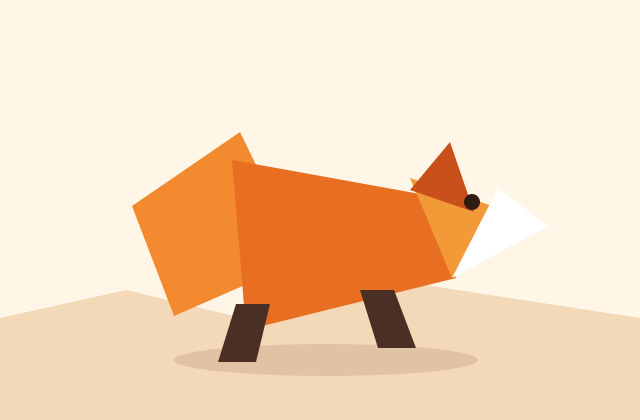
Low-Poly Fox
A stylized animal prop for cozy games, woodland scenes and AR previews.
View details- Triangles
- 24
- Texture
- Flat color
- License
- Commercial use
- Formats
- OBJ
Protected STL download
Production export targets
Highlights
- Model the silhouette first; textures cannot fix a weak outline
- Mobile/WebGL props often target 200-800 triangles
- Hero props commonly sit around 1k-5k triangles
- Stylized animated characters often target 5k-20k triangles
- Use hard edges and split normals deliberately for crisp flat shading
- Keep most props on one 512-1024px atlas and one material
- Place origins at practical snapping points such as the base of the asset
- Export GLB for web/Godot/AR and FBX for Unity/Unreal pipelines
Start with the silhouette because it is the part players recognize first and the part no texture can fix. A low poly tree canopy, sword blade, car roof or character hair shape should read clearly in flat gray before any color is added. Spend triangles on the outer profile and moving joints, then remove internal faces the camera never sees. Static props for mobile and WebGL often sit around 200 to 800 triangles, hero props around 1k to 5k, and stylized characters around 5k to 20k depending on animation and camera distance.
Flat shading is a modeling decision as much as a material decision. Mark hard edges intentionally, split normals where a faceted plane should stay crisp, and avoid accidental smoothing that makes a low poly object look melted. Bevels can be useful, but a bevel that adds three loops around every edge can double the triangle count fast. On hard-surface props, use a few strategic bevels on silhouette edges and fake the rest with baked normals or color gradients.
Materials determine whether the model stays performant after it looks good. A practical low poly asset usually uses one material and one 512 to 1024px atlas for props, with colors, gradients and AO baked into the texture. Every additional material slot is a potential draw call, especially in WebGL and mobile scenes. If a kit shares one palette atlas, dozens of props can batch together far better than the same props with unique textures.
Finish by preparing the model for use, not just for screenshots. Put the origin where placement needs it, usually at the base for props and characters, apply transforms, name objects and materials clearly, add simple collision shapes, and export the right format. GLB is the default for web, Godot and AR; FBX is safer for Unity and Unreal; STL is only for printing. A model is game-ready when scale, pivots, normals, UVs, triangle count and material count all survive import.
Build the full modeling workflow
Frequently asked questions
What makes a model low poly?
A low poly model uses a deliberately small triangle budget, strong silhouette design, hard or flat shading, and few materials rather than simply looking blocky.
Should low poly models use triangles or quads?
Use whatever topology supports the job. Quads help editing and deformation, but the exported game mesh is ultimately rendered as triangles.
How many triangles should a low poly prop have?
For mobile and WebGL, many props fit in 200 to 800 triangles. Hero props can use 1k to 5k when they appear close to camera.
Do low poly assets need textures?
Usually yes, even if they are simple. A shared color atlas, baked AO or gradient texture can reduce material count and keep a kit visually consistent.
What should I check before export?
Check scale, origin, applied transforms, normals, UVs, triangle count, material count and target format before importing into an engine.
Related
Browse allNeed a custom low-poly model?
Generate one from a text prompt or reference image, then export GLB, FBX, OBJ or STL.
Open the generator