
Normal Map Baker
A normal map baker lets a low poly mesh keep the visual detail of a sculpt or scan by storing surface direction changes in a texture instead of in millions of triangles.
Matching downloadable assets
Start with these seed models, then generate variants in the same low-poly direction.
Members unlock protected STL access
Use the free OBJ to test the shape. Subscribe for protected STL downloads now; GLB, FBX, USDZ and Unity are shown as production export targets, not direct library downloads yet.

Nature Starter Pack
Low-Poly Pine Tree
A lightweight forest prop with a trunk, two faceted foliage layers and a clean base pivot for scattering.
View details- Triangles
- 24
- Texture
- Flat color
- License
- Commercial use
- Formats
- OBJ
Protected STL download
Production export targets
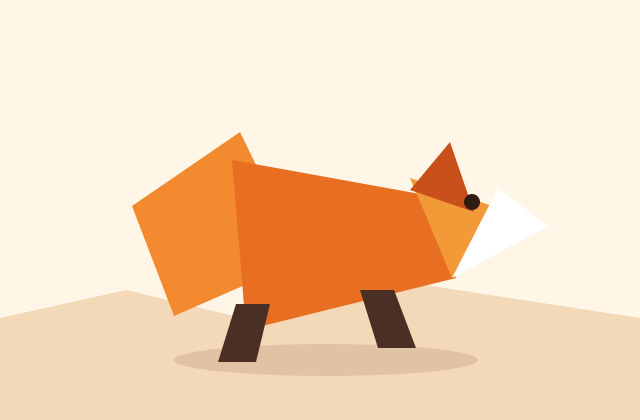
Cozy Animal Pack
Low-Poly Fox
A stylized animal prop for cozy games, woodland scenes and AR previews.
View details- Triangles
- 24
- Texture
- Flat color
- License
- Commercial use
- Formats
- OBJ
Protected STL download
Production export targets
Highlights
- Bake high mesh detail into a tangent-space normal map on the low mesh
- Use a cage or ray distance that covers protrusions without hitting neighboring surfaces
- Explode overlapping parts temporarily to prevent projection smears
- Use non-overlapping UVs with enough padding for mipmaps
- Triangulate before baking if the target engine will triangulate on import
- Props usually need 512-1024px normal maps; close hero assets can use 2048px
- OpenGL and DirectX normal maps differ by green-channel direction
- Test the bake in the target engine lighting before shipping
Normal baking is the core trick behind many game-ready low poly assets. The high mesh supplies the fine surface detail, the low mesh supplies the efficient silhouette, and the baker records the difference as a tangent-space normal map. This is different from simply reducing triangles: the high-frequency dents, bevels, cloth folds and sculpted marks are not modeled on the low mesh, but they still affect lighting through the baked texture.
The cage controls whether the bake reads the right part of the high mesh. If the cage sits inside the high mesh, rays miss protrusions and create black gaps; if it is too inflated, rays hit the wrong neighboring surface and create projection smears. For small props, start with a tight cage and a small ray distance, then inspect corners, thin handles and overlapping parts first. Exploded baking, temporarily moving parts apart before baking, helps avoid one piece projecting onto another.
UVs and triangulation decide whether the bake survives export. UV islands must not overlap unless the mirrored result is intentional, and they need padding so mipmaps do not pull pixels from neighbors. Triangulate the low mesh before baking if the engine will triangulate it later; otherwise the diagonal chosen by Unity, Unreal or a GLB exporter can differ from the one used during the bake, creating shading seams. For low poly props, 512 to 1024px normal maps are usually enough; close hero assets can use 2048px.
Normal map orientation must match the engine. OpenGL-style normal maps use one green-channel direction; DirectX-style maps use the opposite. Blender and many glTF workflows expect OpenGL-style Y+, while Unity commonly uses DirectX-style interpretation depending on import settings. If dents look like bumps or lighting seems inverted, flip the green channel before blaming the model. Always test the baked low mesh under the target engine lighting, not only inside the baking tool.
Bake inside a full workflow
Frequently asked questions
What does a normal map baker do?
It compares a high mesh to a low mesh and writes surface direction differences into a texture so the low mesh lights like it has more detail.
Why are there black gaps or smears in my bake?
The cage or ray distance is wrong, or nearby parts are projecting onto each other. Adjust the cage and try exploded baking for overlapping components.
Should I triangulate before baking?
Yes if the target engine or exporter will triangulate the mesh. Baking and rendering must use the same triangle diagonals to avoid shading seams.
Why do dents look like bumps?
The normal map green channel is probably inverted for the target engine. Flip Y or switch between OpenGL and DirectX normal orientation.
Can normal maps replace silhouette geometry?
No. Normal maps change lighting, not the actual outline. Keep enough geometry for the silhouette and bake only surface detail.
Related
Browse allNeed a custom low-poly model?
Generate one from a text prompt or reference image, then export GLB, FBX, OBJ or STL.
Open the generator