
Low Poly Chest 3D Model
A treasure chest is one of the most re-used props in any RPG or dungeon-crawler, and unlike almost every other environment prop on this site, players expect it to visibly open, which means the lid has to be rigged correctly from the very first export rather than bolted on as an afterthought.
Matching downloadable assets
Start with these seed models, then generate variants in the same low-poly direction.
Members unlock protected STL access
Use the free OBJ to test the shape. Subscribe for protected STL downloads now; GLB, FBX, USDZ and Unity are shown as production export targets, not direct library downloads yet.

Nature Starter Pack
Low-Poly Pine Tree
A lightweight forest prop with a trunk, two faceted foliage layers and a clean base pivot for scattering.
View details- Triangles
- 24
- Texture
- Flat color
- License
- Commercial use
- Formats
- OBJ
Protected STL download
Production export targets
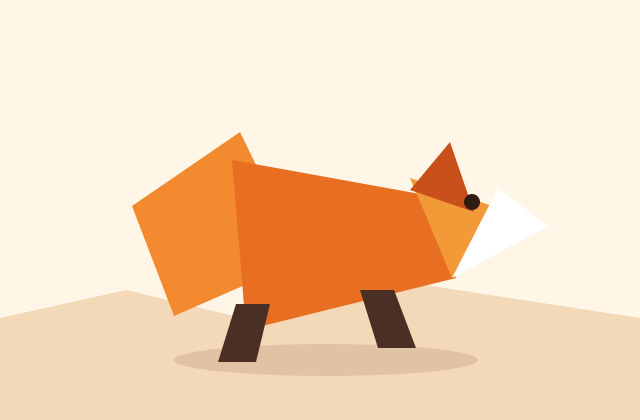
Cozy Animal Pack
Low-Poly Fox
A stylized animal prop for cozy games, woodland scenes and AR previews.
View details- Triangles
- 24
- Texture
- Flat color
- License
- Commercial use
- Formats
- OBJ
Protected STL download
Production export targets

Vehicle Starter Pack
Low-Poly Arcade Car
A simple separated-wheel vehicle mesh for racing prototypes, traffic fillers and WebGL demos.
View details- Triangles
- 30
- Texture
- Material slots
- License
- Commercial use
- Formats
- OBJ
Protected STL download
Production export targets
Highlights
- Background/closed chest: 150-400 triangles; functional loot chest: 400-1,000; hero/boss chest: 1,500-3,000
- Lid modeled and exported as its own mesh, separate from the box
- Hinge pivot placed exactly on the rear hinge line, built as an empty parent in Blender before export
- Open animation swings roughly 100-110 degrees, not a full 180, matching real hinge stops
- A small bounce/settle at the end of the swing sells wood-and-iron weight better than a linear open
- Interior kept as a simple low-detail floor plane with its own small emissive-baked texture
- Latch and hinge detail slightly more resolved than a same-size background prop, since players interact up close
- FBX for Unity/Unreal, GLB for Godot/web, both carrying the correct hinge pivot into the animation system
A closed background chest, the kind stacked in a warehouse or scattered as set dressing, reads clearly at 150 to 400 triangles. A functional loot chest that the player actually opens needs slightly more, 400 to 1,000 triangles, once the lid, latch and interior floor are separated into their own pieces. A hero or boss-loot chest with ornate corner bands, a gem inlay or a glowing interior can reasonably run 1,500 to 3,000 triangles, with the extra budget spent on the metal banding detail rather than the box itself, since the flat wooden panels need almost no additional geometry to read well.
The lid must be modeled and exported as a separate mesh from the box, with its pivot placed exactly along the rear hinge line rather than at the lid's center or the mesh origin. This single detail is the most common reason a "finished" chest looks broken the moment a rigger tries to animate it: a pivot anywhere else makes the lid swing through the box, orbit strangely, or clip through the back wall instead of rotating cleanly upward and back like a real hinged lid. Build the hinge pivot as an empty parent object in Blender before export so both GLB and FBX carry the correct rotation point into the engine.
A believable open animation is short and simple: the lid rotates open roughly 100 to 110 degrees rather than a full 180, since most real chest hinges physically stop well before vertical, and a small secondary bounce or settle at the end of the swing sells the weight of the wood and iron far more convincingly than a linear open. If the chest reveals a glowing loot item inside, keep the interior as a separate low-detail floor plane with its own small emissive-baked texture, since the interior is only ever visible for the few seconds the lid is open and does not deserve real modeling budget.
Chests are also one of the few RPG props players routinely interact with at very close range, tapping, clicking, or standing directly over one, so keep the latch and hinge details slightly more resolved than a generic background prop of the same size would need, and make sure the closed silhouette reads clearly as "container with something inside" rather than a plain box, since that visual promise is what makes a player bother interacting with it in the first place.
Low poly chests populate RPG dungeon loot rooms, pirate and treasure-hunt scenes, tabletop VTT prop libraries, and puzzle or escape-room game assets. Export FBX for Unity and Unreal to carry the hinge pivot correctly into the engine's animation system, or GLB for Godot and the web where the same pivot-as-parent-node approach works identically. Everything generated here is yours to use commercially with no attribution required, so a chest you generate can headline a shipped RPG or a paid dungeon-prop asset pack. Generate one chest style you like, then request wood-tone and metal-accent variants so a whole loot room reads as a deliberate, varied set.
Fill the loot room
Frequently asked questions
How many triangles does a low poly chest need?
A closed background chest reads clearly at 150-400 triangles. A functional loot chest with a separated lid and latch needs 400-1,000, and an ornate hero or boss chest can reasonably run 1,500-3,000.
Why does the chest lid look broken when I try to animate it?
The pivot is almost certainly not on the rear hinge line. Build the hinge as an empty parent object placed exactly along the back edge in Blender before export, or the lid will swing through the box instead of rotating cleanly upward.
How far should the lid open?
Roughly 100-110 degrees, not a full 180. Most real chest hinges physically stop well before vertical, and a small bounce or settle at the end of the swing sells the weight far better than a linear rotation to a full open angle.
Should I model the full interior in detail?
No. The interior is only visible for the few seconds the lid is open, so a simple low-detail floor plane with a small emissive-baked texture for glowing loot is enough; spend your polygon budget on the exterior and hinge instead.
Can I use a generated chest in a commercial game?
Yes. Generated chest models are yours to use commercially with no attribution required, including in a shipped RPG or a paid dungeon-prop asset pack.
Related
Browse allNeed a custom low-poly model?
Generate one from a text prompt or reference image, then export GLB, FBX, OBJ or STL.
Open the generator