
Low Poly Dinosaur 3D Model
Dinosaurs are among the highest-volume 3D-print and kids-education search terms in the entire low poly space, and their exaggerated silhouettes, a heavy tail, a long neck, a stocky bite, stay instantly recognizable even at a very small triangle budget.
Matching downloadable assets
Start with these seed models, then generate variants in the same low-poly direction.
Members unlock protected STL access
Use the free OBJ to test the shape. Subscribe for protected STL downloads now; GLB, FBX, USDZ and Unity are shown as production export targets, not direct library downloads yet.

Nature Starter Pack
Low-Poly Pine Tree
A lightweight forest prop with a trunk, two faceted foliage layers and a clean base pivot for scattering.
View details- Triangles
- 24
- Texture
- Flat color
- License
- Commercial use
- Formats
- OBJ
Protected STL download
Production export targets
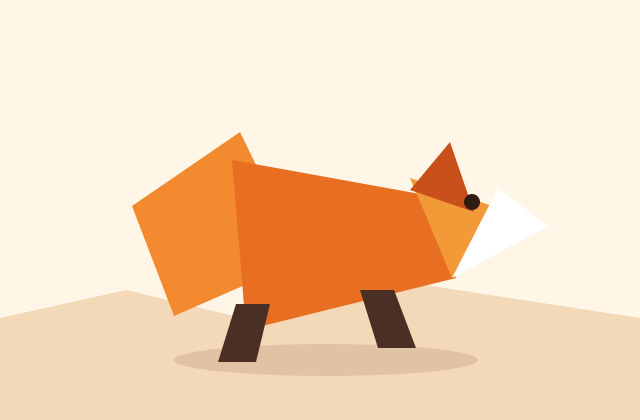
Cozy Animal Pack
Low-Poly Fox
A stylized animal prop for cozy games, woodland scenes and AR previews.
View details- Triangles
- 24
- Texture
- Flat color
- License
- Commercial use
- Formats
- OBJ
Protected STL download
Production export targets

Vehicle Starter Pack
Low-Poly Arcade Car
A simple separated-wheel vehicle mesh for racing prototypes, traffic fillers and WebGL demos.
View details- Triangles
- 30
- Texture
- Material slots
- License
- Commercial use
- Formats
- OBJ
Protected STL download
Production export targets
Highlights
- Static/scatter dinosaur: 500-1,500 triangles regardless of species
- Animated game dinosaur: 2,000-5,000 triangles; desktop hero: up to ~15,000 with LOD
- Tail needs its own 5-8 joint bone chain for whip-like counterbalance motion
- Sauropods/armored species budget extra joints along the neck or back plates
- Four-legged dinosaurs print stably; bipedal ones need a wide base or tail support
- Export STL/3MF for a watertight print; thicken claws and small teeth
- Export true real-world meter scale for educational AR placement accuracy
- GLB/USDZ for AR, FBX for Unity/Unreal rig, GLB for Godot/Three.js rig
Body plan drives polycount more than for almost any other creature, since a two-legged predator, a four-legged sauropod and an armored ankylosaur all distribute their triangles completely differently. A static display or scatter-prop dinosaur reads clearly at 500 to 1,500 triangles regardless of species. An animated game dinosaur generally needs 2,000 to 5,000 triangles so the tail, neck and legs can bend without pinching, with long-necked sauropods and armored species needing more of that budget spent on the neck chain or back plates specifically rather than the limbs. A desktop hero dinosaur, the kind featured in a close-camera boss fight or an educational AR close-up, can reasonably run 8,000 to 15,000 triangles with LOD swapping in a cheaper body at distance.
Rigging a dinosaur is meaningfully different from rigging a mammal because of the tail's job: on a bipedal dinosaur, the tail is not a decorative afterthought but a physical counterbalance to the torso and head, so it needs its own long bone chain (often 5 to 8 joints) capable of a whip-like secondary motion during a run or turn, not just a few stiff segments. Skipping a properly segmented tail chain is the single most common reason a rigged dinosaur looks stiff or robotic in motion even when the legs animate correctly. Keep clean edge loops at the hip and shoulder joints exactly as you would for a mammal, but budget noticeably more joints along the tail and, for sauropods, along the neck.
Dinosaurs are, alongside dogs and cats, one of the most searched 3D-printed figurines on marketplaces like Etsy and Cults3D, largely driven by kids' gifts and classroom projects, and the printing quirk here is about balance rather than overhangs: a four-legged dinosaur prints stably on its own four feet, but a bipedal dinosaur standing on two legs with an unsupported tail in the air needs either a wider stable base merged into the print or a support structure under the tail tip, since the model's own center of mass sits well forward of a two-point stance. Export STL or 3MF for a watertight single-shell print, and consider thickening thin elements like claws or small teeth so they survive printing and handling.
Educational AR is a genuinely large use case for dinosaurs specifically, more so than for most other creatures, since museum apps, classroom AR demos and paleontology-adjacent products regularly place a to-scale dinosaur in a real room. Export GLB for Android through model-viewer or USDZ for iOS AR Quick Look, and if scale accuracy matters for the educational context, model and export the dinosaur at true real-world scale in meters rather than an arbitrary game-convenient size, since AR placement tools read the file's actual scale rather than a visually-eyeballed one.
Low poly dinosaurs work as game enemies and boss encounters, farm and safari-park sim animals, kids' educational app characters, and standalone desk or shelf figurines. Export FBX for Unity and Unreal to carry the skeleton and tail/neck animation clips, or GLB for Godot and Three.js where skeletal animation is equally well supported. Everything generated here is yours to use commercially with no attribution required, so printing and selling dinosaur figurines, publishing an educational app character, or shipping a dinosaur boss in a commercial game are all fine with no attribution required. Generate one species you like, then request skin-color and size variants so a whole prehistoric park reads as a believable, varied ecosystem.
Populate the prehistoric scene
Frequently asked questions
How many triangles does a low poly dinosaur need?
A static or scatter-prop dinosaur reads clearly at 500-1,500 triangles regardless of species. An animated game dinosaur generally needs 2,000-5,000, and a desktop hero dinosaur can run up to about 15,000 with LOD.
Why does a dinosaur rig need more tail joints than a typical animal?
On a bipedal dinosaur the tail physically counterbalances the torso and head, so it needs a long 5-8 joint chain capable of whip-like secondary motion. A short, stiff tail is the most common reason a rigged dinosaur looks robotic in motion.
Is a low poly dinosaur good for 3D printing?
Yes. Four-legged species print stably on their own feet. Bipedal dinosaurs standing on two legs need either a wider merged base or support under the tail tip, since their center of mass sits forward of a two-point stance.
Can I use a dinosaur model in an educational AR app?
Yes. Export GLB for model-viewer on Android or USDZ for AR Quick Look on iOS. For classroom or museum accuracy, model and export at true real-world meter scale rather than an arbitrary game-friendly size.
Can I sell printed dinosaur figurines or ship one in a game?
Yes. Generated dinosaur models are yours to use commercially with no attribution required, including sold prints, educational apps and shipped games.
Related
Browse allNeed a custom low-poly model?
Generate one from a text prompt or reference image, then export GLB, FBX, OBJ or STL.
Open the generator