
Low Poly Door 3D Model
A door is a small architectural prop, but it is also one of the most common interactive objects in a game. The hinge pivot, frame separation and collider setup matter more than decorative plank detail.
Matching downloadable assets
Start with these seed models, then generate variants in the same low-poly direction.
Members unlock protected STL access
Use the free OBJ to test the shape. Subscribe for protected STL downloads now; GLB, FBX, USDZ and Unity are shown as production export targets, not direct library downloads yet.

Nature Starter Pack
Low-Poly Pine Tree
A lightweight forest prop with a trunk, two faceted foliage layers and a clean base pivot for scattering.
View details- Triangles
- 24
- Texture
- Flat color
- License
- Commercial use
- Formats
- OBJ
Protected STL download
Production export targets
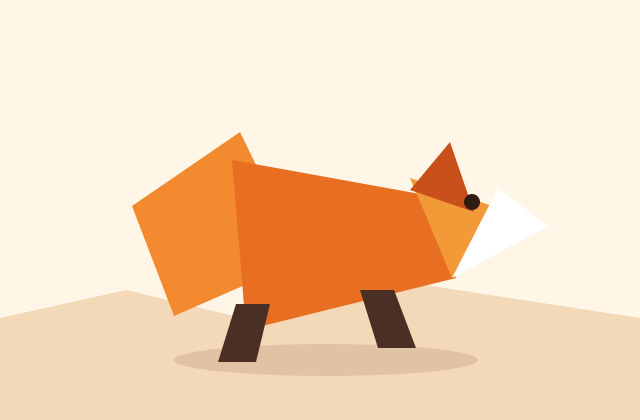
Cozy Animal Pack
Low-Poly Fox
A stylized animal prop for cozy games, woodland scenes and AR previews.
View details- Triangles
- 24
- Texture
- Flat color
- License
- Commercial use
- Formats
- OBJ
Protected STL download
Production export targets

Vehicle Starter Pack
Low-Poly Arcade Car
A simple separated-wheel vehicle mesh for racing prototypes, traffic fillers and WebGL demos.
View details- Triangles
- 30
- Texture
- Material slots
- License
- Commercial use
- Formats
- OBJ
Protected STL download
Production export targets
Highlights
- Simple mobile interior door: 120-300 triangles
- Medieval/dungeon door: 500-1,200 triangles
- Desktop hero door: 2,000-4,000 triangles
- Moving door mesh origin must sit on the hinge line, not the slab center
- Keep frame static and door leaf as a child object with hinge-side local pivot
- Closed and open states need different collider behavior
- Use contrasting handle/keyhole material to show the usable side
- For navmesh, treat closed doors as runtime obstacles or links, not permanent wall geometry
A simple mobile interior door can be 120 to 300 triangles, including a flat slab, handle and frame. A medieval or dungeon door with planks, metal straps and hinges usually sits between 500 and 1,200 triangles. A desktop hero door with carved panels, locks, peephole and animated latch can use 2,000 to 4,000 triangles. For modular buildings, the door, frame and threshold should be separate enough to fit wall kits, but still share one atlas so many doors in a town do not create many material changes.
The door-specific technical fact is hinge pivot placement. The moving door mesh must have its origin on the hinge line, not at the center of the slab, or the door will rotate like a spinning panel instead of swinging through the doorway. Keep the frame as a separate static mesh with its own bottom-center origin, then export the door leaf as a child object whose local pivot sits exactly on the hinge side. This is the difference between an animation-ready asset and a prop that must be fixed after import.
Collision should have two states. A closed door needs a box collider matching the slab to block the player. An open door often disables that collider or swaps it to a thin collider along the open angle so players do not hit an invisible wall. If the door controls navigation, bake the navmesh with a doorway opening and use runtime obstacles or links for the closed state rather than baking the door as permanent wall geometry.
Materials should make interaction readable. Give the handle, keyhole or latch a contrasting metal color so players can identify the usable side. For medieval doors, planks should have uneven heights and bevels, but do not model deep cracks as separate geometry unless the camera gets close; a few dark vertex-color bands or atlas strokes sell the gaps cheaply. For 3D printing, fuse the frame and door if it is decorative, or leave clearance around the hinge if it is meant to open physically.
Low poly doors fit houses, castles, dungeons, shops, sci-fi rooms, AR architecture previews and tabletop terrain. Export FBX for Unity and Unreal to preserve the door/frame hierarchy and hinge pivot, GLB for Godot and web viewers, or STL/3MF for decorative prints. Generated door models are yours for commercial use with no attribution required.
Place it in a building kit
Frequently asked questions
How many triangles should a low poly door use?
A simple mobile door can use 120-300 triangles. A medieval or dungeon door usually needs 500-1,200, and a close hero door can use 2,000-4,000.
Where should a door pivot be?
The moving door leaf origin must sit exactly on the hinge line. The frame should be a separate static mesh, usually with a bottom-center origin for placement.
How should door collision work?
Use a blocking box collider when closed, then disable or swap it when open so players do not hit an invisible wall. Navigation should treat doors as runtime obstacles or links.
Should the frame and door be one mesh?
For a static decorative prop, one mesh is fine. For gameplay interaction, keep the frame static and the moving door leaf separate with a hinge-side pivot.
Can generated door models be used commercially?
Yes. Generated door models are yours for commercial games, AR architecture previews, tabletop prints and asset packs with no attribution required.
Related
Browse allNeed a custom low-poly model?
Generate one from a text prompt or reference image, then export GLB, FBX, OBJ or STL.
Open the generator