
Low Poly Lamp 3D Model
A lamp is both a visible prop and a lighting rig, so its mesh, emissive material and point-light placement have to agree. A beautiful shade with the light in the wrong place will make a room feel fake.
Matching downloadable assets
Start with these seed models, then generate variants in the same low-poly direction.
Members unlock protected STL access
Use the free OBJ to test the shape. Subscribe for protected STL downloads now; GLB, FBX, USDZ and Unity are shown as production export targets, not direct library downloads yet.

Nature Starter Pack
Low-Poly Pine Tree
A lightweight forest prop with a trunk, two faceted foliage layers and a clean base pivot for scattering.
View details- Triangles
- 24
- Texture
- Flat color
- License
- Commercial use
- Formats
- OBJ
Protected STL download
Production export targets
Cozy Animal Pack
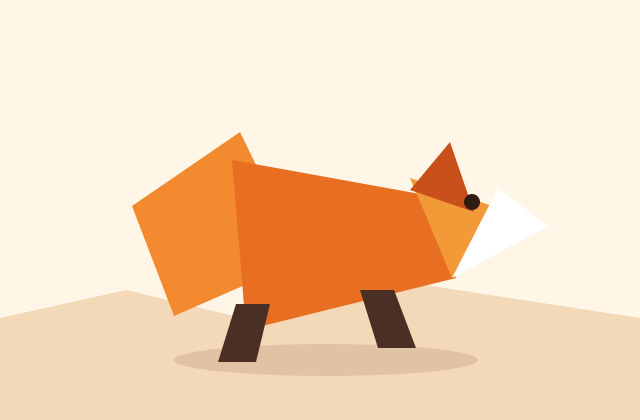
Low-Poly Fox
A stylized animal prop for cozy games, woodland scenes and AR previews.
View details- Triangles
- 24
- Texture
- Flat color
- License
- Commercial use
- Formats
- OBJ
Protected STL download
Production export targets
Village Starter Pack
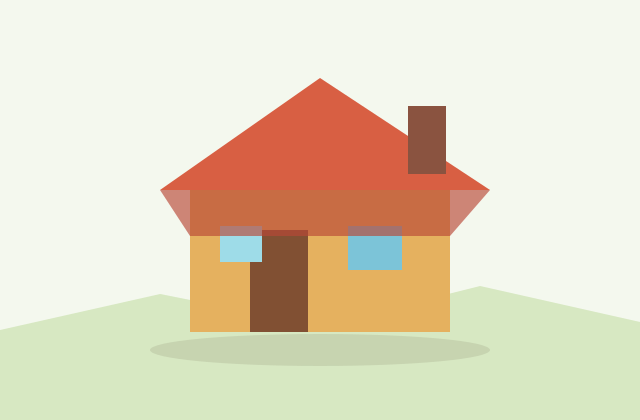
Low-Poly Cottage House
A compact village building for cozy sims, isometric towns and stylized environment blocking.
View details- Triangles
- 18
- Texture
- Flat color
- License
- Commercial use
- Formats
- OBJ
Protected STL download
Production export targets
Highlights
- Table lamp: 180-450 triangles
- Floor or street lamp: 600-1,500 triangles
- Desktop hero lamp: 2,000-4,000 triangles
- Add a named light anchor at the bulb position, not the object origin
- Wall/street lamps benefit from a second node defining spotlight direction
- Use emissive mesh for visible glow and engine lights for actual illumination
- Table lamp origin at base bottom; hanging lamp origin at ceiling mount
- Separate shade and base meshes if the lamp can break or be knocked over
A small table lamp for mobile interiors can use 180 to 450 triangles, including base, stem, shade and bulb. A standing floor lamp or street lamp usually sits between 600 and 1,500 triangles because height and shade silhouette are more visible. A desktop hero lamp with cord, switch, layered shade and detailed base can use 2,000 to 4,000 triangles. In a city or hotel scene, repeated lamps should share one mesh and one atlas, then vary only color temperature or shade tint through material parameters.
The lamp-specific technical detail is the light anchor. Add a named empty or node at the actual bulb position inside the shade, not at the object origin, so the engine light can be placed consistently when the model is imported. If the point light is centered in the whole lamp, shadows and highlights will come from the stand or floor instead of the bulb. For wall lamps or street lamps, add a second forward-facing node to define spotlight direction.
Emissive material should be separated from real illumination. The bulb or shade interior can use an emissive material so the mesh appears to glow, but the room lighting should come from an engine point, spot or area light attached to the anchor. Bloom can make the emissive bulb feel warm, but it should not be the only light source. Keep the shade as a solid faceted mesh unless the art direction truly needs translucency, because transparent shades can sort poorly and double the overdraw in cozy interiors full of lamps.
Pivots and collision are simple but important. A table lamp should have its origin at the bottom center of the base so it snaps to desks and shelves. A hanging lamp should have the origin at the ceiling mount, because designers place it from above. Collision can be one capsule or box around the stand and shade; if the lamp is breakable, separate shade and base meshes so the shattered or knocked-over state can reuse the same components.
Low poly lamps fit cozy rooms, city streets, fantasy inns, puzzle games, AR interior previews and printable miniature furniture. Export GLB for web and Godot, FBX for Unity and Unreal if you want named light anchor nodes preserved, or STL/3MF for non-wired decorative prints. Generated lamp models are yours for commercial use with no attribution required.
Light the surrounding scene
Frequently asked questions
How many triangles should a low poly lamp use?
A table lamp can use 180-450 triangles. A floor or street lamp usually needs 600-1,500, and a desktop hero lamp can use 2,000-4,000 with cord, switch and detailed shade.
Where should I place the light source?
Add a named light anchor at the actual bulb position inside the shade. The object origin is for placement; the light anchor is for illumination.
Is emissive material enough to light a room?
No. Emissive makes the bulb or shade look bright, but actual room lighting should come from an engine point, spot or area light attached to the lamp.
Where should the lamp pivot be?
A table lamp should pivot from the bottom center of its base. A hanging lamp should pivot from the ceiling mount so designers can place it naturally.
Can generated lamp models be used commercially?
Yes. Generated lamp models are yours for commercial games, AR interiors, printable miniatures and asset packs with no attribution required.
Related
Browse allNeed a custom low-poly model?
Generate one from a text prompt or reference image, then export GLB, FBX, OBJ or STL.
Open the generator