
Low Poly Skull 3D Model
A skull is one of the most-searched decor and horror-game props in the entire low poly space, and its instantly recognizable eye sockets and jawline stay readable at a triangle count low enough to scatter dozens across a dungeon floor without any performance cost.
Matching downloadable assets
Start with these seed models, then generate variants in the same low-poly direction.
Members unlock protected STL access
Use the free OBJ to test the shape. Subscribe for protected STL downloads now; GLB, FBX, USDZ and Unity are shown as production export targets, not direct library downloads yet.
Cozy Animal Pack
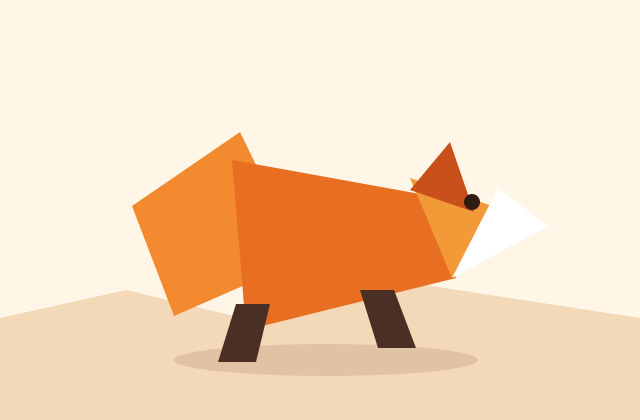
Low-Poly Fox
A stylized animal prop for cozy games, woodland scenes and AR previews.
View details- Triangles
- 24
- Texture
- Flat color
- License
- Commercial use
- Formats
- OBJ
Protected STL download
Production export targets

Nature Starter Pack
Low-Poly Pine Tree
A lightweight forest prop with a trunk, two faceted foliage layers and a clean base pivot for scattering.
View details- Triangles
- 24
- Texture
- Flat color
- License
- Commercial use
- Formats
- OBJ
Protected STL download
Production export targets

Vehicle Starter Pack
Low-Poly Arcade Car
A simple separated-wheel vehicle mesh for racing prototypes, traffic fillers and WebGL demos.
View details- Triangles
- 30
- Texture
- Material slots
- License
- Commercial use
- Formats
- OBJ
Protected STL download
Production export targets
Highlights
- Decor/scatter skull: 200-600 triangles; hero/boss-arena skull: 1,000-2,500 triangles
- Jaw modeled and rigged as its own mesh, pivoting at the temporomandibular joint near the ear socket
- Skulls rarely need LOD; spend extra budget on the jaw hinge, not surface detail
- Always add a small drain/vent hole when hollowing a print — trapped resin can expand and crack the shell
- Orient eye sockets slightly upward on the print bed to avoid heavy internal supports
- Emissive-baked eye sockets read as glowing eyes at zero extra geometry cost
- Single small 512px shared atlas is usually enough for bone-tone coloring
- Export STL/3MF for figurines, GLB/FBX for horror-game props, no attribution required for commercial use
A single decor or scatter skull reads clearly at 200 to 600 triangles, since the eye sockets, brow ridge and jaw are the only features that matter and everything else can stay a simple faceted dome. A hero skull that the camera lingers on, a boss-arena centerpiece or a detailed desk prop, can reasonably run 1,000 to 2,500 triangles for a rounder cranium and cleaner eye socket rims. Unlike most props, a skull almost never needs LOD, since the base shape is already cheap; spend any extra budget on the jaw hinge rather than surface detail.
The lower jaw is the single detail that separates a convincing skull from a static rock-shaped prop, and it should always be modeled and rigged as its own separate mesh rather than fused to the cranium. Place the jaw's pivot at the temporomandibular joint, roughly where the jawbone meets the skull just below and in front of the ear socket, so a simple single-axis rotation opens and closes it correctly for a talking-skull gag, a jump-scare animation, or a simple ambient chatter loop, rather than the jaw needing a complex multi-bone rig.
Skulls are, alongside dogs and mushrooms, a genuinely popular 3D-printed object, driven heavily by Halloween decor and desk-curio searches, and they carry one printing quirk specific to hollow shapes: if you hollow a large skull to save resin or filament, always add at least one small drain or vent hole, since a fully sealed hollow shell traps uncured resin during an SLA/MSLA print, and any trapped liquid resin can expand and crack the shell, or in rare cases even cause a small pressure rupture, when the model is later exposed to heat or sunlight for post-curing. Export STL or 3MF for a watertight single-shell print, and orient the eye sockets facing slightly upward on the print bed so their concave curves do not need heavy internal support.
Emissive or glow-in-the-dark treatments work unusually well on a skull because the eye sockets are already deep-set, natural focal points: a baked emissive texture inside the socket geometry, or a small embedded LED cavity for a physical print, reads as glowing eyes with zero extra geometry cost, and this exact trick is one of the most common requests for horror-game prop packs and Halloween decor prints alike. Keep the whole skull on a single small shared atlas, 512px is usually enough, since bone color needs almost no texture variation beyond a subtle ambient-occlusion bake in the sutures and eye sockets.
Low poly skulls populate horror and dungeon-crawler game set dressing, pirate and treasure-map iconography, anatomy-adjacent educational props, and standalone Halloween decor. Everything generated here is yours to use commercially with no attribution required, so a skull you generate can populate a shipped horror game's dungeon floor or become a sold Halloween print with no licensing concern. Generate one skull style you like, then request scattered variants, cracked, mossy, gilded, so a whole graveyard or trophy pile reads as a deliberate, varied set rather than one model copy-pasted.
Dress the scene
Frequently asked questions
How many triangles does a low poly skull need?
A decor or scatter skull reads clearly at 200-600 triangles. A hero skull featured up close, like a boss-arena centerpiece, can reasonably run 1,000-2,500 for a rounder cranium and cleaner socket rims.
Should the jaw be part of the same mesh as the skull?
No. Model and rig the jaw as its own separate mesh with its pivot at the temporomandibular joint near the ear socket, so a single rotation opens and closes it correctly for animation.
Is a hollowed skull safe to 3D print?
Add at least one small drain or vent hole whenever you hollow a large skull. A fully sealed hollow shell can trap uncured resin, which may expand and crack the print, or in rare cases rupture, when exposed to heat or sunlight during post-curing.
Can I make the eyes glow?
Yes. Bake an emissive texture into the eye socket geometry for a real-time render, or leave a small internal cavity for an embedded LED in a physical print. Either approach adds zero extra geometry.
Can I sell printed skulls or use them in a commercial game?
Yes. Generated skull models are yours to use commercially with no attribution required, including sold Halloween prints and shipped horror games.
Related
Browse allNeed a custom low-poly model?
Generate one from a text prompt or reference image, then export GLB, FBX, OBJ or STL.
Open the generator