
Low Poly Wolf 3D Model
A low poly wolf is not a re-skinned dog: its longer legs, narrower chest and low, straight tail carry the silhouette of a pack predator built for distance rather than a companion bred for a living room, and getting those proportions right is what separates a convincing wolf from an oversized husky.
Matching downloadable assets
Start with these seed models, then generate variants in the same low-poly direction.
Members unlock protected STL access
Use the free OBJ to test the shape. Subscribe for protected STL downloads now; GLB, FBX, USDZ and Unity are shown as production export targets, not direct library downloads yet.

Nature Starter Pack
Low-Poly Pine Tree
A lightweight forest prop with a trunk, two faceted foliage layers and a clean base pivot for scattering.
View details- Triangles
- 24
- Texture
- Flat color
- License
- Commercial use
- Formats
- OBJ
Protected STL download
Production export targets
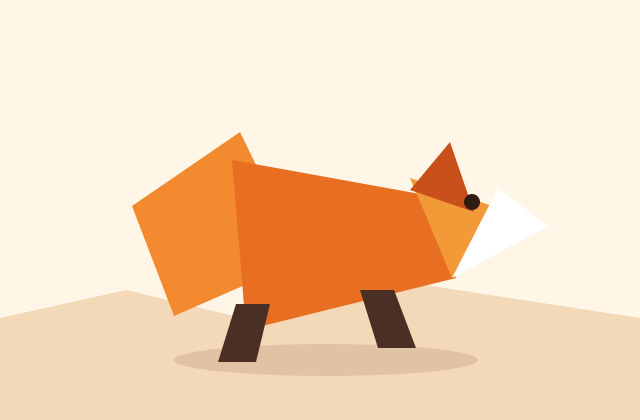
Cozy Animal Pack
Low-Poly Fox
A stylized animal prop for cozy games, woodland scenes and AR previews.
View details- Triangles
- 24
- Texture
- Flat color
- License
- Commercial use
- Formats
- OBJ
Protected STL download
Production export targets
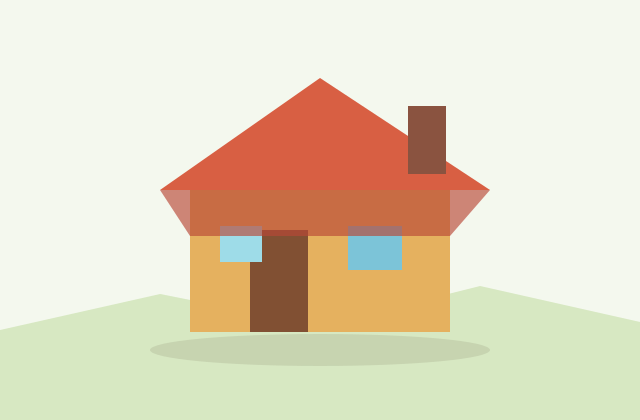
Village Starter Pack
Low-Poly Cottage House
A compact village building for cozy sims, isometric towns and stylized environment blocking.
View details- Triangles
- 18
- Texture
- Flat color
- License
- Commercial use
- Formats
- OBJ
Protected STL download
Production export targets
Highlights
- Static/trophy pose: 500-1,500 triangles; animated pack wolf: 2,000-5,000; hero alpha: 8,000-12,000
- Taller shoulder height and narrower chest than dog/fox models at the same triangle budget
- One rigged base mesh + 3-5 coat-color variants (grey, black, white, brindle) is cheaper than modeling each wolf uniquely
- AnimationTree/Animator blend space crossfades walk/trot/lope gait cycles by speed for a convincing pack
- Hind leg needs a hinged hock joint over a longer bone chain than a dog for a lower, longer stride
- Add a jaw-open blend shape or bone for snarl/howl poses, a wolf-specific animation beat
- Thin legs need extra thickening for 3D printing; standing pose usually needs belly/chest support
- STL/3MF for figurines, GLB/FBX for games, one shared 1024px atlas across the whole pack
A wolf reads as a distinct animal mainly through leg length and chest depth rather than head shape, so keep the shoulder height taller and the ribcage narrower than the dog and fox models on this site even at the same triangle budget. A static scatter or trophy-pose wolf reads clearly at 500 to 1,500 triangles. An animated game wolf, the kind that stalks, lopes or lunges, generally needs 2,000 to 5,000 triangles so the long legs and lowered tail can move without pinching at the hips. A hero alpha wolf featured in a close boss encounter can reasonably run 8,000 to 12,000 triangles with LOD swapping for the rest of the pack at a distance.
Wolves are almost always used as a pack, not a single creature, which changes the optimization target: instead of building one perfect wolf, build one rigged base mesh and generate 3 to 5 coat-color variants, grey, black, white and brindled, sharing the same skeleton and topology. In Godot and Unity this pairs naturally with an AnimationTree blend space or Animator blend tree that crossfades walk, trot and lope cycles by speed, since a real wolf pack rarely holds a single fixed gait, and blending gait speed convincingly is a genuinely different rigging task than the single-speed walk cycle most companion-animal pages need.
The hind leg needs a properly hinged hock joint bending backward partway down the leg, the same digitigrade structure a dog uses but stretched over a longer bone chain, since a wolf's stride is noticeably longer and lower to the ground than a dog's bouncier gait. Keep clean edge loops at the shoulder, hip, hock and the base of the tail, and add a simple jaw-open blend shape or bone for a snarl or howl pose, since both are common wolf-specific animation beats that a generic companion-animal rig does not need.
Wolves print well for the same reason cats and dogs do: flat angular facets hide layer lines, and a lying or seated pose gives a stable, wide base. The narrower chest and longer legs do mean thin leg sections need extra thickening beyond what a stockier dog model requires, or a standing wolf print will need support struts under the belly and chest. Export STL or 3MF for a watertight single-shell figurine, and GLB or FBX for game engines, keeping the whole pack on one shared 1024px atlas so a dozen wolves scattered across a scene stay cheap to render.
Low poly wolves populate fantasy RPG companion and monster rosters, survival-game predator encounters, and winter or forest biome ambiance. Everything generated here is yours to use commercially with no attribution required, so a wolf pack you generate can headline a shipped game or become a sold figurine set. Generate one base wolf you like, then request coat-color variants so an entire pack reads as a believable, coordinated group rather than five copies of the same animal.
Build out the pack
Frequently asked questions
How is a low poly wolf different from a low poly dog model?
A wolf has taller shoulders, a narrower chest and a lower, straighter tail than a dog even at the same triangle budget. Building it on dog proportions is the most common reason a generated wolf reads as an oversized husky instead of a wild predator.
How many triangles does a game-ready wolf need?
A static or trophy-pose wolf reads clearly at 500-1,500 triangles. An animated pack wolf needs 2,000-5,000, and a hero alpha in a close encounter can run 8,000-12,000 with LOD for the rest of the pack.
How do I make a believable wolf pack without modeling each one separately?
Rig one base wolf mesh, then generate 3-5 coat-color variants sharing the same skeleton and topology. Pair it with a blend-space gait system that crossfades walk, trot and lope by speed so the pack moves convincingly.
Is a low poly wolf good for 3D printing?
Yes. Export STL or 3MF for a watertight print. Because a wolf's legs are thinner than a dog's, thicken them beyond a stockier reference, and expect a standing pose to need belly or chest support struts.
Can I sell a wolf model or use it in a commercial game?
Yes. Generated wolf models are yours to use commercially with no attribution required, including sold figurines and shipped games.
Related
Browse allNeed a custom low-poly model?
Generate one from a text prompt or reference image, then export GLB, FBX, OBJ or STL.
Open the generator