
Low Poly Zombie 3D Model
A low poly zombie is not just a damaged human: its readable value comes from asymmetry, an off-balance gait, a slack jaw and clothing layers that sell decay without needing dense gore geometry.
Matching downloadable assets
Start with these seed models, then generate variants in the same low-poly direction.
Members unlock protected STL access
Use the free OBJ to test the shape. Subscribe for protected STL downloads now; GLB, FBX, USDZ and Unity are shown as production export targets, not direct library downloads yet.
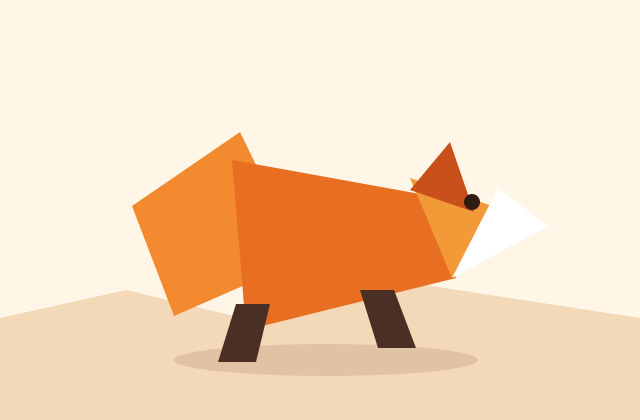
Cozy Animal Pack
Low-Poly Fox
A stylized animal prop for cozy games, woodland scenes and AR previews.
View details- Triangles
- 24
- Texture
- Flat color
- License
- Commercial use
- Formats
- OBJ
Protected STL download
Production export targets

Nature Starter Pack
Low-Poly Pine Tree
A lightweight forest prop with a trunk, two faceted foliage layers and a clean base pivot for scattering.
View details- Triangles
- 24
- Texture
- Flat color
- License
- Commercial use
- Formats
- OBJ
Protected STL download
Production export targets
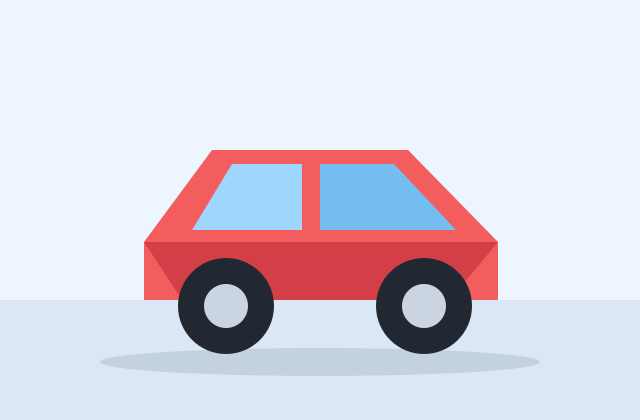
Vehicle Starter Pack
Low-Poly Arcade Car
A simple separated-wheel vehicle mesh for racing prototypes, traffic fillers and WebGL demos.
View details- Triangles
- 30
- Texture
- Material slots
- License
- Commercial use
- Formats
- OBJ
Protected STL download
Production export targets
Highlights
- Background horde zombie: 1,200-2,500 triangles
- Standard animated enemy: 3,000-6,000; close boss: 8,000-14,000 with LODs
- Use asymmetric controls: dragged ankle, lowered shoulder and loose neck
- Jaw bone or blend shape supports groan, bite and slack-mouth poses
- Torn clothes as separate shells, not many simulated cloth strips
- One 1024px atlas covers skin, cloth and blood-stain accents
- Flat blood patches keep crowds cheaper than glossy gore materials
- FBX for humanoid retargeting; GLB for Godot/WebGL horror prototypes
A background horde zombie can be as low as 1,200 to 2,500 triangles, because players read the silhouette and gait before they read surface detail. A standard animated enemy usually needs 3,000 to 6,000 triangles so shoulders, hips, jaw and torn clothing can deform without obvious tearing. A close horror boss or cinematic infected character can run 8,000 to 14,000 triangles with LODs, but the extra budget should go toward layered clothing, hands and face shape rather than tiny wounds that vanish in motion.
The useful rigging fact is that a zombie needs intentional asymmetry in the animation controls, not just a symmetric humanoid walk played slowly. Give one ankle a drag offset, lower one shoulder control, loosen the neck with a 2 to 3 joint head-and-jaw chain, and add a simple jaw bone or blend shape so groans, bites and slack-mouth idle poses work. If both arms swing evenly and both feet plant normally, the character reads as tired rather than undead.
Clothes should be modeled as separate torn shells over a very simple body, with holes and ragged hems cut into large polygon shapes rather than simulated cloth strips. This lets you swap shirts or faction uniforms for different zombie types while reusing the same body rig. Use one 1024px atlas for skin, cloth and blood-stain accents; keep blood as flat dark red patches or decals, because glossy gore shaders fight the flat low poly look and add material cost in a crowd.
Export FBX for Unity and Unreal when you need humanoid retargeting plus bite, stagger and crawl clips, or GLB for Godot and WebGL horror prototypes. For performance, build three LODs and keep a horde on two or three shared materials so draw calls do not explode. Generated zombie models are yours to use commercially with no attribution required, including shipped survival games, horror jams, trailers and paid enemy packs.
Build the horror enemy pipeline
Frequently asked questions
How many triangles should a low poly zombie have?
A background horde zombie can be 1,200-2,500 triangles. A standard animated enemy usually needs 3,000-6,000, while a close boss can use 8,000-14,000 with LODs.
How do I make a zombie walk look undead instead of just slow?
Add asymmetry: one dragged ankle, a lowered shoulder, a loose neck and uneven arm swing. A symmetric walk played slowly reads as tired, not undead.
Should zombie clothing use cloth simulation?
Usually no. Model torn clothes as separate low poly shells with large ragged cuts. That keeps the horde cheap and lets you swap outfits across zombie variants.
What export format is best for a zombie enemy?
Use FBX for Unity or Unreal if you need humanoid retargeting and animation clips. Use GLB for Godot, WebGL and quick horror prototypes.
Can I use generated zombies in a commercial horror game?
Yes. Generated zombie models are yours to use commercially with no attribution required, including games, trailers and paid enemy packs.
Related
Browse allNeed a custom low-poly model?
Generate one from a text prompt or reference image, then export GLB, FBX, OBJ or STL.
Open the generator